A new “reuse” consumption model offers a way to reduce plastic waste while creating economic value.
The following three scenarios show the future of reusable plastic products and how they could help society win the war on plastic waste.
Drawing on in-depth interviews, data analysis and scenario modelling, the findings present a new global picture and approaches to collaboration across regions.
Click here to read the full report
16 November 2021, Beijing, China — Reusing 10% of the world’s plastic products would be equivalent to reducing annual ocean waste discharges by nearly half. This is just one of the key findings of the report, “The Future of Reusable Consumption Models.”
Co-authored by the World Economic Forum and Kearney, the report states that shifting consumption from single use to reuse could help society regain ground in the war on plastic waste. In reuse models, consumer goods are designed for repeated use, creating added value throughout the economy.
Today, 50% of the plastic products produced globally are single-use, and only 14% of plastic packaging is recycled. In China, the packaging industry has grown rapidly in recent years, driven by e-commerce and on-demand delivery. Many companies tend to use excessive packaging to make products more appealing; consumer awareness of using more recyclable packaging, including reducing single-use packaging, also needs to be strengthened.
At the same time, China has a number of advantages for promoting reusable consumption models: young Chinese consumers under 35 are much more positive about socially responsible brands than older consumers; Chinese entrepreneurs are innovative and energetic, and have taken a global lead in some business model innovations, especially digital business models; and some important infrastructure related to reuse, such as logistics systems, is already highly efficient and relatively cost-effective.
The report team conducted in-depth interviews, data analysis and scenario modelling, and developed a pioneering framework applicable to different consumer product categories and regions. The report analyses three scenarios in detail, showing the potential for reusable consumption models to reduce plastic waste in oceans and landfills:
Scenario 1: By 2030, if 10%–20% of plastic packaging is reusable, approximately 7 million to 13 million tonnes of plastic packaging would shift to reusable packaging, equivalent to 45–90% of annual ocean plastic waste.
Scenario 2: If reusable packaging accounts for 20% to 40%, it would be equivalent to 90–185% of ocean plastic waste and 25–50% of plastic waste in landfills.
Scenario 3: If reusable packaging accounts for 40%–70%, this would be equivalent to shifting 185–320% of annual ocean plastic waste and 50–85% of plastic waste in landfills to sustainable packaging.
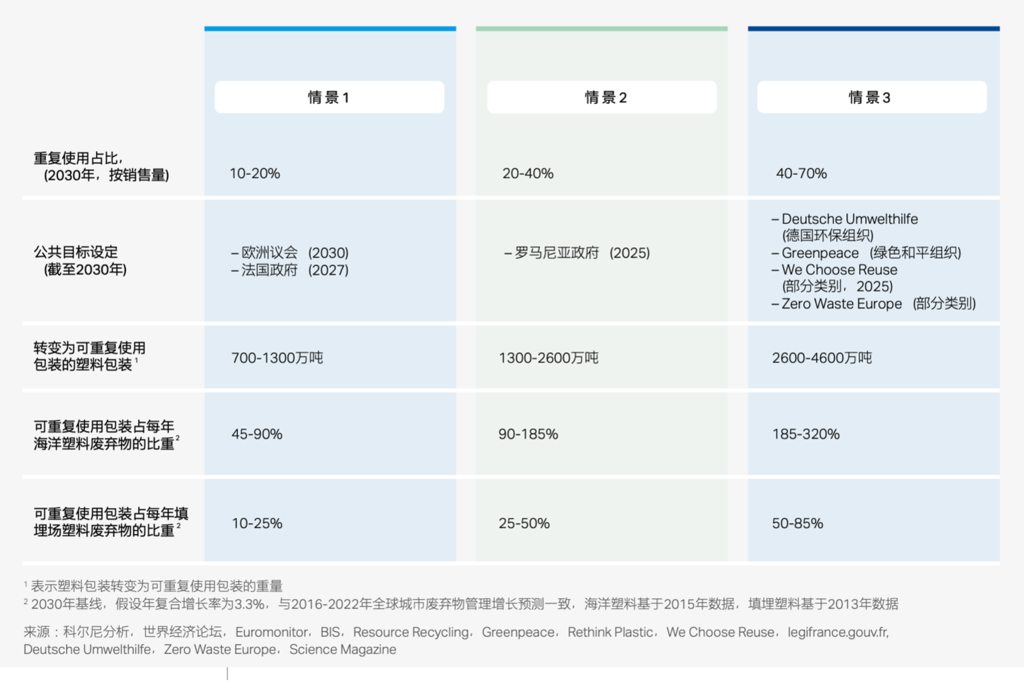
The report explores these prospects in depth and provides detailed methodological guidance aimed at addressing key challenges around reuse faced by some businesses and public-sector organizations: how to make reusable systems scalable and viable.
Zara Ingilizian, Head of the Consumer Industries and Shaping the Future of Consumption platforms at the World Economic Forum, said: “The shift from single-use to reusable consumer products is still at an early stage, but clear progress has already been made. Just as recycling and composting were once considered eccentric, and electric vehicles were seen as science fiction, attitudes about what is feasible when it comes to sustainability are changing dramatically. A shift in attitudes towards reusable goods is likely to become one of the strongest expressions of this change.”
Beth Bovis, Kearney Global Partner and Global Head of Social Impact and Sustainability, said: “We need to move from ‘dealing with’ waste to preventing it from being created in the first place. Any shift to reusable consumer products depends on three key participants in the economy — consumers, businesses and the public sector. Each group has an essential role to play in making reuse a reality. We urgently need an economic model led to a greater extent by reuse, with its share growing year by year. This requires the participation of all stakeholders.”
Mayuri Ghosh, Head of the Shaping the Future of Consumption platform at the World Economic Forum, said: “When we talk about these three scenarios, it is worth emphasizing that any one of them would represent extremely valuable progress compared with the status quo. The challenge of plastic waste is already too severe to be solved simply through recycling. There is not yet a global agreement aimed at addressing plastic waste on a large scale; in this context, the sooner we can make systematic, meaningful progress on reuse, the better.”
The report aims to inform business, government and civil society leaders about another option for reducing plastic waste. The first half explores the three key participants essential to transforming reuse systems; the second half introduces the “Reuse Feasibility Assessment Framework” to help leaders assess the scale and viability of improving reuse systems.
The report calls on the public and private sectors to work together to develop reusable systems that meet our economic and environmental needs. It is part of the World Economic Forum’s Consumers Beyond Disposable initiative, which focuses on innovative reuse and durability-based solutions, and continually tests and improves their viability.
Editor’s note:
Click here to read the full report
Explore the Forum’s photos
Learn about the Forum’s agenda, French | Spanish | Chinese | Japanese
Become a Forum Facebook fan
Watch the Forum’s videos
Follow the Forum on Twitter @wef @davos
Follow the Forum on Instagram | LinkedIn
Learn about the Forum’s impact
Subscribe to the Forum’s press releases.