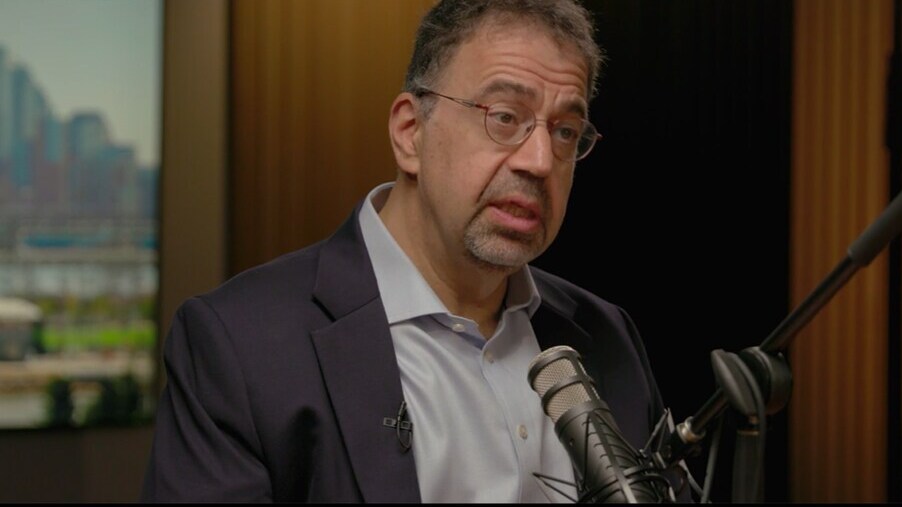
Nobel Prize-winning economist Daron Acemoglu discusses themes from his latest book, ‘What Happened to Liberal Democracy? Remaking a Politics of Shared Prosperity’ on the latest Radio Davos.
Nobel Prize-winning economist Daron Acemoglu argues that the way we develop and use AI could either create broader prosperity or deepen inequality—and put liberal democracy under even greater strain. He breaks down the themes from his latest book, ‘What Happened to Liberal Democracy? Remaking a Politics of Shared Prosperity’ and explains:
The forces weakening prosperity - and the growing divide between college-educated and non-college workers
His concept of “pro-worker AI” – and its potential impact on prosperity and economies
What leaders must prioritize – and the key economic metric to watch
His take on common predictions for the future of work and AI
Subscribe to Radio Davos for more conversations on the biggest forces shaping tech and economies.
Daron Acemoglu, MIT Economist & Nobel Laureate: AI is going to remake every aspect of our lives. And not just our lives. The lives of 6 billion people who are outside of the United States and China. They have no voice, and we have a voice. We still live in a democracy. It is our responsibility to have a say about how our future is being remade. Even if it's being remade by two or three companies, it doesn't mean that their CEOs have the right to make every decision. I think the democratic input is a very important part of that.
Linda Lacina, Radio Davos: Welcome to Radio Davos. This is the podcast that looks at the biggest challenges and how we might solve them.
I'm Linda Lacina stepping in for Robin Pomeroy this week as we had the chance to snag a very special guest in our World Economic Forum's New York City offices. Our guest is a renowned economist, an MIT professor, and a 2024 Nobel Prize winner. He is also the world's foremost expert on AI's impact on the economy, which is one of the most critical issues of our time.
He has a new book out. It is What Happened to Liberal Democracy. And a lot of very smart people are calling it a “tour de force,” a “must read,” and even “the most optimistic thing that they've read in a very long time.”
He is going to explain the crisis as he sees it, crisis that is widening the economic divide, what's needed to fix it, and also the role that AI, especially pro-worker AI, could play in solving this issue.
Welcome to Daron Acemoglu.
Daron Acemoglu, MIT Economist & Nobel Laureate: Thank you, Linda. It's my pleasure to be with you.
Why Daron Acemoglu Believes Liberal Democracy Is in Crisis
Linda Lacina, Radio Davos: We are very, very honored to have you. Why don't we get started, dig right in. What is this crisis? What is the biggest crisis that is facing the economies and humanity right now as you see it?
Daron Acemoglu, MIT Economist & Nobel Laureate: I believe that liberal democracy is one of humanity's greatest achievements. If you look at our past, the million-year evolution, the existence in fighting bands, or very unfree societies, people at that point would have had a very hard time imagining that we could build a complex society with very different people. But all cohabiting, participating in politics mostly peacefully, and using state institutions for creating also shared prosperity, meaning economic growth from which many people, most demographic groups, are also taking their fair share. That is just an incredible achievement.
Linda Lacina, Radio Davos: And just to get our listeners and our watchers sort of all on the same page, can you define liberal democracy as you see it and as you wrote about it in the book?
Daron Acemoglu, MIT Economist & Nobel Laureate: Liberalism, at its heart, is about individual freedoms, freedom of expression, association, religion, but also about turning those into an actual behaviour in which people can realize their aspirations.
And that requires state institutions that provide opportunities, education, infrastructure, insurance against very tough things happening to people such as disability or inability to earn a living from their families, but all the time consistent with liberal principles.
And liberal democracy is the most successful institutionalization of those liberal ideas because it brings elements of liberal thought and principles together with democratic participation.
Linda Lacina, Radio Davos: If we're not able kind of get liberal democracy out of crisis, what happens?
Daron Acemoglu, MIT Economist & Nobel Laureate: Today, liberal democracy is viewed as the establishment. And anti-establishment feelings are everywhere. And not only those movements that challenge liberal democracy are illiberal. They're not democratic. They don't want to provide voice and ability to self-government to people. But they are often Ideologies that separate people, create more divisions, and also they are stances that have not been able to deliver any kind of welfare or improvement to people.
So we really would be looking at both bad ideas, sometimes hateful ideas, but would also have to put up with worse corruption, more arbitrary rule, no equality before the law, and ultimately nothing like shared prosperity, which we are still aspiring for.
The Divide Between College-Educated and Non-College Workers
Linda Lacina, Radio Davos: The fault lines started around 50 years ago, you started to see them. Let's talk a little bit about that to understand what's shaping this, what's really putting shared prosperity into great risk. Can you take us through what changed at the end of the industrial era to the post-industrial era? What was this change that we saw?
Daron Acemoglu, MIT Economist & Nobel Laureate: I think if you want to understand what's going on with liberal democracy, you have to start with diagnosis. I would say the roots of our crisis go back at least 50 years. Liberal democracy's problems are rooted in the transition from industrial society to a post-industrial society.
By post-industrial, I mean an economy in which digital technologies play an important role. Globalization combines supply chains and flow of goods much more seamlessly around the world.
And these processes fundamentally change the nature of the economy, in particular making it much harder to reach shared prosperity. Not impossible, and there's nothing inevitable about either globalization or digital technologies. But the way that things have transpired, in the United States and many other industrialized economies, was that one of the major channels for creating shared prosperity, which went from businesses innovating, expanding, producing more, to workers also benefiting, which was through businesses' desire to hire workers. And in a democratic framework with strong labour unions, that meant they had to pay higher wages, as well as create jobs.
And that was something that created a powerful drive towards shared prosperity because it meant that greater profits and greater revenues for businesses came hand-in-hand with higher wages.
Digital technologies changed every aspect of that bargain. First of all they started favoring more college-educated workers. Who could take managerial positions, work with data, administrative positions.
But something else more important was also at play.
That was the use of digital technologies as a platform for automation. By automation, I mean the use of machinery and algorithms to replace tasks that were previously done by workers. And automation is a game changer because it severs the link between business expansion and shared prosperity. I want to be very clear that this is not in the nature of digital technologies that they always have to increase inequality. It's the way that we developed and used these technologies.
Equally important, post-industrial society brought very different social relations. It elevated the social status and political power of college-educated workers, especially those integrated into the global economy in major urban centres, such as in New York or Boston. But at the same time, they started segregating into their own neighbourhoods, their own social networks, their own communities. And diverging from the rest in terms of values.
So this created a tension in a broad coalition that was essential for liberal democracy. For example, you can see that in how centre-left parties, the Labour Party in Britain, social democratic parties in Europe, or the Democratic Party in the United States, which used to receive the majority of their votes from working class people, people without a college degree, working in manual or service jobs. Now that demographic group votes for the centre-right or the hard-right, and centre- left parties are overwhelmingly the party of choice for people who live in large urban areas with college degrees or postgraduate degrees.
But centere-left parties are essential for liberal democracy because they have been the pioneers of the welfare state, of shared prosperity, supporting the rights of workers. And now they became less concerned with the rising inequality or the non-college groups in society falling behind. and then ultimately, with the cultural politics of our era, even became a part of a big divide within society that has created a major backlash.
Linda Lacina, Radio Davos: There's a lot of very unique examples you have in the book. In fact, you can correct me if I'm remembering this wrong, but in Ohio, the Anchor Hocking Company, where all of the people, whether you worked in the factory, you worked at the office, you were a manager, everybody's kids went to the same school, everybody lived on the same block. And then within a few decades, that was very much not the case. And certainly all of us sort of understand that there's certain areas where elite people live and certain places where they don't. How important are those examples to helping drive home to people that how these ideas walk and talk in there every day?
Daron Acemoglu, MIT Economist & Nobel Laureate: You summarize it so well, thank you for doing that, but they really tell the story.
Not only has there been a big sea change that you don't see managers and workers living in the same communities, sending their children to the same school, going to the same churches, but you have also broken one of the major ways in which you learn about the plight of other people or learn to empathize with them. And that has accelerated in the age of social media and online communication because we are interacting with each other much less in natural social networks.
And that's very important for recognizing something that really in hindsight is shocking. In the 2016 election, when Hillary Clinton was defeated by. Donald Trump in the United States, or in the 2016 Brexit referendum, most people who were very well-educated, living in major cities like London, New York, Boston, were genuinely shocked that there was so much reaction against establishment. But that showed the extent of the discontent, but the shocking thing is how such strong feelings went unnoticed for almost three decades, and that is because we came to live in silos.
The major newspapers that we read are part of that silo. Who we talk to is part of the silo, our education system is part of that silos, and it's not just a failure of our information ecosystem, but it also makes it much harder for us to form bridges with each other, to form that's broad consensus that are so important for democracy to work.
How Economic Inequality Became a Political Divide
Linda Lacina, Radio Davos: People forget or overlook the connections between political institutions and economic prosperity. What is the before and after of that? How does one feed into the other?
Daron Acemoglu, MIT Economist & Nobel Laureate: Institutions are critical. Part of the reason why I am drawn to study and want to improve liberal democracy is because I believe liberal democratic institutions are essential for the kinds of lives that we aspire to: Peaceful, based on dialog and understanding, prosperous, and free. If we start sacrificing our institutions, we risk losing all of these things very badly.
That's why the book talks both about liberal ideas, how they have evolved, how they worked and why they were important for shared prosperity voice and other things.
Something's not working. There is a real crisis here
Daron Acemoglu
Daron Acemoglu, MIT Economist & Nobel Laureate
Linda Lacina, Radio Davos: You write in the book, you say, liberalism's crisis is intimately linked to its failure to adapt to a changing world. And you argue that we should remake liberalism. Why is a new framework needed?
Daron Acemoglu, MIT Economist & Nobel Laureate: First of all, clearly something's not working. There is a real crisis here. People are willing to put to power, ideas, leaders that really are very questionable in terms of their corruption, in terms of their incompetence. But it shows the strength of the feelings.
I think liberalism needs a new governing philosophy.
Daron Acemoglu,
MIT Economist & Nobel Laureate
You cannot remake institutions without something that brings people together around their shared moral values and an understanding of how you could build a better society. That's what I mean by a governing philosophy, that is a collection of coherent ideas need to be part of that.
In the past, for instance, social democratic ideas played a very important role in the development of the European welfare state, in the affirmation of the desirability of shared prosperity, of providing much higher quality public services to poorer parts of the country.
So we do need something like that again. Social democracy was for the industrial age, so that's why I emphasize something related, but different, what I call working class liberalism. And that is my rallying cry for this sort of new governing philosophy.
Linda Lacina, Radio Davos: You say AI, could enable this shift. You say, AI, if steered correctly, can be complementary to the expansion of collective knowledge and the rebuilding of shared prosperity, and then you introduce this idea that we mentioned earlier in the introduction of pro-worker AI. Tell us, what is pro-worker AI?
Daron Acemoglu, MIT Economist & Nobel Laureate: Well first let me take a step back and again I'm sort of partly responding to your previous question because I didn't want to go on and on but working class liberalism at its heart has to be about shared prosperity, jobs, and better economic conditions for the working class people who don't have a college who are going to work in manual jobs, service jobs and a variety of trades. So that's essential.
The other very big important element. In working class liberalism is community. So, you have to bring communities in, give them room for self-government, to make different choices, experiment with their different values, and do that while being consistent with the founding principles of liberal individual freedom, individual rights to expression, and this drive for people to have voice.
Now, taken at its face value, AI is a threat to both of them. If AI goes in the AGI, artificial general intelligence, artificial superintelligence, direction, it could displace a very large fraction of the workforce from their jobs in the United States, in Europe, ultimately in the emerging world. And that would make shared prosperity essentially impossible. It would make workers dispensable, not so important, second-class citizens, so to speak. It would usher in an era of inequality far surpassing our very, very unequal present.
But AI would also, could also, continue the trend of social media and pacify us more, take us away from our communities, don't encourage us to get into the messy but ultimately essential business of making compromises in real world interactions, getting to understand different parties, different segments, perspectives, form bridges, deliberate with them.
All of these things are a real threat to the future of liberal democracy.
But here is the catch. There's nothing in the nature of AI that it should do those things. It's how we develop AI and how we use AI and the idea of pro-worker AI. It's about how we should conceptualize AI and how we could achieve it and why it might actually be complementary to building shared prosperity and making a better liberal democracy.
Linda Lacina, Radio Davos: And how does it walk and talk, pro-worker AI?
Daron Acemoglu, MIT Economist & Nobel Laureate: My argument is that AI is not just a very powerful generative technology that could be used for automation or become the basis of something like artificial general or super intelligence, but it's also an amazingly versatile and powerful information technology, meaning that it can provide very relevant, accurate, context-relevant information to individuals in real time.
What that promises then is that all of us could become much better at solving problems in which we specialize, expanding our expertise, starting doing new things, new tasks, more innovation, provide better or different goods and services in our line of business.
And those are very different from AGI or artificial super intelligence because they still have the worker in a critical part. We are making the worker's capabilities expand. We're making the workers perform new tasks.
As a result, rather than being sidelined, this could increase demand for workers and re-energize that channel that I emphasize. Business is doing well, but also paying higher wages and creating jobs. And that's so important for the future of shared prosperity and the future of liberal democracy.
Linda Lacina, Radio Davos: And what holds us back?
Daron Acemoglu, MIT Economist & Nobel Laureate: Oh, that's not the direction in which we're going.
We can benefit a lot from AI, but we also need to develop it in a way that could be complementary to humans. That's the pro-worker agenda.
Daron Acemoglu
MIT Economist & Nobel Laureate
Daron Acemoglu, MIT Economist & Nobel Laureate: Right now, there is more than a trillion dollars being spent on AI, and a very large fraction of that goes into building more and more sophisticated foundation models. They're very, very impressive, by the way. I will not sympathize with anybody who says these are just stochastic parrots. These are really capable models. And. And we can benefit a lot from them, but we also need to develop them in a way that could be complementary to humans. That's the pro-worker agenda.
I give many examples in the book or in my other work, but there are so many places where you can see the promise of pro-workers AI. You can make nurses far better. They can play a much more important role in diagnosis, care, prescribing drugs, making follow-up decisions.
You can made educators much more effective, essentially a single teacher can become -- with the help of AI -- much better at doing new things in terms of reorganizing the classroom and coming closer to a cost-effective but quite competent version of individualized education programmes.
You can make electricians or plumbers and all the trades much better because the problems that they are solving are becoming more complex. Now you can give them tools that expand their expertise and enable them to do many things than they could do. All of us working in knowledge occupations obviously can benefit from AI in the same way as well.
Linda Lacina, Radio Davos: All of us have heard the promise of these wonderful things that could happen. But still, plenty of folks are equally worried, equally, like, gnawing on their fingernails. Why is it that this might not happen?
Daron Acemoglu, MIT Economist & Nobel Laureate: Oh, they are absolutely 100 percent, 1,000 percent right to be worried. This is not the direction we're going.
The kind of pro-worker AI I'm describing is actually not a big technological barrier. It is within our capabilities right now.
There are a few companies that are working here, but they are marginal companies without the best scientists, the best models, the GPUs, and they are making progress. So we need much more of the resources to go in this direction.
But it's not what's happening. It's not happening because of the economic model of Silicon Valley. But it is also because of ideology of Silicon Valley, where all of the leaders are prioritizing building more and more human-like or human-improving models.
Linda Lacina, Radio Davos: You mentioned the algorithmic cage. Can you talk a little bit about that and how that impacts how we think and maybe also the direction we might go in?
Daron Acemoglu, MIT Economist & Nobel Laureate: Communities, almost by their nature create these cages of norms. They have their own norms and they try not to let people break out of them.
When communities do that, we still have to protect individual liberty and that's the complex relationship between community and freedom that is at the heart of the book as well.
What I call the “algorithmic cage” is that when the same thing is done, say, by social media, you don't get many of the benefits, but you get an even more powerful version of that cage of norms because now the algorithms are policing you or the algorithms are finding other people who are going to very strongly police you and are going be very, very militant if necessary in forcing you into certain modes of behavior. And all of that happens without the shared moral values, the shared understanding, the development of information exchange, et cetera, that community brings.
Why Leaders Missed The Rise of Economic Discontent
Linda Lacina, Radio Davos: There's an interesting, anecdote you had in the book where after the pandemic you went to a conference and you were all excited, you're like, oh gosh, this is a big deal, we're going to talk about wage stagnation, and this is really important thing, people need to be digging into this, it has all these other implications, and then folks didn't talk about that, and you're, like, what? What was going on? And why am I bringing that up? Because do you think that people are focused on the wrong signals?
Daron Acemoglu, MIT Economist & Nobel Laureate: To some extent, yes. And that's, again, it's because of the algorithmic cage. And this is because of that division between the college-educated groups that have become very dominant in politics throughout Europe and the United States and the less educated.
So wage inequality effects all of us. But it's really the burden is on people without a college degree.
In the United States. It's an extreme case, but it's a very telling extreme case. While wages of college graduate Americans have increased, those of post-graduate Americans have increased very rapidly.
By the 35 years from 1980 onwards, the real inflation-adjusted earnings of non-college workers, non-college men declined almost every year. So inequality discussions have to start there. That is just phenomenally large change.
But who are those bearing that burden? Those are the non-college workers. And if you start thinking that the noncolleage workers have the wrong values, they're not coming part of your coalition, you stop empathizing because you're not interacting with them as much, then that goes to the second rank of the problems that you focus on. And that's exactly what I witnessed.
By the 35 years from 1980 onwards, the real inflation-adjusted earnings of non-college workers, non-college men declined almost every year. So inequality discussions have to start there.
Daron Acemoglu
MIT Economist & Nobel Laureate
What is Pro-Worker AI?
Linda Lacina, Radio Davos: You make the point in the book that business models can also influence political frameworks. Can you tell a little about that connection and how maybe that can help unlock better perspectives for AI.
Daron Acemoglu, MIT Economist & Nobel Laureate: I think the most important aspect of the business model that we need to debate is what managers, CEOs, view labour as. If you think that labour is a cost, that is going to push you more and more towards automation, because if something is a costs, you just try to cut it. That's the right thing to do. But labour, your workers are also your main asset. And rather than just trying to limit the costs, what you should do, is Ask yourself, how can I make that key asset be more productive? That's where pro-worker AI would come. That's one aspect.
Another aspect is the business model of, for example, social media. The social media mess that we have today, and I say very clearly in the book, social media is not responsible for the crisis of liberal democracy, but it is exacerbating it. But that mess is very related to the business models of the social media companies, which is capture people's attention. And then make money by sending them individualized digital ads. That's a particular type of business model, but it's not consistent with the promise of digital technologies and online technologies that people believed in in the end of 1990s or early 2000s when, if you remember, everybody was talking about new economic democracy, news democracy, more organic forms of journalism, better communication. And they were looking at what was happening in the Arab Spring and celebrating that as a gift of Facebook and Twitter.
Well, these people weren't fully naive. Of course, their analysis turned out to be incorrect, but their aspirations weren't naive because digital technologies are fully capable of doing that. They can create new public spheres for us. They can provide us with better information and more effective ways of forming bridges and sharing information with each other. But it's just that, social media's business model isn't that.
The most important aspect of the business model that we need to debate is what managers, CEOs, view labour as.
Daron Acemoglu
MIT Economist & Nobel Laureate
Linda Lacina, Radio Davos: If I'm a business leader listening to this, and I read your book, and there's that line where you say, you know, “we have to get better at identifying pro-worker, sorry, pro-workers technologies,” right? We have to keep identifying pro worker technologies. What do I do? What is my instinct that I'm moving towards. Can you help them sort of right side?
Daron Acemoglu, MIT Economist & Nobel Laureate: Business leaders who are actually producing things are very sympathetic. But what can they do?
First of all, they need tools from the tech sector to actualize pro-worker AI, and they're not getting that.
Second, we've created expectations in the stock market through their boards that unless you're going lockstep in automating work using AI, you're falling behind your competitors. So they have to demonstrate to their boards since they're shareholders that they're doing that. So they're actually between a rock and a hard place as well.
That's why the first step is changing the narrative. Davos has been at the heart of this agenda of automation and businesses should make more profits, they should get leaner, we should build more complex networks of supply chains. I think Davos people should also ask themselves that question. Is this the right direction that we're pushing as the aspiration for our future?
Davos people should also ask themselves that question. Is this the right direction that we're pushing as the aspiration for our future?
Daron Acemoglu
MIT Economist & Nobel Laureate
Linda Lacina, Radio Davos: Nobody thinks that they're taking anything into a bad direction, right? Everybody is trying to do the right thing. I run the Leadership Podcast: Everyone's a great listener, everyone's kind. To help them have a gut check, is there a question that, anyone listening to this or watching this can be asking themselves in different moments, different decision points to help gut check if they're going in the right direction?
Daron Acemoglu, MIT Economist & Nobel Laureate: I can think of two kinds of questions that should help. One is, if you actually start spelling out the kind of future we are going towards with more and more automation, I think ultimately you will realize that it's not a sustainable one.
You cannot have democracy if a growing fraction of the population is poor, is dispensable. It feels and is viewed in society as not contributing anything to our collective good, I think that's a dystopian future.
Second, when you actually think about your organization, what makes a real difference isn't whether you cut cost by 2%, or 3%, 4%, or 5%. It's whether you do new things. The companies we remember from the past, such as Ford Motor Company, are not the ones that cut costs. They're the ones revolutionize production by doing new things, and for that, you need your most creative workers, and you need to give them better tools.
Linda Lacina, Radio Davos: What are the biggest misconceptions about how AI is impacting jobs. What’s frustrating you about the conversation?
Daron Acemoglu, MIT Economist & Nobel Laureate: I would say mostly two things. The first one is the media's emphasis on this false dichotomy that either AI is going to bring boundless prosperity or it's going to create killer robots that destroy human civilization.
The concerns that I'm expressing are somewhere in the middle. There will be advances, but we push these advances in the wrong direction. The media, and thought leaders. have a role in making sure that the relevant kinds of information is provided to the public on this, and we've failed at that. Second is the notion that somehow any democratic input into the direction of AI is stopping progress. So you hear that from many leaders in the tech sector or their supporters that if you want a better future, let these geniuses work. And that is the worst attitude you can have.
AI is going to remake every aspect of our lives, and not just our lives. The lives of 6 billion people who are outside of the United States and China, whose lives are going to be shaped by AI as well. They have no voice, and we have a voice. We still live in a democracy. It is our responsibility to have a about how our future is being remade, even if it's being remaked by two or three companies. It doesn't mean that their CEOs have the right to make every decision. I think the democratic input is a very important part of that.
We still live in a democracy. It is our responsibility to have a about how our future is being remade.
Daron Acemoglu
MIT Economist & Nobel Laureate
What Would Happen if We Get AI Right?
Linda Lacina, Radio Davos: If we get AI right, how does our everyday look different?
Daron Acemoglu, MIT Economist & Nobel Laureate: In the same way that our everyday started looking different after electricity became part of our lives. Not everything went smoothly, but we started being much more productive. Our factories became much more modern and effective. Our lives became much better with household appliances that used electricity.
In the same way our lives started becoming better after the internet, especially before the internet started going in the wrong direction, especially with social media, where we had access to much better services and information with the early internet. We could do many things that we couldn't do before. There was more competition from companies to provide goods and services to us. And many, many, many new creative companies could be built via the internet.
So AI is going to do many of those things if we play our cards right.
The Metric Leaders Should Watch
Linda Lacina, Radio Davos: And what's the tell it's going in the wrong direction? If we start seeing a particular statistic or a particular trend, what's something that should make us all set up a little bit straighter?
Daron Acemoglu, MIT Economist & Nobel Laureate: One telltale sign of automation is that labour's share of value either in industry or labour's share in national income is going down. We've been experiencing that for the last three decades. And if there is an acceleration in that, that's a sign that we are putting all of our eggs in the automation basket.
There is nothing wrong with automation, by the way. Automation has been going on since 1750, and it's going to be a part of our future as well. The problem is if we just do automation and we don't do the other things, creating that human complementary AI building on that pro-worker AI.
Linda Lacina, Radio Davos: And that trend with that statistic, if it goes in the wrong direction, you know, why is it so important that we avoid that fate?
Daron Acemoglu, MIT Economist & Nobel Laureate: Because it would usher in an era of unimaginable inequality and it would destroy our liberal democracy. What else?
How to Think About AI and Job Desctruction
Linda Lacina, Radio Davos: What about job destruction? Is there a job destruction sort of statistic, some kind of a turning point we would get to where it's like, okay, gosh, now there's no turning back or we need to start kind of finding a new way? What are your thoughts about that as a tell?
Daron Acemoglu, MIT Economist & Nobel Laureate: I don't think there is a job destruction threshold, because if you actually look at the US economy, even when it was creating shared prosperity, it was destroying a lot of jobs and creating a lot of jobs.
So I'm not saying that we should ultimately always have 3 and a half million customer service representatives in the United States. Some of those jobs will go away. But here's the problem. If we destroy 3.5 million customer service representative jobs, and we create no opportunities for these workers, that's a very different world. And we actually give them opportunities to upskill and do even more meaningful and higher paying jobs.
And you can see some of that contrast by comparing what happened when robots were introduced in Michigan versus in Germany. In Michigan. In Detroit, Flint, when robots were introduced by Ford, General Motors, Chrysler, and their suppliers, they laid off workers, operators, welders, painters, et cetera. In Germany, what they did is that they took those workers and they trained them to become technicians and higher-skilled workers. The implications are very different, both for productivity and for inequality.
What Should Leaders Prioritize in 2027 for an AI Era?
Linda Lacina, Radio Davos: Is there a change that you would like to see happen in the year ahead in 2027 that gosh, you know If we can kind of make this steer that'll be a step in the right direction .
Daron Acemoglu, MIT Economist & Nobel Laureate: I think the ultimate huge success which is impossible next year or even in a few years is that the conversation changes such that a notable share of the amazing talent that's going into the tech sector right now goes there not to achieve AGI and make their science fiction dreams come to reality. But they go there because they think that AI can be developed in a pro-worker direction to improve our communication, to make our agency better rather than worse.
Linda Lacina, Radio Davos: And what will it take to to get there to make that change?
Daron Acemoglu, MIT Economist & Nobel Laureate: I don't know. I wish I knew.
Linda Lacina, Radio Davos: It's not in here?
How Government Policy Could Shape the Future of AI
Daron Acemoglu, MIT Economist & Nobel Laureate: It's not in there, but I'll tell you, it's a social change. So it's change of norms, first of all.
But government policy can help. The government cannot steer AI without any constraints. The government can not be the entrepreneur that does AI. But the government sets the framework. Taxes influence what happens.
The United States and many other advanced economies have, in my opinion, a very distorted tax system that benefits capital, that benefits many people who are part of Davos because they make their money from capital, and punishes labour. Capital is taxed at such a lower rate. That's not just unfair and inequality-inducing. It's actually bad for the future of AI, because what it does is that it sends a signal to firms, a powerful signal, that they should automate, because the government is subsidizing automation, so we have to change those tax policies.
We also need support for more socially productive directions of AI. We need new laws so that people's data are protected, and you encourage experts to invest in high-quality data. That would be good for all kinds of AI models, but especially for pro-worker AI models.
So there are many things that governments can do, but it's not gonna be a silver bullet.
Nobel Laureate Daron Acemoglu Weighs in on Common Predictions for the Future of Work and AI
Linda Lacina, Radio Davos: I may have a little rapid response to the section here to kind of close us out where I'll give you some statement that we've all heard about sort of the inevitable direction for work and tech and then you'll tell me whether you think it's going to happen or not.
How about this one: One day we'll all work for AI agents.
Daron Acemoglu, MIT Economist & Nobel Laureate: I don't think so. AGI, I think, is not something we're going to be able to achieve anytime soon, even though AI models are getting better. And there will always be people who control AI as well. Not all of us will work for AI agents.
Linda Lacina, Radio Davos: We'll have a four-day workweek.
Daron Acemoglu, MIT Economist & Nobel Laureate: Possible. I'm not sure. But I'm also not sure that's a solution to our problems.
Because if you want to have a society in which there is wage growth and shared prosperity, you need to make labour more productive. Whereas the four-day drive comes from the idea that there's a fixed amount of jobs or a shrinking amount of jobs and we have to divide that and better among the remaining humans and that's why we're going to make each one work less.
It's very different from saying, you know, we're getting richer and richer. We have a lot to contribute to the production process, but we also have to do a lot of learning because we have longer lives and a more complex economy. Let's take that time for leisure or building our skills. That's very different. If that's the drive for a four-day week, I'm much more sympathetic. Or if the drive of a four day week is that jobs are disappearing, there's nothing we can do about it. We're throwing the towel against AI. Let's cut it to four days or three days. That's a very different proposition and I'm not that much in support of that.
Linda Lacina, Radio Davos: Generalists, not specialists, will be the kings of the AI era.
Daron Acemoglu, MIT Economist & Nobel Laureate: There could be some truth to that, if by generalist you mean people who have the flexibility to change what they do and holistically combine different perspectives, especially in a more innovative and creative way.
Linda Lacina, Radio Davos: We'll have pro-worker AI.
Daron Acemoglu, MIT Economist & Nobel Laureate: I wish, I wish I wish.
Linda Lacina, Radio Davos: How likely do you think it is?
Daron Acemoglu, MIT Economist & Nobel Laureate: I am not giving up hope, but we do need a change of direction.
Linda Lacina, Radio Davos: Would you put a probability on it?
Daron Acemoglu, MIT Economist & Nobel Laureate: I am very bullish that liberalism has the energy to recreate itself ultimately. And I'm very bullish if we put the effort to create pro-worker AI, we would do it with very good social outcomes as a consequence.
Whether we'll make those investments in both liberal democracy and pro-worker AI, I would say that's certainly not more likely than 30 or 40 percent. So my optimism is about what we can achieve, not whether we'll actually get our act together and achieve it.
Linda Lacina, Radio Davos: And your last question, sir, what should leaders listening and watching this, what should they be prioritizing in the year ahead?
Daron Acemoglu, MIT Economist & Nobel Laureate: I believe understanding AI is very, very important, but caring about liberal democracy's future, our ability to come together around shared moral values that bring us together rather than divide us apart. I think that's very, very important as well. And thinking about the working class, inequality, jobs, are first steps in that direction.
Linda Lacina, Radio Davos: Thank you very much, Daron. Oh, thank you, Linda. It's an honor for us.
Daron Acemoglu, MIT Economist & Nobel Laureate: Oh, it's my pleasure. That was great.
Linda Lacina, Radio Davos: And that is all the time that we have today. Thank you so much, Daron. Robin Pomeroy will be back as host next week. You can check out Radio Davos and my podcast, Meet the Leader, at wef.ch/podcasts.
Thanks again for listening and watching. Have a great day.