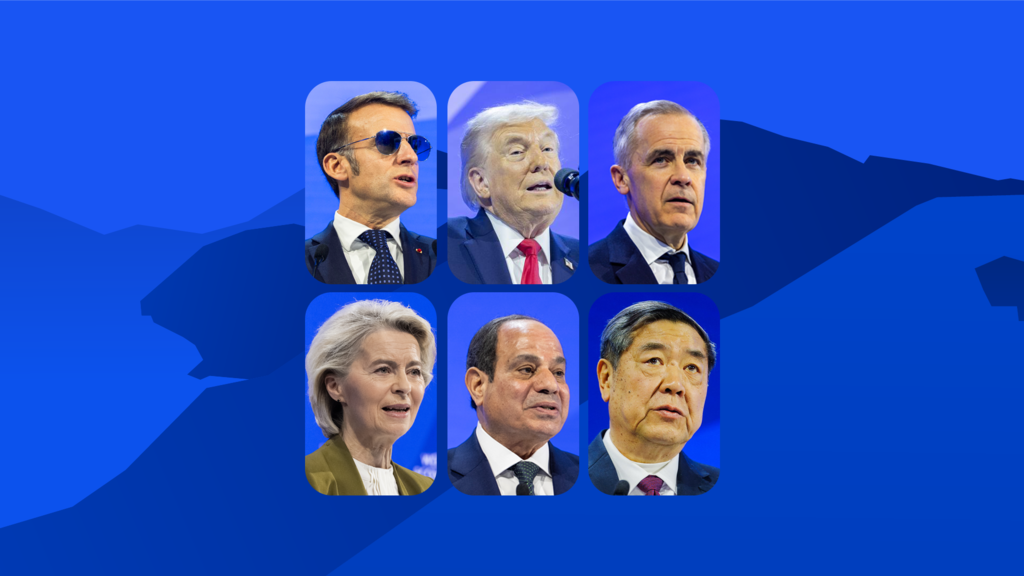
The World Economic Forum's Annual Meeting 2026 was held in Davos, Switzerland, under the theme of A Spirit of Dialogue.
Davos 2026 was one of the highest-level gatherings in the Annual Meeting’s history.
This article will be updated throughout the week with new remarks and insights from the world leaders.
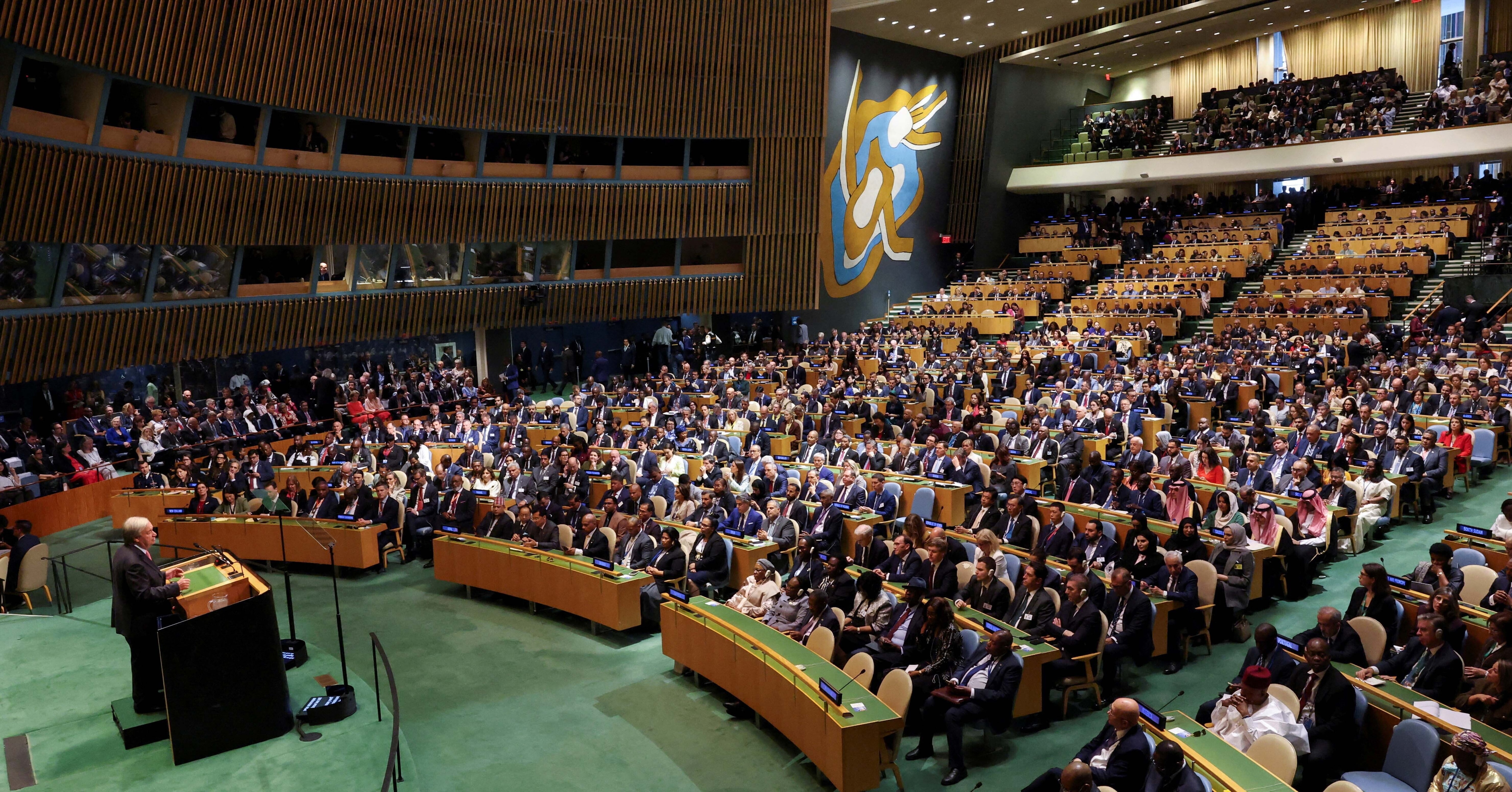
This week, hundreds of top political leaders from around the world, including close to 65 heads of state and government, gathered in Davos, Switzerland, for the World Economic Forum's Annual Meeting 2026.
The world leaders met against the most complex geopolitical backdrop in decades, with rising fragmentation and rapid technological change transforming the global economy. Participants included several G7 leaders as well as numerous heads of states from G20 economies and BRICS countries. The leaders gathered alongside nearly 830 of the world’s top CEOs and chairs.
In Davos, several of the heads of state delivered special addresses and participated in public panel discussions. Here’s what they had to say.
Aziz Akhannouch, Head of Government, Kingdom of Morocco
In a conversation with André Hoffmann, Vice-Chairman of Roche Holding and Interim Co-Chair of the World Economic Forum, Head of Government of Morocco Aziz Akhannouch discussed Morocco's unique position as a "crossroads between Europe, Atlantic and African countries".
Akhannouch added that Morocco has strong economic foundations and touted the country's fiscal reforms that have facilitated economic development in recent years.
Guy Parmelin, President, Switzerland
In a special address, Swiss President Guy Parmelin welcomed participants to Davos 2026, urging unity in the effort to find "lasting solutions to the major challenges of our time."
"Society, science, economics and politics must work together hand in hand, in a spirit of partnership," he said. "Otherwise problems can only be addressed in a partial and imperfect manner."
Parmelin also thanked the many countries that offered their support and solidarity following the tragedy in Crans-Montana.
Ursula von der Leyen, President, European Commission
In a special address, European Union President Ursula von der Leyen detailed Europe's efforts to pursue new trade relations and adapt to the ongoing era of US tariffs and protectionism. "Europe will always choose the world, and the world is ready to choose Europe," she said.
Amid ongoing US threat to take over Greenland, von der Leyen added that Europe "needs to adjust to a new security architecture.”
He Lifeng, Vice-Premier, People's Republic of China
In a special address, Chinese Vice-Premier He Lifeng urged countries to pursue economic cooperation, noting that "tariffs and trade wars have no winners."
He added that "while economic globalization is not perfect," countries "can not completely reject it and retreat to self isolation."
Moreover, He stated that China has put domestic demand on the top of its economic agenda in 2026 in an effort to boost consumption while maintaining its production prowess.
Emmanuel Macron, President of France
In a special address, French President Emmanuel Macron addressed the rapidly evolving geopolitical landscape, noting that "we are living through a profound global shift."
“Faced with the brutalization of the world, France and Europe must defend an effective multilateralism," he said, adding that "it serves our interests and those of all who refuse to submit to the rule of force."
Sheikh Mohammed bin Abdulrahman Al Thani, Prime Minister of Qatar
In a conversation with World Economic Forum President and CEO Børge Brende, Qatari Prime Minister Sheikh Mohammed bin Abdulrahman Al Thani spoked about the evolving security landscape across the Middle East.
“We need to address those root causes,” he says, adding that “the moment has come for the region to come together and to think about how we can reshape our security architecture so that at least we ensure that we are not representing a threat for each other.”
Mark Carney, Prime Minister of Canada
In a special address, Canadian Prime Minister Mark Carney delivered a stark assessment of the global moment.
"For decades, countries like Canada prospered under what we called the rules-based international order," he said. "We joined its institutions, we praised its principles, we benefited from its predictability… this bargain no longer works."
Moving forward, Carney said "we aim to be both principled and pragmatic," adding that Canada will "actively take on the world as it is, not wait around for the world we wish to be."
Abdel Fattah El-Sisi, President of Egypt
In a special address, Egyptian President Abdel Fattah El-Sisi discussed Egypt's vision for stability, development and its role in shaping the future of the Middle East and beyond.
"The world today faces monumental challenges," he said, urging cooperation in order to "seize the opportunities for the good and mutual benefit of our nations."
Mohammad Mustafa, Prime Minister of the Palestinian National Authority
Mohammed Mustafa, Prime Minister of the Palestinian National Authority, sat down with Mirek Dušek, Managing Director of the World Economic Forum, for an in-depth discussion.
Mustafa examined the legacy of the Oslo Accords and discussed Palestinian independence, saying he would push for a "dignified life" for the Palestinian people.
Donald Trump, President of the United States of America
In a lengthy special address delivered at a fraught moment of US-European relations, US President Donald Trump spoke a wide range of issues including trade and tariffs, regional security, AI development, nuclear power, housing affordability, migration and pandemics.
One highlight came in relation to US threats to take over Greenland: “I won’t use force” to attain it, he said.
Javier Milei, President of Argentina
In a special address, Argentine President Javier Milei spoke about the "substantial transformation" that Argentina is undergoing, and how his country is transitioning from recession and hyperinflation towards more fiscally disciplined times.
Isaac Herzog, President of Israel
In a conversation with CNN's Fareed Zakaria, Israeli President Isaac Herzog spoke about the geostrategic shifts in the region, the fragility of the Iranian regime, and prospects for the Board of Peace, assembling on the sidelines of Davos this week.
Friedrich Merz, Federal Chancellor of Germany
In a special address, German Chancellor Friedrich Merz spoke about the dramatic geopolitical shifts taking place around the world, noting that the changes have "the most profound ramifications for freedom, security and prosperity."
"We must face harsh realities and chart our course with clear-eyed realism, he said, noting that "our greatest strength remains the ability to build partnerships and alliances among equals."
Prabowo Subianto, President of Indonesia
In a special address, Indonesian President Prabowo Subianto spoke about how "peace and stability are our most valuable assets," noting that they are the "ultimate prerequisites for growth and prosperity"
He also detailed how Indonesia is preparing its economy for the industries of the future.
Volodymyr Zelenskyy, President of Ukraine
A special address, Ukrainian President Volodymyr Zelenskyy spoke about Russian aggression against Ukraine, the international justice system and security guarantees for the post war scenario.
Zelenskyy mentioned the need for a European "coalition of action" and said "no security guarantees work without the US". He also called for united armed forces for Europe and questioned NATO's readiness to respond to aggression.
Other heads of state who will be delivering addresses and participating in the Annual Meeting include Ilham Aliyev, President of the Republic of Azerbaijan; Bart De Wever, Prime Minister of Belgium; Gustavo Petro, President of Colombia; Félix-Antoine Tshisekedi Tshilombo, President of the Democratic Republic of the Congo; Daniel Noboa Azín, President of Ecuador; Alexander Stubb, President of Finland; Micheál Martin, Taoiseach, Ireland; Daniel Francisco Chapo, President of Mozambique; Dick Schoof, Prime Minister of the Netherlands; Mian Muhammad Shehbaz Sharif, Prime Minister of Pakistan; Karol Nawrocki, President of Poland; Aleksandar Vučić, President of Serbia; Tharman Shanmugaratnam, President of Singapore; Gitanas Nausėda, President of Lithuania; Andrej Plenković, Prime Minister of Croatia; Jose Raul Mulino Quintero, President of Panama; Daniel Noboa Azín, President of Ecuador; Ismaïl Omar Guelleh, President of Djibouti; Julius Maada Bio, President of the Republic of Sierra Leone; Harini Amarasuriya, Prime Minister of Sri Lanka; and Viktor Orbán, Prime Minister of Hungary.