Tariffs, trade and financial crime: What banks must do now
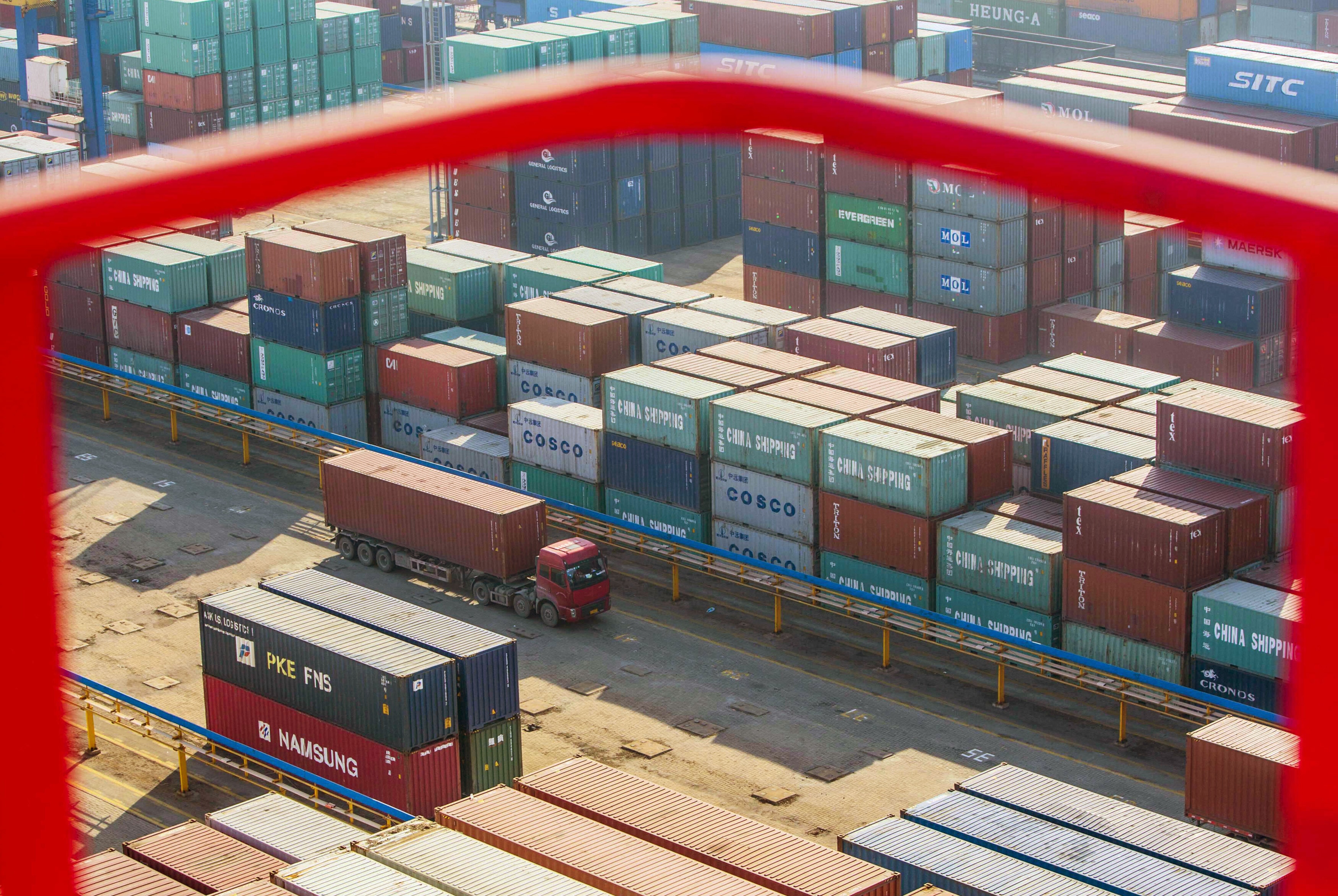
Disruptions to the global trade status quo have created vulnerabilities for criminals to exploit. Image: REUTERS/China Daily
- As much as $5.5 trillion annually may be laundered worldwide annually.
- Significant portions of that happen via the global trade system – a trend that risks exacerbating as the status quo shifts.
- Banks are on the front line of this issue, and must harness technology to keep up with criminals.
Seismic shifts are underway in global trade. Economies are redrawing global supply chains. Tariffs are springing up, and sometimes falling, at a pace not seen before. The rules of global trade are in constant flux – and that creates opportunity for criminals.
Estimates suggest that 2-5% of global GDP, as much as $5.5 trillion annually, is laundered worldwide. A significant share of this flows through trade, which remains one of the most exploited channels for money laundering and the illicit movement of funds.
Criminals are moving a worrying amount of money across borders in plain sight. The chaos from geopolitical disputes only blurs the line between lawful commerce and illicit activity further. And that growing instability has made financial crime harder to detect but easier to disguise.
The real question, therefore, is whether today’s systems can adapt as quickly as the threats themselves.
The new frontline of financial crime
Sudden shifts in tariffs and sanctions create volatility in trade flows, forcing banks to adjust risk models on the fly while leaving exploitable gaps. The European Central Bank has even warned that such shocks ripple through supply chains and financial systems, where criminals are quick to seize on the instability.
Ports, shipping companies and customs authorities are crucial infrastructure, yet their processes are built for logistics and revenue collection, not financial crime detection. From falsified invoices to vessels rerouting from declared routes or “going dark” entirely, much of this activity takes place in plain sight. Recent industry warnings highlight how rising cargo theft and global freight fraud are only exacerbating these risks.
And the burden of policing this complexity then falls squarely on banks, financial institutions and payment service providers. When tariffs rise or sanctions are imposed, new loopholes open up across these networks. Tariffs, in particular, can fuel trade-based financial crime by encouraging over- and under-invoicing, rerouting shipments through less regulated markets and creating inconsistencies in trade documentation.
Alongside this, financial crime is evolving in ways traditional controls were never designed to catch. Criminals are using AI and other emerging technologies to circumvent the broader chaos of the ecosystem, whether that’s analysing sanctions enforcement for exploitable gaps or generating and using shell companies as the proverbial “getaway car” for criminals to obscure the ultimate beneficiary. Banks often only see the payment, not the goods or routes behind it, leaving them one step behind once more.
While criminals innovate, compliance teams are being stretched to breaking point. Across Europe, 75% of compliance decision-makers report that regulatory demands on their teams have increased significantly in the past year, and the pace of change shows no signs of slowing. Yet when institutions are still conducting manual reviews and duplicating work across siloed systems, it comes as little surprise that $750 billion in illicit funds slipped through Europe in 2024. Decades of “patch and upgrade” approaches have left institutions with fragmented infrastructures, which has led to overworked teams and investigations moving more slowly than the crime itself.
The reality is that banks are being asked to monitor a chaotic, interconnected web of global trade with tools built for a different era. It’s not that the right technologies don’t exist – because they do – but making them work effectively is a challenge in itself. To close the gap, institutions need solutions that are not only advanced but implemented in ways that truly cut through the growing complexity of trade-based financial crime.
Building real-time, intelligence-led defences
Financial institutions must therefore build a layered, intelligence-led defence; one that keeps pace with shifting trade flows and the wider global landscape. This is no longer about replacing existing systems, but simply enhancing them with the tools criminals are already using – automation, AI and advanced monitoring.
It starts with automation. By linking and cross-checking invoices, bills of lading, shipping manifests and customs data scattered across jurisdictions, automation can expose mismatches that would otherwise be buried in paper trails. Integrated with real-time vessel tracking data, this provides visibility into both the financial and physical movement of goods, flagging unexplained route deviations or behavioural anomalies instantly. It also continuously screens against rapidly changing sanctions and watchlists, reducing the lag that criminals exploit when policies shift overnight. In the context of tariff disputes, automation helps banks avoid being caught off guard by sudden regulatory or trade changes.
AI strengthens this layered defence by making sense of the sheer volume and complexity of trade data. Instead of relying on manual checks or static thresholds, machine learning models learn to recognise subtle patterns and anomalies that would otherwise slip through. By turning unstructured records into structured intelligence, AI gives compliance teams the ability to interrogate trade flows at scale and speed. As criminals increasingly turn to cryptocurrencies, stablecoins and even AI itself to conceal illicit flows, financial institutions need equally adaptive tools – able to evolve as quickly as the threats do.
Advanced monitoring brings the picture together. Integrated dashboards connect the dots between data streams, giving compliance teams real-time visibility across global trade flows. What makes these capabilities different is not just the ability to see trade flows more clearly, but seeing them in context. Particularly when monitoring extends beyond transactions to incorporate macro-level intelligence – from tariff disputes and shifting sanctions lists to the risks of unstable jurisdictions. When these geopolitical factors are built directly into compliance workflows, financial institutions can anticipate where risks are likely to emerge, rather than reacting after the fact.
The goal of this layered defence is to stem the billions lost to illicit trade flows each year. By identifying anomalies in real-time and closing the gaps, financial institutions can better protect revenue, safeguard legitimate commerce and reduce exposure to penalties and market distortion.
Turning volatility into resilience
Today’s geopolitical turbulence leaves financial institutions with a choice: continue with outdated processes and systems, or seize this moment to rebuild defences that are fit for a more volatile world.
Because in the midst of chaos, there is also opportunity. Banks can use it as a catalyst for change. To reset, to integrate intelligence and to finally bring clarity to the largest channel of financial crime. In a climate where trillions may be laundered annually, every penny kept out of criminal networks is value retained within the system. And when done right, this layered defence becomes a source of financial and operational resilience in an uncertain geopolitical era.
Don't miss any update on this topic
Create a free account and access your personalized content collection with our latest publications and analyses.
License and Republishing
World Economic Forum articles may be republished in accordance with the Creative Commons Attribution-NonCommercial-NoDerivatives 4.0 International Public License, and in accordance with our Terms of Use.
The views expressed in this article are those of the author alone and not the World Economic Forum.
Stay up to date:
Illicit Economy
Related topics:


Forum Stories newsletter
Bringing you weekly curated insights and analysis on the global issues that matter.
More on Trade and InvestmentSee all

Anne Christianson and Ying Jie Tan
February 20, 2026


