The Pope's recent encyclical was a call to ensure the vulnerable aren't left behind in the rush to build AI.
Contemporary geopolitics is upending longstanding notions of the common good and commitments to the care of vulnerable communities.
Religious teachings and leadership can help refocus global agendas on those at society’s margins.
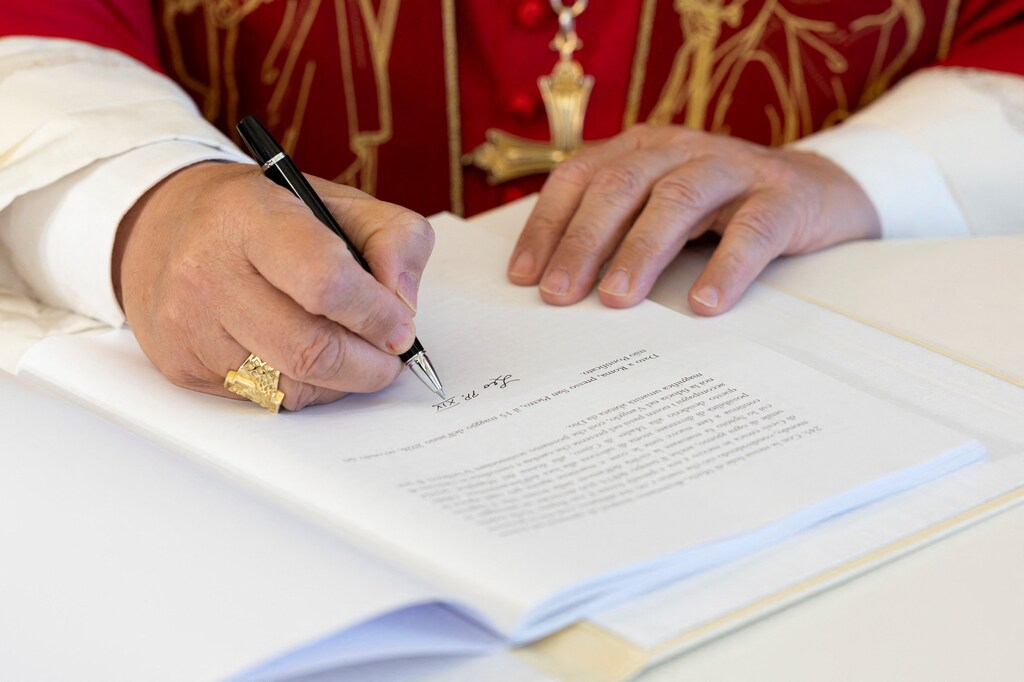
Pope Leo XIV’s May 2026 encyclical Magnifica Humanitas, which focused on AI, highlights opportunities but also grave threats facing global leaders and communities. It is a powerful reminder that serving the common good is key to human flourishing – and to progress.
Pope Leo zeroed in on vulnerability as a leading contemporary challenge; the word "vulnerable" appears 21 times in the encyclical, and "vulnerability" four times. Today’s turbulence threaten to leave many behind, he wrote, worsening social, political and economic inequalities and suffering, and undermining welfare and social cohesion. During economic and financial crises, the poor always pay the highest price; theories that promise automatic general prosperity tend, he noted, to be illusory.
A core teaching of every major world religion is the imperative to care for those at society’s margins, to hear their voices amid the cacophony of interests and power.
The threats facing societies across the world indeed loom large. Social disharmony, tensions around migration and increased conflict undermine the solidarity and social cohesion on which security depends. World systems of cooperation on peace, trade and other areas, and the norms that underpin them, have come under great and fast-evolving stress. Sharp cuts in humanitarian funding and overseas development assistance (ODA) reflect a fraying of the global consensus on responsibility for development and humanitarian action.
Meanwhile unsustainable debt levels and critical financial straits limit options. Sharply changed budget priorities mirror cruel but lived priorities. The 2030 global agenda reflected in the Sustainable Development Goals (SDGs), unanimously approved by the United Nations General Assembly in 2015, is far off track. That year’s euphoric visions of a shared commitment to the common good, to “leave no one behind”, seem a distant illusion.
This demands a conversation, within and among religious communities, and with religious communities at the global policy tables, about how societies define fairness, responsibility and human flourishing. What does social protection mean in contemporary society? How to balance rights, responsibilities and obligations? Fresh thinking and renewed commitments to solidarity and the common good are sorely needed.
Large segments of the world’s people are affected by insecurity and heightened vulnerability. Funding for health programmes, schools and scholarships, research on food security, and women’s initiatives are among policies and programmes facing cutbacks.
Attempts to explain what social protection means too often evoke blank stares, with a murky sense of who is responsible. This has unsettled longstanding assumptions that robust welfare programmes and support for those in need are fundamental elements of a moral economy, especially in times of transition. Leadership discussions focus much too rarely on who is most vulnerable, who most needs support, and how best to respond.
Leaders within religious communities offer robust teachings and centuries of practice.
Religious teachings shared by large segments of the world’s people point both to moral imperatives and practical paths towards consensus and action. Ancient principles of compassion and care offer much for today’s turbulent times. Catholic Social Teaching is a prominent example; the pope's encyclical highlights its core insights and principles, notably social justice, human dignity, solidarity and a preferential option for the poor.
Religious action on social protection goes well beyond teaching and preaching, to lived care and accompaniment. Yet in many reflections on social policy challenges, the rich experience and assets of religious communities are rarely seen as integral parts of systems and response. A more robust appreciation for these roles can enrich responses at every stage of the journey, from global leadership to local communities and families.
Religious communities have long reminded world leaders of their core ethical responsibilities. Religious institutions have often served as intermediaries between markets and communities, providing and advocating for social protection, education, healthcare and humanitarian assistance. Their rich teachings awaken conscience and empathy; advocating to protect and care for people gives weight to calls to act for the common good.
Many religious institutions deliver services, with deliberate, preferential approaches to the most vulnerable. Religious institutions in the United States have long helped mobilize bipartisan support for foreign aid, though it has withered at least temporarily amid today's divisive politics. Islamic zakat, Christian teachings, Jewish tzedakah, Buddhist dana, and Hindu traditions of seva and dana all embed economic life within broader moral frameworks.
As fractured and diverse societies make clear, supporting those at the margins is extraordinarily difficult. Pope Leo warned against the dangers of losing sight of long-term perspectives in the heat of the moment: “The language of the common good loses credibility, and, at the same time, social inequalities and divisions grow.”
Subsidiarity, a central Catholic teaching that echoes across religious and secular traditions, can be helpful; responsibilities and agency must be understood at different levels, with decisions made, where possible, at levels closest to those involved. Subsidiarity recognizes the practical imperative to address issues at multiple levels, from the very global (the UN, the G7 or G20) to regional, national and local. At each and every level, from global prophetic voices to daily on-the-ground accompaniment, there is agency and an urgent call for insight and attention.
Religious leaders and institutions – globally, nationally and at the grassroots level – can work to persuade and support those inside and outside governments about shared commitments to, and understanding of, the common good.
They share two vital responsibilities: highlighting the moral dimensions of choices, and speaking and acting for those who are most vulnerable. At their best, they advocate for and support shared, common goals. The hope is that religious communities – globally, nationally and at the grassroots level – can persuade leaders, inside and outside governments, to come together around the notion that societies and economies that serve all people are truly feasible.
The common quest for a moral economy is a necessary foundation for healthy markets and societies. Leaders confronting global challenges – from AI governance to climate change, safety-net policies and public health – confront daily social, political and ethical choices, often embedded in highly technical economic and security decisions (take debt as just one example).
Nowhere is this more true than in policy decisions including those on resource allocation, which affect society’s most vulnerable. The notion that such choices must necessarily pit market-friendly policies against core values is false. Successful societies absolutely need market-friendly policies grounded in solid values. Markets must work alongside actions driven by care and compassion, driving towards a sustainable present and future that serve the common good.
Along this journey, the real test of success will be how we respond to the calls of the pope's encyclical: to work relentlessly for the common good, always with caring hearts, while serving those who are most vulnerable.