Successful urban regeneration projects create social value, but confusion around the concept is a challenge that public-private partnerships face in delivering those projects.
The public and private sectors often have different perspectives, drivers and measurements for social value.
Understanding perspectives, defining the roles of all stakeholders and then leveraging a framework to identify the ways impact will be planned for, measured and incentivized, is a potential way forward for successful public-private partnerships.
What do we call the spectrum of results in real estate that provide broad-reaching benefits to all stakeholders, users, communities and the planet? Is this social value? Is it the same as social impact, social sustainability and social well-being? How does social capital relate?
While these terms seem to broadly conceptualize the same idea (i.e. something that is good for society), the variation reflects diverging perspectives, drivers and measurements — which risks confusion and can diminish outcomes on complex, urban regeneration projects dependent on strong public and private sector cooperation.
Our work with the World Economic Forum on social value creation suggests that public sector organizations often struggle to engage the private sector effectively – even when there is broad agreement about the need for positive social impact.
Defining 'good' outcomes
A shared-value approach is possible and essential, particularly in public-private partnerships. To assist with this approach, we are developing an Impact Framework — an adaptable tool to help communicate shared outcome objectives and align decisions with those objectives consistently across asset and project lifecycles.
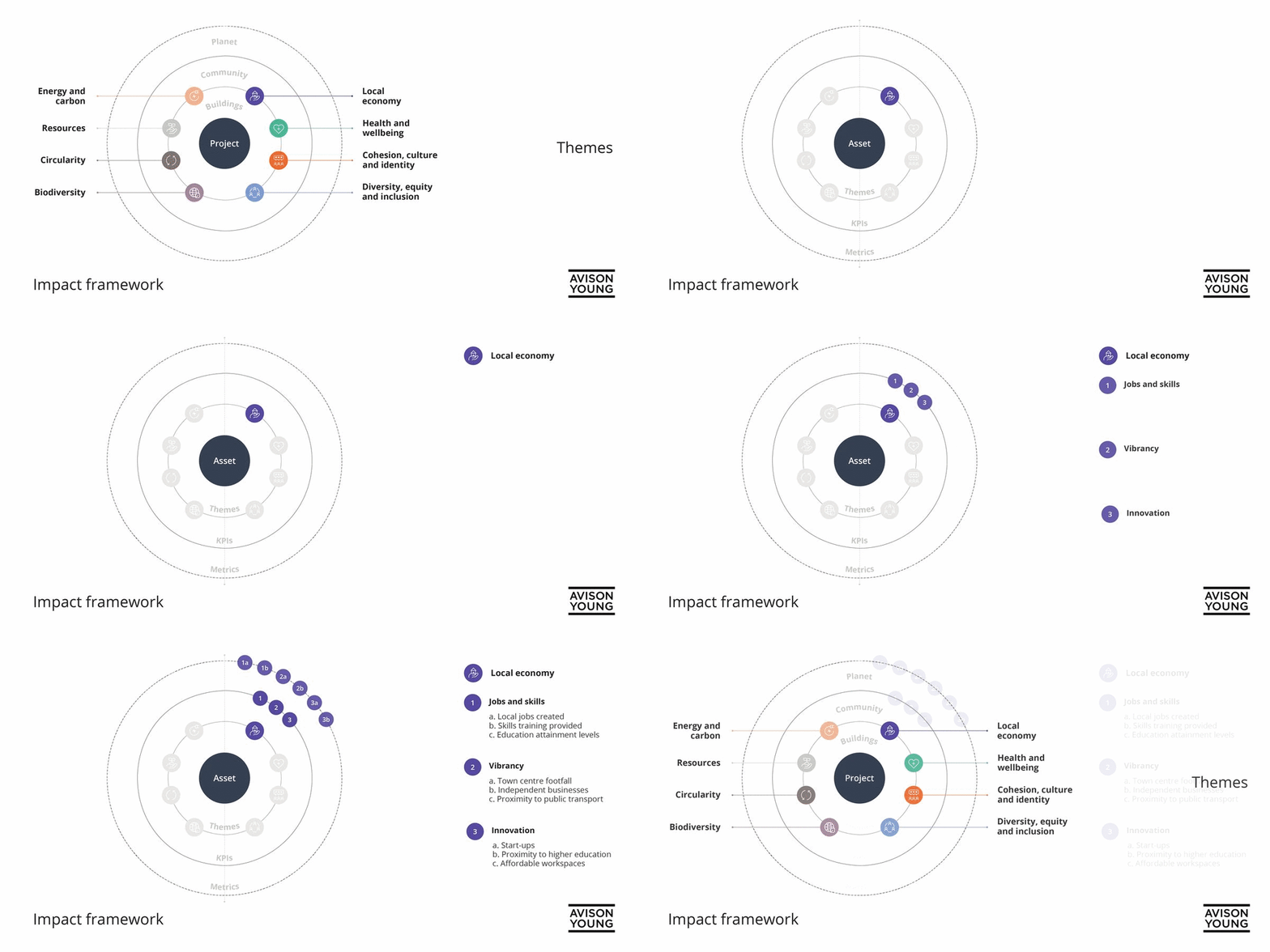
The Impact Framework identifies eight themes that are relevant to real estate and the built environment. While these can be flexible, it is intended to encourage a balanced approach, allowing users to see interactions and potential trade-offs between different themes. The scale of impact, represented by three circles, helps identify broader stakeholders beyond building users. Under each theme, KPIs and metrics continue to be adjusted to assist specific decision-making required at a particular point in the project (Figure 1 above). Metrics are useful for comparison in option appraisal to test emerging ideas and design proposals (Figure 2 below).

Salisbury Square, London, UK
For the redevelopment of Salisbury Square, an impact framework aided the City of London Corporation in defining strong project drivers around sustainability and social impact. In support of a £400 million+ construction project, the framework captured the standards and priorities of a public sector organization representing residents, local businesses and the far-reaching impact of a global city. Salisbury Square will be home to major public organizations, including the City of London Police and His Majesty’s Courts and Tribunals Service.
Working with the client, the team tailored the Impact Framework to manage and monitor the construction phase. The framework encouraged the team to consider the impact on different stakeholders, including future building users, the local community and broader society. Performance measures set out by the framework include the percentage of workforce from neighbouring boroughs, the percentage of reused materials to be used and the number of participants in school engagement programmes.
The framework is embedded in the project charter, which was signed by all involved consultants and contractors and tracked by individual organizations and at the overall project level, to ensure all activities are aligned to achieve outcome objectives collectively. Nine months into the project, some metrics (e.g., educational activities and community investment) already exceed the initial targets.
Agreed objectives reflected the Corporation’s aspirations, social and environmental goals set out in the Local Plan, as well as the aspirations of wider stakeholders, neighbouring landlords and tenants. KPIs and metrics were workshopped to help ensure that project outcomes and contracted work aligned with the agreed objectives.

The Strand, Sefton, UK
For Sefton Council, underpinning the business case for the acquisition of The Strand in Bootle was the recognition that its ownership was essential to enable the wider regeneration of the town centre. This included recognizing the need to invest in the shopping centre to retain a positive asset at the heart of the Bootle community.
The vision is to reinforce the ‘Spirit of Place’ for the people of Bootle and offer new cultural, educational and large spaces that activate the site and create more destinations, leading to improved perceptions of the town and increased footfall, dwell time and spending in the local economy.
In Phase 1 of the project, a tailored Social Value Framework is being developed to translate vision into the planning and design of the redevelopment. The framework will set out social, economic and environmental outcome objectives based on a series of community engagement and local needs analysis.
The framework helps balance the needs and priorities of the Council as the asset owner and custodian of community value. The design team will use the framework to test emerging ideas and proposals, enabling objective, transparent and outcome-oriented decision-making throughout the development process.
The framework can be retained beyond the current master planning stage to ensure detailed design, construction and asset management are all aligned with the agreed objectives throughout subsequent stages of the development and eventually, the evolution of the place.
What is the World Economic Forum doing to promote sustainable urban development?
Cities are responsible for 75% of global greenhouse gas emissions and are home to over half of the world’s population—a number that will grow to two-thirds by 2050. By prioritizing cleaner energy, cities could contribute more than half of the emissions cuts needed to keep global warming to less than 2°c, which would be in line with the Paris Agreement.

To achieve net-zero and nature-positive cities and communities by 2050, the World Economic Forum is partnering with public and private sector stakeholders on initiatives that drive global ambition through local action. Here are just a few:
Davos Baukultur Alliance: Advancing high-quality planning, construction and management of buildings, infrastructure, and public spaces using principles based on climate resilience, sustainability and circularity in the built environment. Learn more.
Global New Mobility Coalition: Exploring new solutions to reduce congestion and emissions, enhance EV infrastructure and transform urban mobility and deliveries. Learn more.
Alliance for Urban Innovation: Connecting innovators and entrepreneurs to new markets and opportunities that reimagine and reshape quality of life and local economies. Learn more.
G20 Global Smart Cities Alliance: Accelerating intelligent, practical solutions to build climate resilience, enhance public well-being and tackle the most pressing challenges facing cities and local communities. Learn more.
Future of Travel and Tourism: Driving inclusive and sustainable economic growth while preserving cultural heritage and protecting natural ecosystems. Learn more..
Discover how you can be a part of our efforts to create more sustainable and livable cities and communities. Contact us here.
A framework for impact and value
We use ‘social impact’ as a way to describe the result of action. An organization or a development has an ‘impact’ on people and in places. The ‘social value’ of a development or a place (a piece of land) depends ultimately on what we as a society decide to value or devalue.
Social impact can be measured as change from the baseline, while social value can be measured as alignment with what is desirable for building owners, users, the community and wider society. Understanding perspectives, defining the roles of all stakeholders and then leveraging a framework to identify the ways impact will be planned for, measured and incentivized, is a potential new way forward for successful public-private partnerships.