America’s top 10% of earners work an average of 4.4 hours more each week than those in the bottom 10%, according to a US Census Bureau survey.
But the top 10% in many other countries work around 1 hour less each week than the bottom 10%, at least among full-time workers.
A big factor behind differences in working hours around the world is tech innovation and machines, which tend to allow wealthier countries to increase output without putting in as many hours.
The Actual Working Hours of Different Income Levels
Do you really need to work 100-hour weeks for success?
In 2021, America’s top 10% of income earners made at least $129,181 a year—more than double the average individual income across the country.
When looking at differences between income groups, there are many preconceived notions about the work involved. But what are the actual average working hours for different income groups?
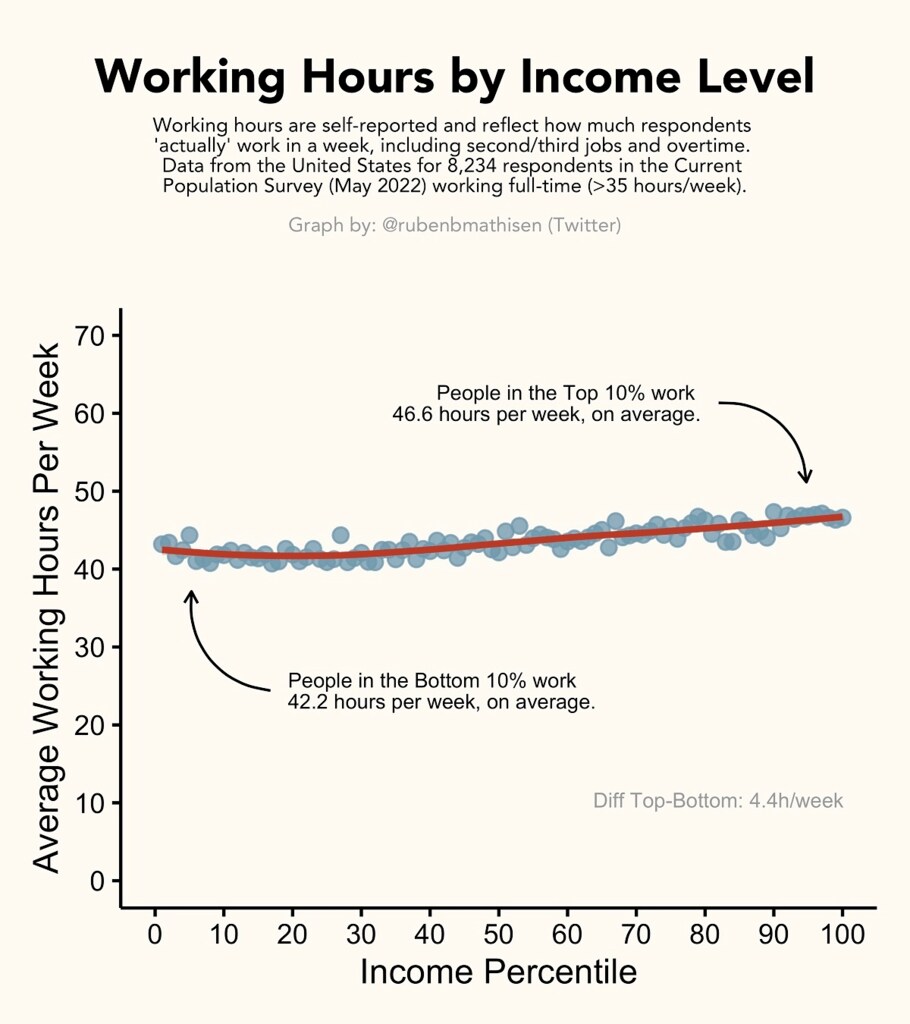
This graphic by Ruben Berge Mathisen uses the latest U.S. Census data to show the average working hours of Americans at different income levels.
Comparing Average Work Weeks
The data used for this graphic comes from the U.S. Census Bureau’s May 2022 Current Population Survey, which surveys more than 8,000 Americans from various socioeconomic backgrounds.
Importantly, the data reflects the average work hours that respondents in each income percentile “actually” work each week, and not what’s on their contract. This also includes overtime, other jobs, or side gigs.
According to the survey data, America’s top 10% income percentile works 4.4 hours more each week than those in the bottom 10%. And in surveys across other countries, though with hundreds of respondents instead of thousands, the discrepancy was similar:
While both income and wealth gaps are generally widening globally, it’s interesting to see that higher earners aren’t necessarily working more hours to achieve their increasingly larger salaries.
In fact, the top 10% in the 27 countries shown in the graphic are actually working around 1 hour less each week than the bottom 10%, at least among full-time workers.
How is the World Economic Forum promoting equality in the workplace?
The Future of Jobs Report 2023 found that 75% of companies surveyed expect to adopt AI, big data and cloud technologies in the next five years.
The Centre for the New Economy and Society provides a platform for leaders to share insights on the adoption and efficacy of new technologies, and the readiness of the workforce to use them. Our work includes developing insights and dialogue on growth, jobs, skills, equity and risks.
Learn more about our impact:
Gender parity: Since 2006, we have annually measured the state and evolution of gender parity in 101 economies, supporting decision-makers to identify the most effective policies to close gender gaps. In Chile, we helped establish gender parity accelerators and benefitted 728,000 women – reducing the gender gap by 37% in the participating companies.
Reskilling Revolution: With our partners, we are helping the global workforce future-proof their careers, working with over 350 organizations to provide 1 billion people with better education, skills and economic opportunities by 2030.
Disability inclusion: Working with the Valuable500, we are collaborating with the largest global network of CEOs committed to closing the disability inclusion gap. Members are making progress by increasing the adoption of digital accessibility best practices and including disability in diversity, equity and inclusion strategies.
Racial justice: We are collaborating with a global coalition of 55 organizations in 13 industries who are committed to building equitable and just workplaces for professionals from under-represented racial and ethnic identities.
Want to know more about our centre’s impact or get involved? Contact us.
Zooming Out: Average Working Hours per Country
Similarities arise when comparing average working hours across different countries. For starters, people living in poorer countries typically work longer hours.
According to Our World in Data, the average worker in Cambodia works about 9.4 hours a day, while in Switzerland, people work an average of 6 hours a day.
While many factors contribute to this discrepancy in working hours, one large factor cited is tech innovation, or things like physical machines, processes, and systems that make work more efficient and productive. This allows wealthier countries (and industries) to increase their output without putting in as many hours.
For example, from 1948 to 2011, farm production per hour in the U.S. became 16x more productive, thanks to innovations like improved machinery, better fertilizers, and more efficient land management systems.