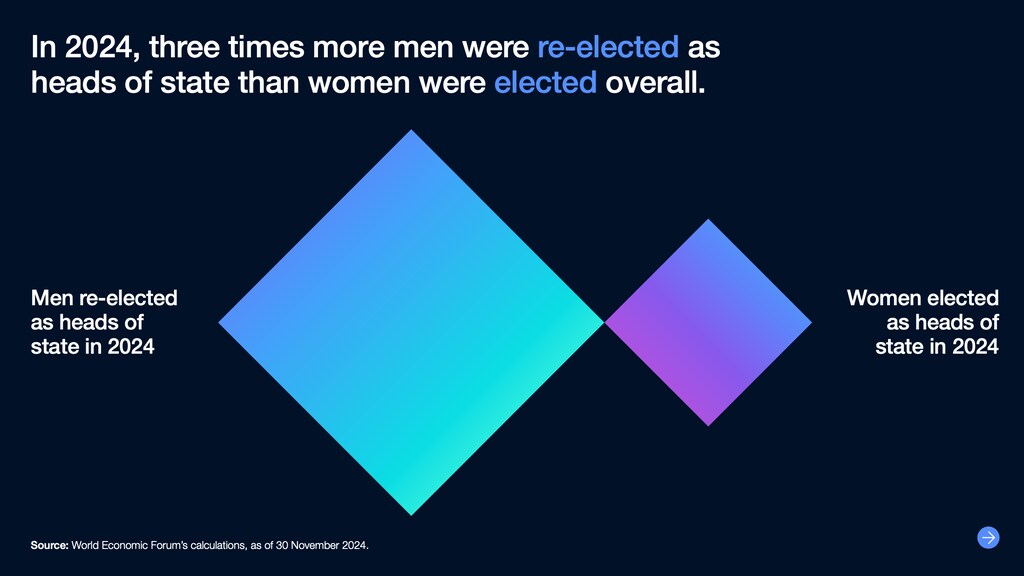
In 2024, three times more men were re-elected as heads of state than women elected overall.
Economic barriers play a crucial role in limiting women's political participation.
The World Economic Forum's Global Gender Parity Sprint aims to advance economic gender parity and parity in senior leadership.
Last year, an aura of possibility hovered in anticipation of around 60 elections that were held across the world. Today, we face the outcomes of ballot choices that continue to cap women’s political leadership at a global level, as the UN Women's latest report highlights a slowdown of equality between women and men in politics.
Moving the needle on political empowerment
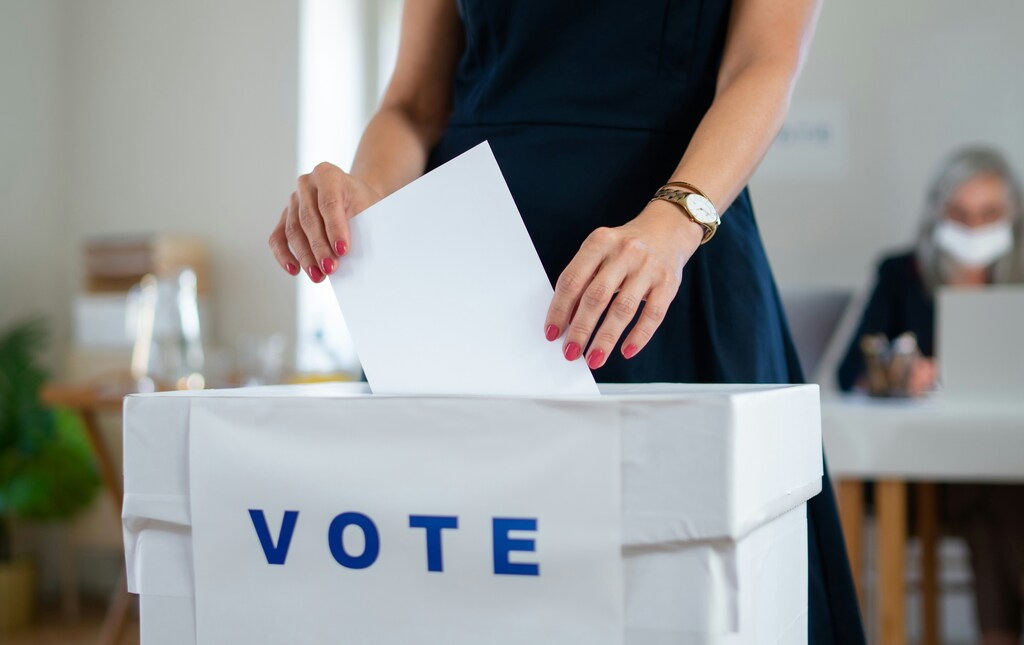
Approximately half of the head of state elections held in 2024 had women running for the top job. Out of virtual parity however, there were three times as many men re-elected than women elected overall. In terms of gender, the balance is slightly more positive. While two economies saw female incumbents replaced by newly elected male candidates, in four economies, electorates chose women to succeed men as head of state. However, when it comes to volume, out of the Global Gender Gap Report’s most populous economies, three elected men, and only one elected a woman as head of state.
For the legislative sphere, results are mixed. Among economies with parliamentary elections in 2024, Mexico and Rwanda continue to lead in female representation, with 50% and 64% of seats won by women in their lower houses, respectively. Belgium, Iceland, Senegal, South Africa, and the UK, achieved just over 40% of female representation. However, 80% of legislatures elected in 2024 selected men to the role of speaker, keeping legislative leadership overwhelmingly male.
Most countries have tackled the lack of female representation in their political decision-making by implementing legal candidate quotas. While this approach increased the proportion of female candidates, no major impacts have been observed on the proportional representation among elected officials. Notably, only two economies achieved higher percentages of elected women compared to female candidates.
The economics of political parity
The adoption of institutional mechanisms like quotas has been very successful in increasing access and opportunity for women and diverse candidates, but ultimately insufficient in sparring with the cultural and economic attitudes that influence outcomes in political representation.
There are, of course, numerous factors playing into the outcomes of the 2024 super-electoral cycle. However, in the absence of a clear recipe for equal political representation, what stands out as a clear problem is the high-cost women pay to be political leaders in their own communities.
Globally, public confidence in women's political leadership is declining. The Reykjavik Index, measuring perceptions of gender equality in political leadership, has regressed to its lowest level among G7 economies since 2018. In the US only 47% of respondents expressing full comfort with women in leadership roles.
How is the World Economic Forum promoting equity in the workplace?
The Future of Jobs Report 2023 found that 75% of companies surveyed expect to adopt AI, big data and cloud technologies in the next five years.
The Centre for the New Economy and Society provides a platform for leaders to share insights on the adoption and efficacy of new technologies, and the readiness of the workforce to use them. Our work includes developing insights and dialogue on growth, jobs, skills, equity and risks.
Learn more about our impact:
Gender parity: Since 2006, we have annually measured the state and evolution of gender parity in 101 economies, supporting decision-makers to identify the most effective policies to close gender gaps. In Chile, we helped establish gender parity accelerators and benefitted 728,000 women – reducing the gender gap by 37% in the participating companies.
Reskilling Revolution: With our partners, we are helping the global workforce future-proof their careers, working with over 350 organizations to provide 1 billion people with better education, skills and economic opportunities by 2030.
Disability inclusion: Working with the Valuable500, we are collaborating with the largest global network of CEOs committed to closing the disability inclusion gap. Members are making progress by increasing the adoption of digital accessibility best practices and including disability in diversity, equity and inclusion strategies.
Racial justice: We are collaborating with a global coalition of 55 organizations in 13 industries who are committed to building equitable and just workplaces for professionals from under-represented racial and ethnic identities.
Want to know more about our centre’s impact or get involved? Contact us.
The hardening of attitudes towards gender parity reflects a not-so-silent cultural regression to traditional gender attitudes. More significantly though, it also mirrors a hardening of the material conditions in which political and social attitudes are forged. When unpredictability and instability cull economic promise, women see political participation and representation diminished by lack of opportunity, increased vulnerability, and of course, violence.
Resources make a stark difference in who can even aspire to run, and win. As Mexican Secretary Alicia Bárcena pointed out during the Towards Parity in Power discussion held in Davos this year, “closing the political gap is very much connected to building up the economic autonomy of women”. Economic autonomy can lower entry barriers to the political sphere, while also improving prospects for women’s political influence, reach, and safety.
Economic dependency is at the root of political disparity. As mentioned by Francois Valerian during the same Davos session: “women have fewer financial resources than men” to start with. Having fewer financial resources puts women overall on the “outsider track” and in a disadvantaged position from the get-go – which in countries like the US, can lead women to be “more strategic” and self-selecting about the races they run in the first place. This is especially worrying in a context of electoral processes flooded by hyper masculine leadership tropes running on platforms of economic scarcity.
Sprinting to parity
As we reflect on the current political landscape, it's clear that to boost political parity we need to improve economic opportunity for women – and vice versa. The private sector, policymakers, and civil society must work together to dismantle financial and cultural barriers that keep women on the political sidelines. The Global Gender Parity Sprint provides a global platform, bringing together businesses, governments, international organizations and other stakeholders to accelerate progress by 2030 by joining forces to anchor gender parity as a fundamental driver of the economy. The Sprint focuses on inspiring action across sectors through heightened visibility, impactful initiatives to advance gender parity in workforce and senior leadership, and new evidence at the frontier of the tech, green and care transitions.