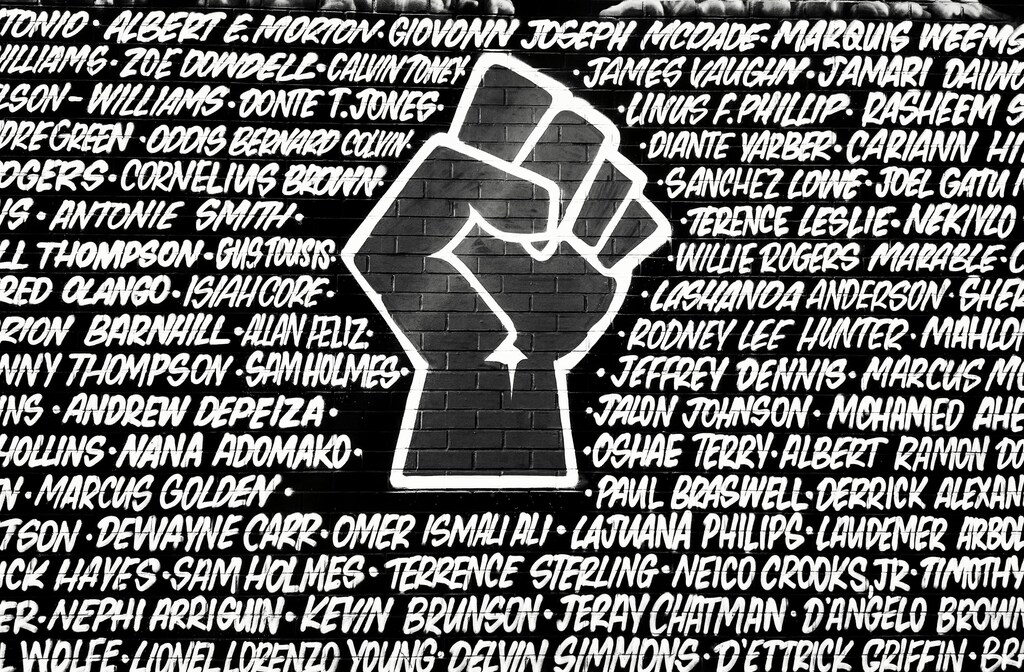
Pew Research Center surveys explore Black Americans’ views on how to overcome racial inequality.
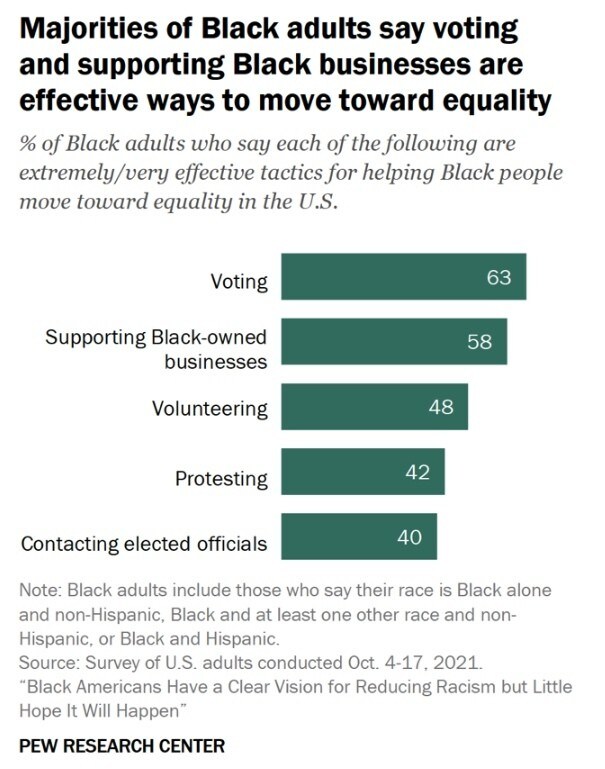
Black American adults view voting as the most effective strategy for progress towards equality, with 63% considering it extremely or very effective.
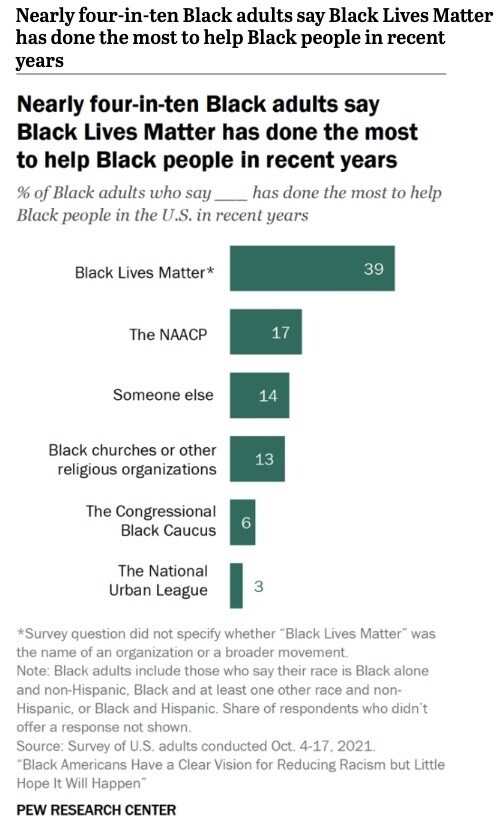
While the Black Lives Matter movement is considered by 39% as having done the most to help Black people in the US in recent years.
Black History Month originated in 1926 as Negro History Week. Created by Carter G. Woodson, a Black historian and journalist, the week celebrated the achievements of Black Americans following their emancipation from slavery.
Since 1928, the organization that Woodson founded, the Association for the Study of African American Life and History, has selected an annual theme for the celebration. The theme for 2023, “Black Resistance,” is intended to highlight how Black Americans have fought against racial inequality.
Black Americans’ resistance to racial inequality has deep roots in U.S. history and has taken many forms – from slave rebellions during the colonial era and through the Civil War to protest movements in the 1950s, ’60s and today. But Black Americans have also built institutions to support their communities such as churches, colleges and universities, printing presses, and fraternal organizations. These movements and institutions have stressed the importance of freedom, self-determination and equal protection under the law.
Black Americans have long articulated a clear vision for the kind of social change that would improve their lives. Here are key findings from Pew Research Center surveys that explore Black Americans’ views about how to overcome racial inequality.

1. Most Black adults see voting as an extremely or very effective strategy for helping Black people move toward equality, but fewer than half say the same about protesting.
More than six-in-ten Black adults (63%) say voting is an extremely or very effective strategy for Black progress. However, only around four-in-ten (42%) say the same about protesting.
There are notable differences in these views across political and demographic subgroups of the Black population.
Black Democrats and Democratic-leaning independents are more likely than Black Republicans and Republican leaners to say voting is an extremely or very effective tactic for Black progress (68% vs. 46%). Black Democrats are also more likely to say the same about supporting Black businesses (63% vs. 41%) and protesting (46% vs. 32%).
Views also differ by age. For example, around half of Black adults ages 65 and older (48%) say protests are an extremely or very effective tactic, compared with 42% of those ages 50 to 64 and 38% of those 30 to 49.
2. Black Americans say Black Lives Matter has done the most to help Black people in recent years.
Around four-in-ten Black adults (39%) say this, exceeding the share who point to the NAACP (17%), Black churches or other religious organizations (13%), the Congressional Black Caucus (6%) and the National Urban League (3%).
Black Democrats are more likely than Black Republicans (44% vs. 26%) to say Black Lives Matter has done the most to help Black people in recent years. And Black adults with at least a college degree are more likely than those with less education (44% vs. 37%) to say Black Lives Matter has done the most.
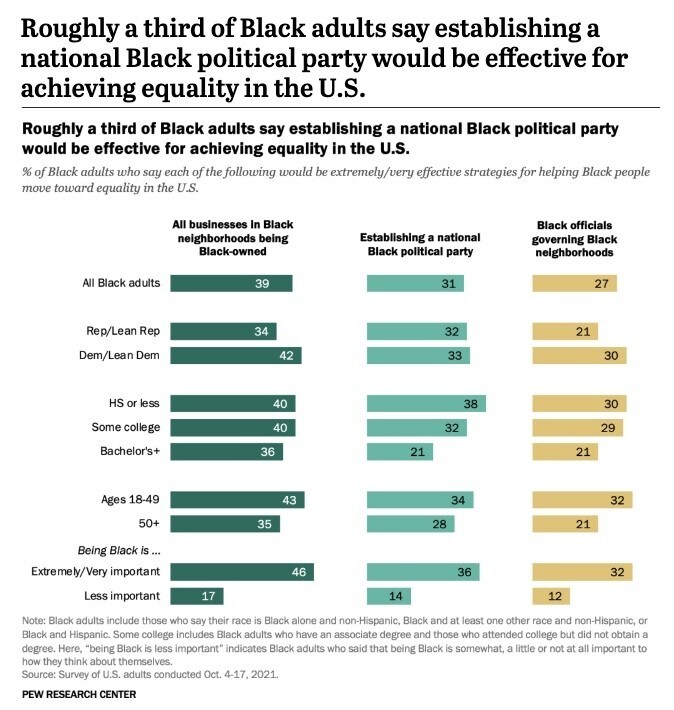
3. Some Black adults see Black-owned businesses and Black-led communities as effective remedies for inequality.
When it comes to moving Black people toward equality, about four-in-ten Black adults (39%) say having all businesses in Black neighborhoods be owned by Black people would be an extremely or very effective strategy. Smaller shares say the same about establishing a national Black political party (31%) and having all the elected officials governing Black neighborhoods be Black (27%).
While none of these strategies have majority support among Black adults, certain groups are more likely than others to say they would be effective. Those who say being Black is at least very important to their identity are especially likely to say each of the three strategies are effective, for example.
Those with a high school education or less are more likely than college graduates to say establishing a national Black political party would be effective at achieving equality for Black people. Meanwhile, younger Black adults (ages 18 to 49) are more likely than older ones (50 and older) to say Black officials governing Black neighborhoods would help make progress toward equality.
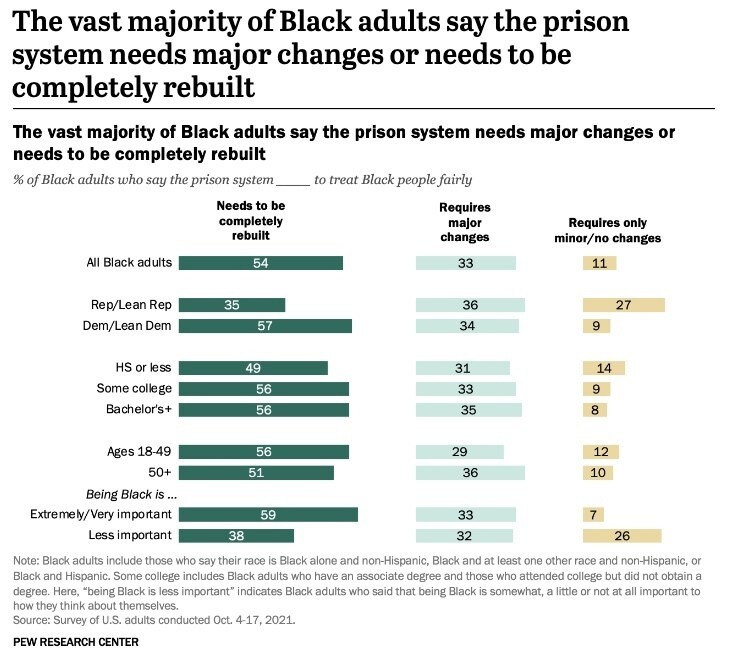
4. The vast majority of Black adults say the prison system needs significant changes for Black people to be treated fairly.
That includes a majority of Black adults (54%) who say the prison system needs to be “completely rebuilt” in order to ensure fair treatment. Groups especially likely to say this include Black Democrats and those who say being Black is extremely or very important to how they see themselves.
Far smaller shares of Black adults say the prison system requires only minor or no changes, though this view is more common among Black Republicans and those who say being Black is somewhat, a little or not at all important to their identity.
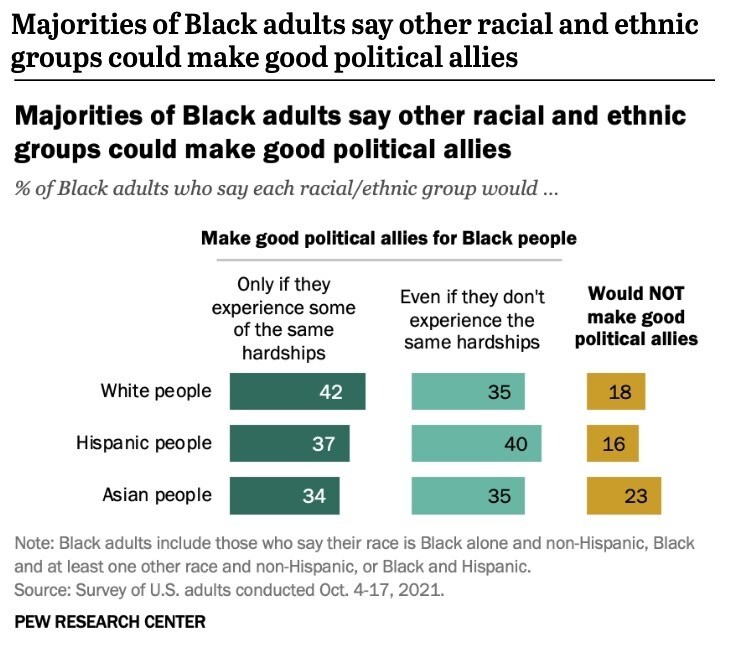
5. Clear majorities of Black adults say people of other races or ethnicities could make good political allies for Black people.
About four-in-ten Black adults (42%) say White people would make good political allies only if they experience the same hardships as Black people; another 35% say White people would make good political allies even if they don’t experience these same hardships. Around one-in-five Black adults (18%) say White people would not make good political allies.
About four-in-ten Black adults (37%) say Latinos would make good allies only if they experience the same hardships as Black people, while a similar share (40%) say Latino people would make for good allies even if they don’t experience the same hardships. Some 16% of Black adults say Latinos would not make good political allies.
The views of Black adults on this question are similar when it comes to Asian people, though a somewhat higher share (23%) say Asian Americans would not make good political allies.
Note: Here are the questions used for the survey, along with responses, and its methodology.
How is the World Economic Forum promoting equality in the workplace?
The Future of Jobs Report 2023 found that 75% of companies surveyed expect to adopt AI, big data and cloud technologies in the next five years.
The Centre for the New Economy and Society provides a platform for leaders to share insights on the adoption and efficacy of new technologies, and the readiness of the workforce to use them. Our work includes developing insights and dialogue on growth, jobs, skills, equity and risks.
Learn more about our impact:
Gender parity: Since 2006, we have annually measured the state and evolution of gender parity in 101 economies, supporting decision-makers to identify the most effective policies to close gender gaps. In Chile, we helped establish gender parity accelerators and benefitted 728,000 women – reducing the gender gap by 37% in the participating companies.
Reskilling Revolution: With our partners, we are helping the global workforce future-proof their careers, working with over 350 organizations to provide 1 billion people with better education, skills and economic opportunities by 2030.
Disability inclusion: Working with the Valuable500, we are collaborating with the largest global network of CEOs committed to closing the disability inclusion gap. Members are making progress by increasing the adoption of digital accessibility best practices and including disability in diversity, equity and inclusion strategies.
Racial justice: We are collaborating with a global coalition of 55 organizations in 13 industries who are committed to building equitable and just workplaces for professionals from under-represented racial and ethnic identities.
Want to know more about our centre’s impact or get involved? Contact us.