
The ocean already supports more than 100 million jobs and is key to global prosperity and resilience. Catalytic blue finance can help unlock commercial capital for a resilient, regenerative ocean economy.
The importance of the ocean has become increasingly visible, from shipping routes and global trade to energy security, food systems and communications infrastructure.
The ocean economy supports more than 100 million jobs worldwide, and is becoming increasingly important both to global prosperity and resilience.
Yet, at the same time, many promising sustainable ocean projects struggle to attract the capital required to move beyond a pilot, reach commercial scale or become repeatable investment opportunities.
The question is: why?
Catalytic blue finance key to scaling the ocean economy
At first glance, the answer seems straightforward: the ocean economy needs more capital. Yet capital alone is not the constraint.
Capital tends to flow most easily towards established markets, while areas with impact potential continue to face significant barriers to investment. Addressing these barriers requires the right expertise and partnerships, and innovative finance mechanisms.
The World Economic Forum’s new Catalytic Blue Finance report, supported by the UBS Optimus Foundation, identifies the key challenges in financing the ocean economy and what is needed to scale this sector.
Drawing on an analysis of 229 verified ocean-related transactions completed between 2021 and 2026, the research spans established sectors such as ports, shipping, offshore wind, desalination and water treatment, as well as emerging opportunities including the blue bioeconomy, pollution mitigation technologies and nature-based solutions.
The findings reveal a surprising pattern. Catalytic capital is not limited to early-stage or experimental opportunities. It is present across a remarkably broad spectrum of the ocean economy.
Of the transactions reviewed, 46% included a catalytic capital layer. While this was most common in emerging sectors, catalytic capital also appeared in almost four out of 10 transactions in established sectors.
Most strikingly, 78% of the transactions reviewed in the $100 million–$500 million range included a catalytic component. This demonstrates that catalytic capital can play a role not only in helping smaller, innovative ideas get started and accelerate, but also in enabling larger transactions to overcome barriers to growth and achieve commercial scale.
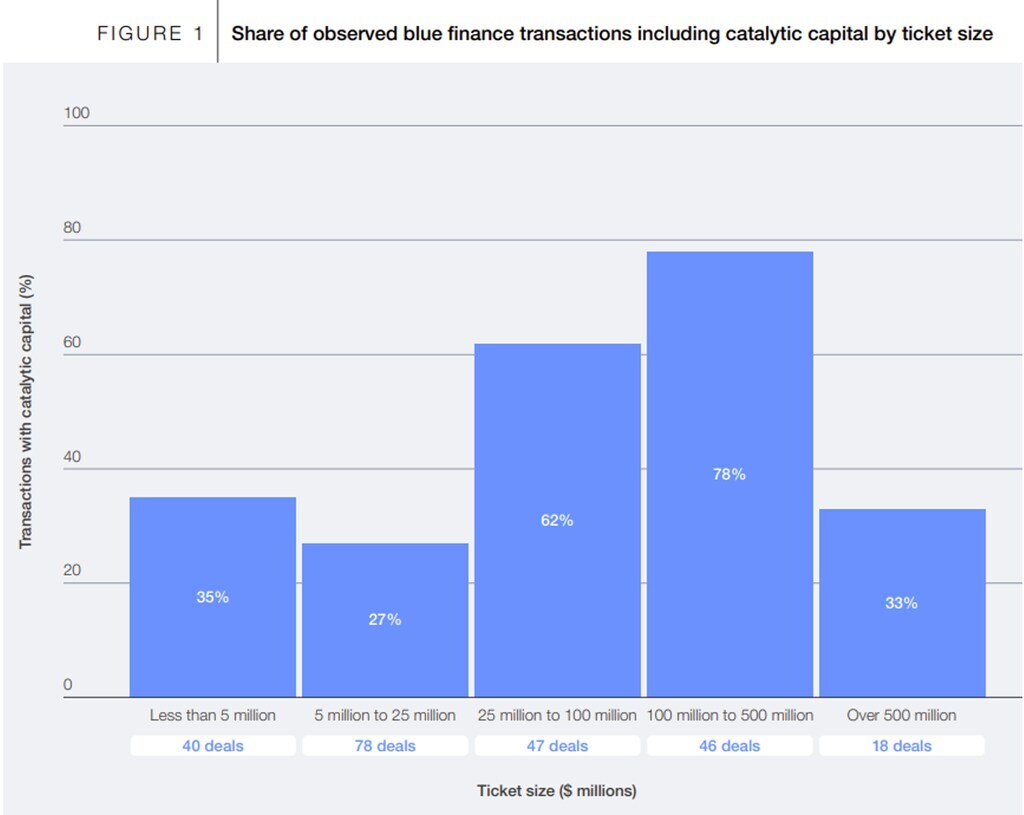
This highlights an important pattern: transaction size alone does not determine whether catalytic engagement is needed. Even large and established investments can face country risk, first-of-a-kind technologies, complex permitting processes, uncertain revenues and limited reliable data.
This raises the question of which specific barrier prevents an otherwise investable opportunity from attracting appropriate financing.
How catalytic capital can best unlock flows of funding
For philanthropic actors and other capital providers alike, these insights have practical implications. At UBS Optimus Foundation, a global network of charitable organizations founded by UBS that provides financial support to non-profits and social impact ventures, catalytic capital is often considered through three lenses: innovation, acceleration and scale.
At its best, catalytic capital is not defined by the amount deployed, but by its ability to unlock larger flows of funding over time. Through its work across the sustainable ocean economy, the foundation has seen that promising opportunities in the market are constrained not by a lack of ideas, but by the absence of structures and risk-sharing mechanisms needed to attract larger pools of capital.
This is why the UBS Optimus Foundation focuses on identifying promising solutions early, testing and refining new approaches, helping to de-risk those opportunities that commercial capital cannot yet support on its own, and building the partnerships and structures needed to attract additional public and private investment to scale impact.
To better understand these patterns, the WEF report introduces the Ocean Investment Matrix. It captures investments across multiple ocean sectors, financing instruments and geographies, providing a structured view of how the market is evolving.
It was designed as a tool to identify recurring investment patterns and provide evidence on how different forms of capital – including catalytic finance – can most effectively support the growth of the ocean economy.
Through the Ocean Investment Matrix, the report identifies four ways catalytic capital can help move ocean opportunities from fragmented potential to scalable investment.
1. Portfolio solutions for ocean investment
Many ocean-related investments require specialized technical knowledge that mainstream investment teams may not have in-house. Specialist ocean funds can concentrate that expertise, identify opportunities and provide investors with diversified exposure to the ocean economy.
2. Aggregation through financial intermediaries
Sectors such as fisheries, aquaculture, coastal tourism and wastewater services often involve large numbers of relatively small borrowers. Local and regional financial institutions are typically best placed to serve these businesses because they understand the borrowers, markets and regulatory context. External investors can then provide capital through credit facilities, portfolio guarantees, securitized loan portfolios or thematic funding lines.
3. Commercializing solutions for ocean innovation
The ocean economy is producing a growing pipeline of innovative companies. Early-stage enterprise value across emerging ocean opportunities increased from $1.1 billion in 2010 to $24.7 billion in 2025, while ocean-related start-ups overall are now valued at approximately $120 billion. Many companies, however, still face a significant finance gap between proving a solution through a pilot and securing the patient capital, customers and operational capacity required to scale.
4. Blended finance for nature-based solutions
Marine and coastal ecosystems generate substantial economic and social value through biodiversity, carbon sequestration, coastal protection, fisheries and tourism. Blended finance can help connect this value with sustainable revenue streams by combining grants, concessional capital and private investment around viable conservation and blue economy models.
From catalytic blue finance to scalable ocean investment
The key question is whether the intervention makes the opportunity better understood, better prepared, better measured or easier to finance. When it does, catalytic capital has achieved more than absorbing a first loss: it has created first proof.
Scaling the ocean economy will depend on identifying and repeating these proof points, directing finite catalytic resources towards the barriers where they can make the greatest difference.
When commercial investors, public finance providers, philanthropies, developers and communities work together to turn bespoke blue transactions into repeatable investment opportunities across sustainable ocean sectors and geographies, they can transform proof into practice and practice into scale.