The energy sector currently accounts for three-quarters of global greenhouse gas emissions.
The urgency of energy transition continues to be underestimated.
Economic growth is possible alongside reducing carbon emissions - as long as more renewables are included in the energy mix
There needs to be a massive adjustment in how the world produces its energy in order to meet climate change goals, according to a new UN report, World Economic Situation and Prospects 2020.
As this chart clearly shows, the current energy mix is incompatible with emissions targets.
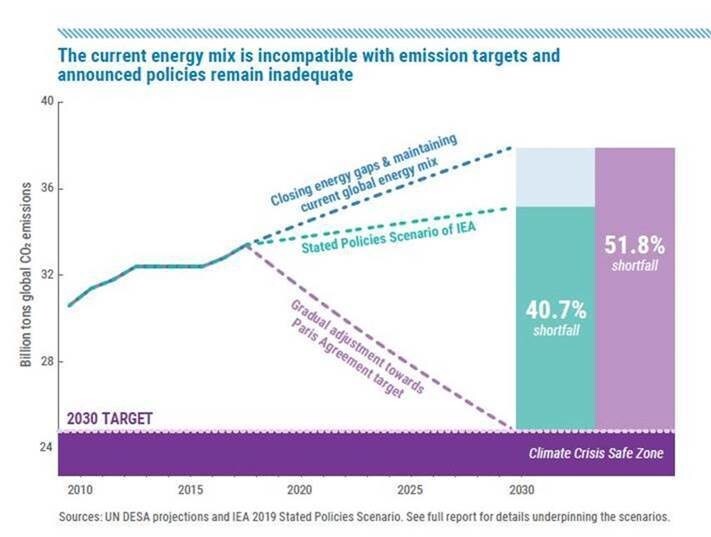
The only way to decisively break the connection between greenhouse gas emissions and economic activity is to change the energy mix, the report says, calling for a much greater emphasis on renewables and other low-carbon energy sources.
The energy sector currently accounts for three-quarters of global greenhouse gas emissions.
But if per capita emissions in developing countries were to rise towards those in developed economies, global carbon emissions would increase by more than 250%.
This is in stark contrast to the global goal of reaching net zero emissions by 2050.
Time for policy change
The World Economic Situation and Prospects 2020 report also warns that current policy decisions are often shortsighted, and that the urgency of the energy transition continues to be underestimated.
How is the World Economic Forum facilitating the transition to clean energy?
The Centre for Energy and Materials connects leaders to make sense of the complex transitions reshaping energy, materials and industrial systems. It provides a platform to explore how energy security, affordability and sustainability intersect.
Through collaboration across value chains and regions, the Centre enables shared pathways that help partners align around practical solutions for a secure, low-carbon and equitable transition.
For example, expanding investment in oil and gas exploration and coal-fired power generation leaves investors and governments exposed to sudden losses, as well as posing substantial setbacks to environmental targets.
Any delay in decisive action towards the energy transition could double the eventual costs, the report says.
The warning comes a day after the IMF unveiled its forecast for the global economy at Davos, and said the impact of climate change - including bushfires in Australia, hurricanes in the Caribbean and floods in eastern Africa - is already dampening growth.
However, the UN report remains optimistic that economic growth can run in tandem with limiting carbon emissions - so long as there is a shift in the energy mix.
Climate change and how to shift the world economy to a sustainable model are key themes at the World Economic Forum's Annual Meeting in Davos.