
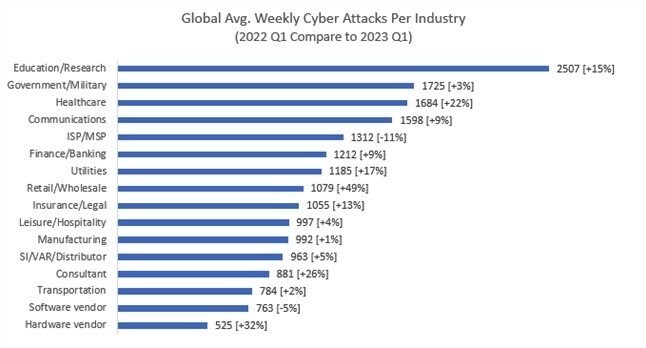
The education and research sector is the most frequent target of cyberattacks.
The sector suffered an average of 2,507 attacks per week in Q1 2023, a new study says.
Other targeted sectors include healthcare, the military, banking and retail.
A cybersecurity skills gap is leaving organizations vulnerable to attacks, finds a World Economic Forum report.
Advances in technology including artificial intelligence are giving cybercriminals new ways to mount attacks.
While no industry is safe, new research has revealed which sectors are under the greatest threat. Analysts at checkpoint.com found that education and research organizations faced the highest number of cyberattacks in Q1, 2023. The data shows the sector faced “an average of 2,507 attacks per organization per week, marking a 15% increase compared to Q1 2022”.
Checkpoint’s study suggests many educational institutions are still struggling to secure their systems following the switch to remote learning during the pandemic.
The data shows that the government/military sector is also being heavily targeted by cybercriminals, with attacks spiking at 1,725 in the first quarter of 2023. That’s an increase of 3% on the previous year. Healthcare, communication and banking are also frequent targets for cyberattacks.
What is the World Economic Forum doing on cybersecurity?
The Centre for Cybersecurity provides a trusted platform where leaders come together to make sense of evolving cyber risks and their systemic implications. It focuses on building understanding and trust in an increasingly interconnected digital world.
By enabling cross-sector collaboration and insight sharing, the Centre helps partners strengthen cyber resilience and address challenges that require collective responses.
The cybercrime risk landscape
Advanced technology is just one factor behind the growing risk of cybercrime. The World Economic Forum’s Global Cybersecurity Outlook 2023 lists geopolitical instability and a lack of talent to fill vacant security jobs as major drivers of online crime.
The Forum’s research suggests business leaders are alive to the cyber-threats related to geopolitical risks, but IT security leaders in business frequently struggle to fully articulate the scale of the threat. Despite that, the report finds a willingness to make changes to mitigate the biggest risks.
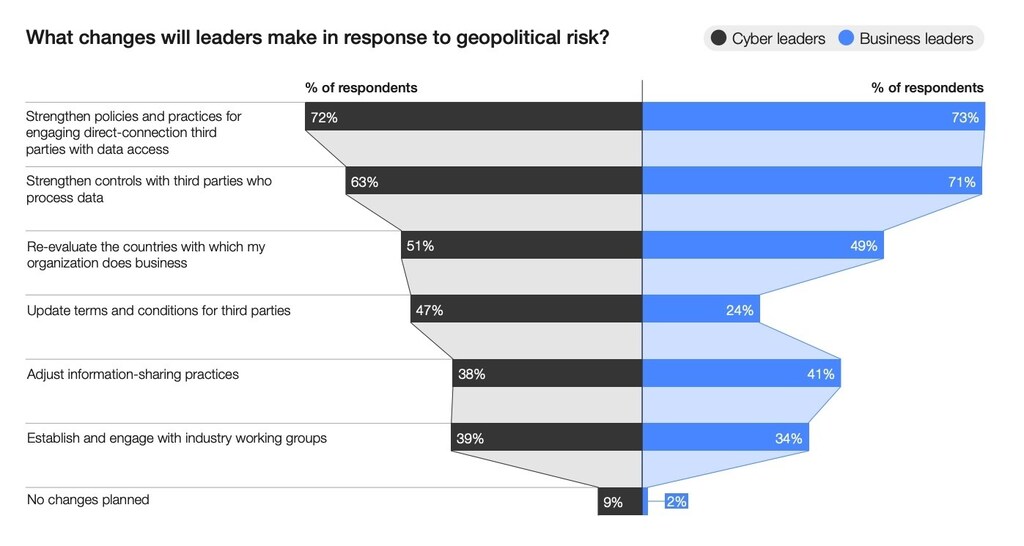

More than 70% of business leaders and cyber leaders recognize the need to tighten up policies around third-party access to data. There’s also broad agreement on re-evaluating which countries to do business with. Alignment between the two sets of leaders falls when it comes to engaging with wider industry to confront the danger of cybercrime.
The report urges leaders “to think more deeply about cybersecurity and listen more intently to cyber experts, and to each other, in order to ensure our shared resilience”.