Today there are 323 million people considered rich worldwide, 4% of the global population, but they account for 36% of all consumer spending.
They are heavily concentrated: the US alone is home to 44% of them, and 74% live in OECD countries.
The next decade's new wealth will overwhelmingly come from India, China and other emerging markets.
The geography of global spending is changing. And while many people think that it is the ultra-wealthy who spend the most money around the world, it’s actually an emerging global middle and wealthy class who are set to dominate the global economy.
Today and in the future, the real business opportunity won’t be with the world's more than 3,300 billionaires or its 58 million millionaires. Consumer spending is driven by a far broader group of “rich people”, and a global middle class that is now more than four billion people strong.
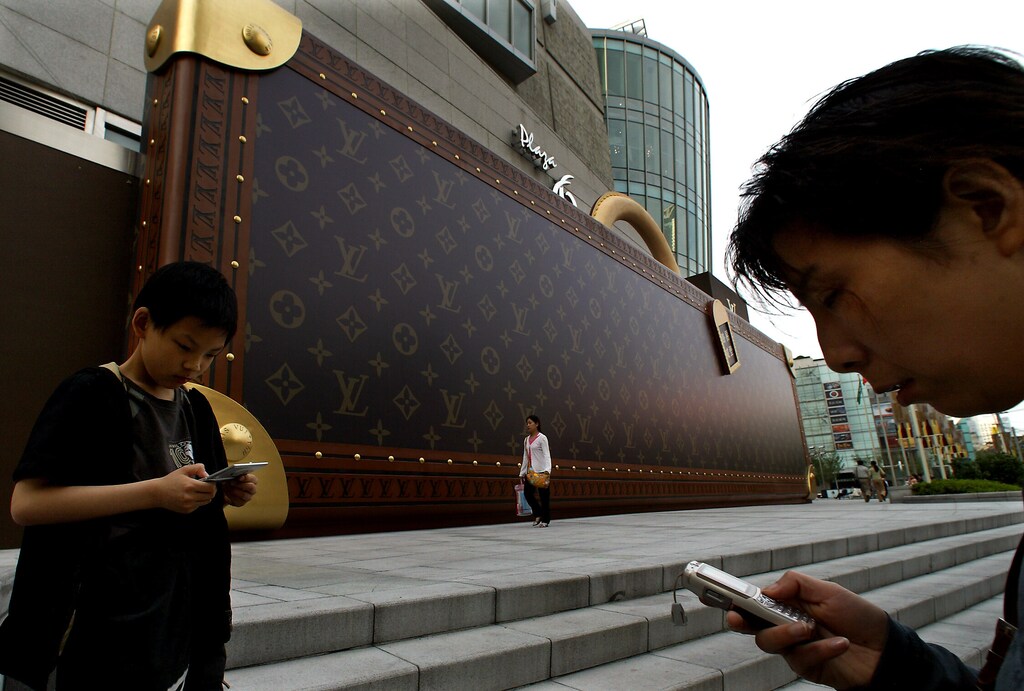
At World Data Lab, we track this wider group of people who can afford an affluent life. They may not own a mansion or a private jet, but they can comfortably afford a Louis Vuitton bag, a premium car and a luxury holiday. Their story will be one that defines the global economy in the coming decade.
Who are the global rich, really?
World Data Lab defines a rich person as anyone who spends more than $130 a day (in 2021 purchasing power parity), which is ten times the entry point to the middle class, a threshold the economist Homi Kharas defines in The Rise of the Global Middle Class. As a simple way to visualize and quantify the lives of the wealthy, the middle class and the poor:
The rich live without financial worry. They hardly need to make any financial trade-offs.
The middle class needs to make choices. A holiday this year, or a new car or saving for the children's education, but not all three.
The poor don’t have these choices. They just focus on making ends meet and spend almost everything on food, housing, clothes and transport.
Contrary to common perception, the “rich” don’t entirely dominate the global economy, but they play a disproportionate role. There are around 323 million rich people worldwide today, spending $25 trillion. That means just 4% of the world's population accounts for 36% of all consumer spending. The world’s 55 million millionaires will spend around $10 trillion in 2026, well under half as much, meaning that the spending power that matters most is spread across the far broader population of the rich.
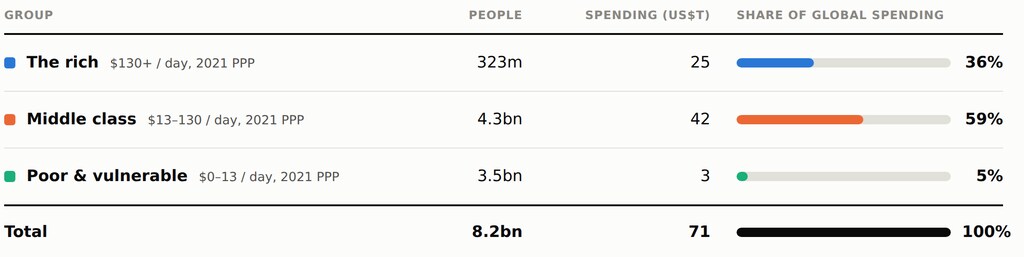
Based on current trends, the number of rich people is growing. Their growth is steady and substantial. By 2036, the rich will add 213 million more people and $22 trillion in spending, while the middle class will add 990 million more people and $21.5 trillion. This means that while the middle class will add 4.6x as many people as the rich, both groups will generate about the same amount of additional consumer spending. The world will pass 500 million rich people in 2035 and approach one billion in 2050, nearly tripling in one generation.
The geography of affluence is one-sided
In 2026, almost every second rich person in the world (44%) is an American, and 74% of the rich live in OECD countries. The rich generate 72% of all consumer spending in the United States and 49% across the OECD as a whole, compared with around 12% in emerging markets. For any company selling luxury goods, close to 88% of the world's affluent spending still takes place in high-income countries (OECD).
Today, 3.5 billion people, 42.8% of the world, live below the consumer class line and are defined by World Data Lab as vulnerable and poor. By 2036, the group falls to 2.9 billion, 33.3% of the world. Asia is home to 58% of this group today and Africa 34.7%; by 2036 Asia will be at 45.8% and Africa at 46.9%. While Asia holds the majority of the world's poor today, it will not in a decade's time, and global poverty statistics will become increasingly concentrated in Africa.
Africa’s rising share is mostly the result of population growth. The share of Africans who are considered Vulnerable and Poor is expected to fall over the next decade, from 78% to 72%. But Africa’s population is expected to grow by 380 million over the same period, so the absolute number is still expected to rise, from 1.21 billion to 1.38 billion.
The new rich are emerging in Asia
However, the geography of the rich is changing fundamentally. New customers will overwhelmingly be in emerging markets, especially Asia. India’s rich population will expand by 41m – from approximately 5 million today to almost 46 million in 2036. That huge growth couples with strong increases in the USA (+29m), China (+ 28m), Egypt (+9m), Indonesia (+8m) and Turkey (+7m).
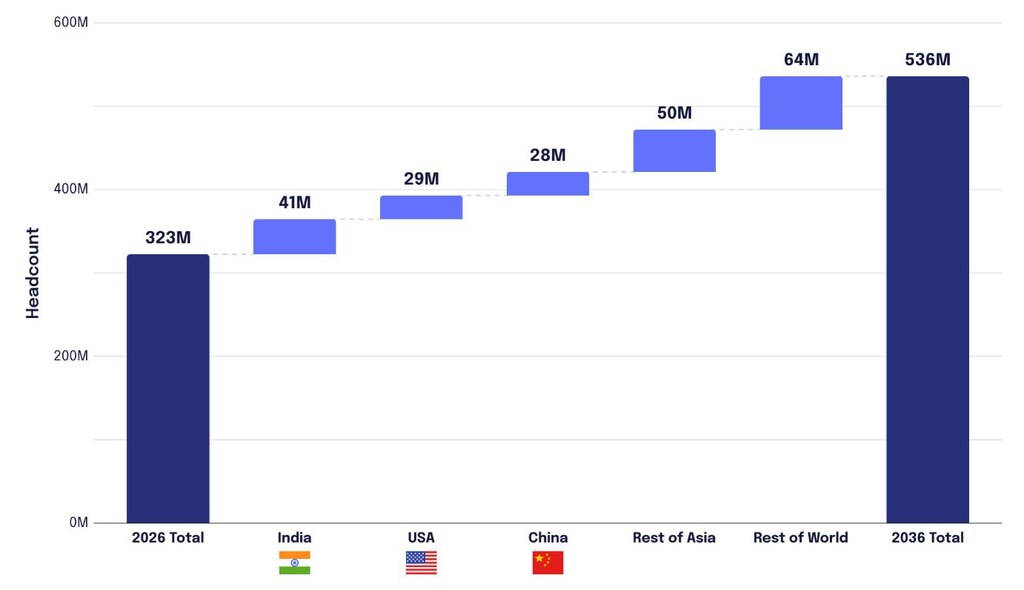
The implication for business is a dual strategy. Revenue today comes from the United States and the wider OECD, but over the next decade, a new affluent customer is increasingly likely to live in Asia.
Implications for global inequality
Contrary to what a rising number of rich people might suggest, the world has not been pulling apart. Global spending inequality has been falling steadily, with the global Gini coefficient falling from 0.70 in the year 2000 to 0.59 today. However, almost all of this improvement comes from convergence between countries, rather than within them. The world has become more equal because poorer countries have grown faster than richer ones, not because richer countries are more equal at home.
Within countries, the record is mixed. Consumption inequality fell in 138 of the 194 countries between 2000 and today, and rose in 56. It fell sharply in Mexico, Poland, Brazil, Indonesia and India, and it rose in Egypt, China, the United States and Germany.
Why measuring the rich matters
The rich are still a minority. They represent only 4% of the world’s population, but their number is rising fast. Within the next decade, there will be more than 500 million rich people in the world, driven by a new geography of affluence. A generation ago, rich people concentrated in a handful of cities in the United States and Europe; today it is within reach in Mumbai, Jakarta, Cairo and Istanbul, a sign that the path to prosperity is widening across far more of the world.