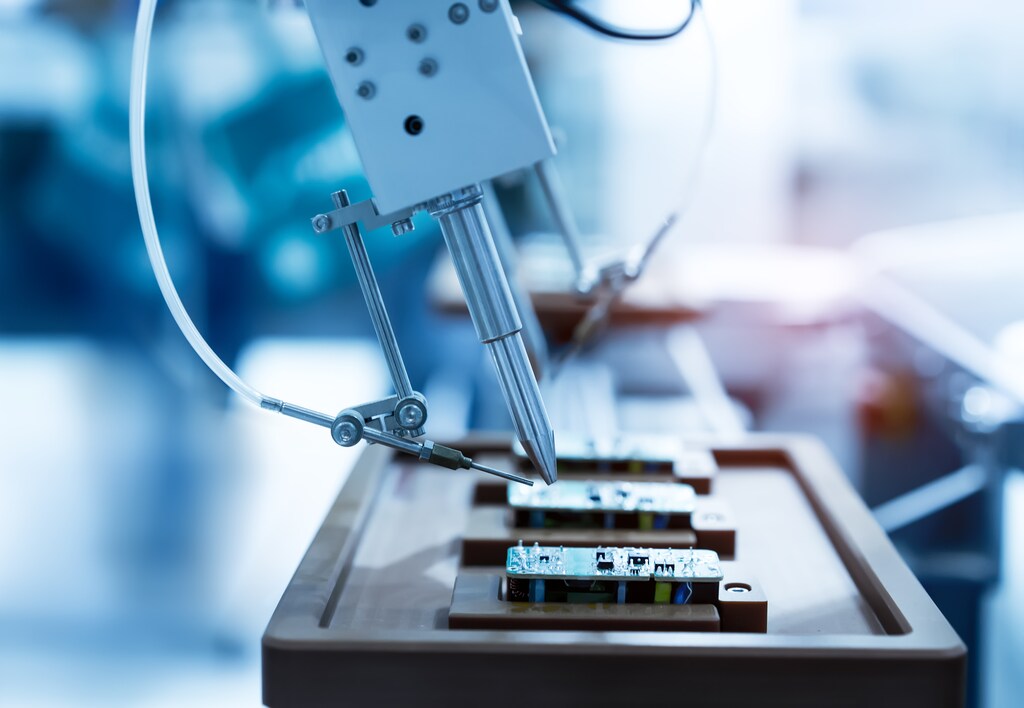
India is one of many countries investing in microchip manufacturing, but its facilities also need to be able to scale quickly and successfully to become integral to the global chip industry.
Governments everywhere are building chip industries, creating some of the largest industrial programmes of the modern era. The US has its CHIPS and Science Act, Europe has the Chips Act, Japan has Rapidus and India has the India Semi-Conductor Mission.
But investment alone does not determine whether a new semiconductor fabrication plant becomes a national capability or a stranded asset. What matters is the ability to run it at volume, on time and at good yield.
India has committed heavily to its chip industry. It has approved 12 manufacturing units across six states, with an investment pipeline that has scaled to roughly $17 billion. A further $485 million over three years will modernize the Semi-Conductor Laboratory (SCL) at Mohali – the country’s only fully integrated public foundry with privatization completely ruled out.
This is not a new strategy for India. The state-owned SCL in Mohali has produced chips for strategic space and defence needs for decades without achieving commercial scale, prompting New Delhi to commit to modernize the facility. The reasons for its earlier commercial struggles matter as much in Arizona, Dresden, and Kumamoto as they do in Mohali
The speed bottleneck in chip manufacturing
In the chip industry, factory capacity is just a number on a purchase order. What actually matters to designers and commercial buyers is cycle time – how long it takes a batch of silicon (the main semiconductor material used in chip manufacturing) to clear production.
Manufacturing a semiconductor chip is a highly complex process that can take up to 26 weeks. Structural limitations at SCL Mohali have also historically constrained domestic output for some non-strategic sectors. Part of the problem is that the production line currently operates as a "single string" with no backup equipment at critical bottlenecks. If a single piece of equipment breaks down, the entire factory grinds to a halt.
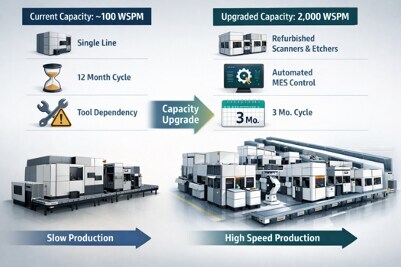
The previously mentioned $485 million government investment to modernize and expand the facility could resolve bottlenecks and ensure local innovators don't have to rely exclusively on foreign chips. The Chips to Start-up (C2S) programme shows this transition is already happening, with 56 student-designed chips successfully fabricated at SCL to date.
The clear takeaway for policymakers globally is simple: Measure the success of semiconductor subsidies by the number of wafers leaving the factory door, not by the billions pledged at company launch events.
The chip manufacturing quality trap
Another issue for SCL is that any success with test chips says little about the plant's ability to produce the larger chips that real-world products need. The bigger a chip, the more likely it is to contain a defect. The risk here is that yields can fall as chips get larger.
As previously mentioned, small batches of student-designed test chips were produced by SCL Mohali in 2025 and the plant reportedly produced around 10,000 chips for commercial use that same year.
Using older tools creates a structural strain for the lab, however. It currently spends approximately $14 million annually on equipment repair and maintenance alone. Again, the government's targeted modernization roadmap should overhaul the facility's toolset, addressing legacy bottlenecks and reducing long project delivery times.
Chip fabrication plants need strong process controls to ensure large chips are viable. Governments signing technology transfer deals must ensure capabilities for root-cause error analysis are developed alongside the basic chip manufacturing recipe.
Talent retention trumps recruitment
A severe worldwide workforce crunch is affecting the entire industry, creating another challenge for India's chip manufacturing sector. The US projects a shortfall of 67,000 semiconductor workers by 2030, while Deloitte expects the global industry will require more than 1 million additional skilled professionals over the same timeframe. This talent deficit is actively choking new fabs in the US and Taiwan, China, as well as in South Korea and Japan.
Interestingly, India's challenge is not a lack of raw talent. Industry estimates suggest the country is home to more than 120 semiconductor R&D centres and more than 50,000 engineers.
But a critical gap lies in mid-level operational leadership for chip manufacturing plants. SCL suffered a devastating fire in 1989, which disrupted the employment of some of its workforce. Since then, SCL has continued to struggle with talent retention, according to some reports.
On the other hand, SCL employees have spent decades producing chips for India’s space and strategic programmes. This has created a repository of institutional knowledge that money simply cannot buy.
Policymakers and plant owners should capitalize on this knowledge by ensuring these employees are involved in efforts to build and scale India's chip industry, clearing the path for the nation's technological ambitions.
Building a global chip manufacturing industry
India’s semiconductor journey is worth watching because it has already lived through the learning curve that other countries are just starting to encounter. The government has funded a state factory generously but, when managed like a bureaucratic department, such facilities can lead to slow, low-yield output and steep bills.
And so, the solution to the global chip manufacturing race is not more cash. Building the industry will require slashing factory cycle times, enforcing strict accountability for yield quality, retaining key mid-level talent and establishing a global clarity of purpose.