
A former company VP and COO offers insights on workplace awareness from her many years' experience as a tech executive.
Here, she outlines four work style preferences – the analyzer, director, promoter and collaborator – and the personality traits generally associated with them.
While it's dangerous to fall into stereotypes, such assessments can help create a company culture that recognizes and utilizes the different skills of all types of workers, she says.
Quartz at Work has already called awareness the meta skill for the future of work. We love to look at the three levels of awareness: self, other, and organizational. While there’s much more leaders and companies can do to make all three easier, we can’t get close to other-awareness or organizational-awareness without first strengthening the self.
Claire Hughes-Johnson, former Google VP and Stripe COO, agrees. In her new book, Scaling People, Johnson offers key insights from her 15+ years as a high-powered tech executive, including ways to build your own awareness of you, who you work with, and the organization you agreed to work for.
The 4 work style preferences
At a basic level, most work style and personality preference assessments plot you and your team on a continuum from introverted to extroverted and from task-oriented to people-oriented.
The point of such exercises is not to be deterministic about who you are or how you work, or, worse, to stereotype people, but rather to give you and your colleagues some shared language around your expressed preferences and to make you aware of some of the opposing poles of those leanings.
With the caveats that it’s dangerous to fall into stereotypes and that we’re all unique individuals, I think of the primary quadrants of all work style assessments this way:
Analyzer: introverted, task-oriented
The analyzer is very deliberate about decisions and constantly seeks data on which to base any action or reaction. As a result, they’ll be rigorous and prevent you from falling into an intuitive trap that lacks data-driven support. They have trouble acting without data, though, and because they’re task-oriented, they can be less good at collaboration, process building, and bringing people along with their decisions and actions.
Director: extroverted, task-oriented
Directors have strong opinions about the “right” answer and a bias toward rapid action because they care a lot about getting to the proper outcomes quickly. They’re great at establishing a vision but want everyone to align with it. They often do the work themselves because they don’t enjoy building processes and feel confident about exactly what steps need to be taken, which can disempower others.
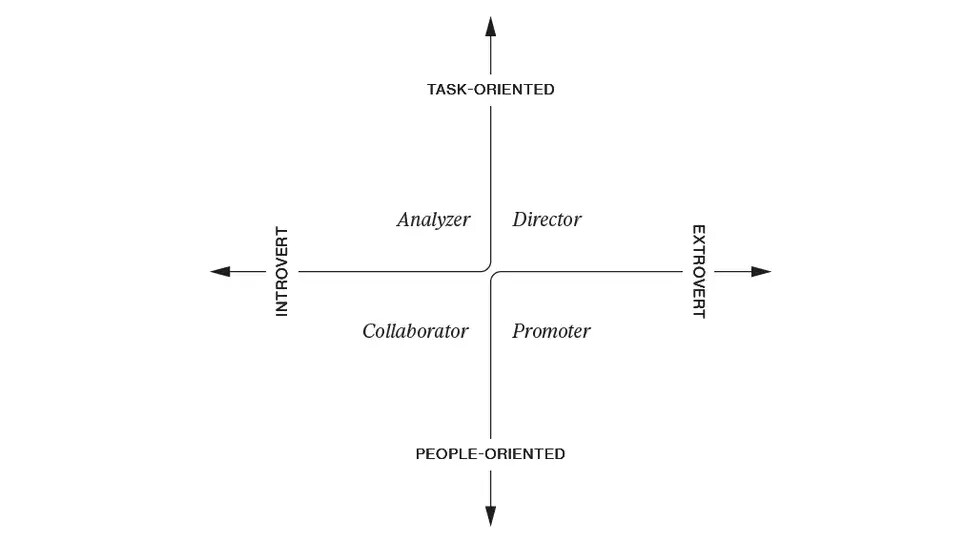
Promoter: extroverted, people-oriented
These talented individuals are charismatic and people-oriented. They have a lot of ideas and the ability to articulate an inspiring narrative. They don’t like details or administration, and they’re usually great starters but not always finishers. They can see the big picture and excel at inspiring others and building relationships.
How is the World Economic Forum promoting equality in the workplace?
The Future of Jobs Report 2023 found that 75% of companies surveyed expect to adopt AI, big data and cloud technologies in the next five years.
The Centre for the New Economy and Society provides a platform for leaders to share insights on the adoption and efficacy of new technologies, and the readiness of the workforce to use them. Our work includes developing insights and dialogue on growth, jobs, skills, equity and risks.
Learn more about our impact:
Gender parity: Since 2006, we have annually measured the state and evolution of gender parity in 101 economies, supporting decision-makers to identify the most effective policies to close gender gaps. In Chile, we helped establish gender parity accelerators and benefitted 728,000 women – reducing the gender gap by 37% in the participating companies.
Reskilling Revolution: With our partners, we are helping the global workforce future-proof their careers, working with over 350 organizations to provide 1 billion people with better education, skills and economic opportunities by 2030.
Disability inclusion: Working with the Valuable500, we are collaborating with the largest global network of CEOs committed to closing the disability inclusion gap. Members are making progress by increasing the adoption of digital accessibility best practices and including disability in diversity, equity and inclusion strategies.
Racial justice: We are collaborating with a global coalition of 55 organizations in 13 industries who are committed to building equitable and just workplaces for professionals from under-represented racial and ethnic identities.
Want to know more about our centre’s impact or get involved? Contact us.
Collaborator: introverted, people-oriented
These employees care a lot about the customer, be it an internal customer (an employee at the company) or an external one (a product user). Given this inclination, collaborators often build great systems to bring others along. Conversely, people-oriented builders tend to overcomplicate things because they don’t want to leave anyone out. They may create a process everyone can agree on, but that doesn’t benefit the organization. For example, you might end up with a process in which practically everyone on a team gets to meet a job candidate, but the time in process for that candidate might be 90 days.

Pay attention for progress
None of these work style preferences is objectively better or worse than the others. Often, however, one might be better or worse in specific circumstances. For example, during a technical outage, you want to have systems in place that allow a small set of individuals to make a lot of big decisions quickly. You may not care that much about getting longer-term buy-in from others because you need action to be taken immediately. You need a director. If you’re trying to build a planning process that enables you to decide what teams are going to work on for the next year, you probably want to build something that will endure and help people understand the importance of the work. You could do all the planning yourself with a select group of people you trust, but that would mean leaving out the people who actually have to do the work. Plus, you wouldn’t be helping them develop the skills they need for future planning cycles. You need a collaborator, and probably a promoter, too.
Much of this dimension of self-awareness comes down to paying attention. Consider when you feel energized, when you feel drained, and when you feel like you’re reaching new heights at your job or hitting new lows. You’ll start to see patterns. If you have trouble trusting your own instincts, ask someone whose judgment you respect: When have you seen me do my best and worst work? This increased awareness helps an individual execute better.
Claire Hughes-Johnson, author of Scaling People: Tactics for Management and Company Building, is a corporate officer and advisor for Stripe, a global technology company that builds economic infrastructure for the internet. She previously served as Stripe’s COO, helping the company grow from fewer than 200 employees to more than 7,000.
Prior to Stripe, Claire spent 10 years at Google leading various business teams, including overseeing aspects of Gmail, Google Apps, and consumer operations. She is a board member at Hallmark Cards, The Atlantic, Ameresco, and HubSpot. Claire also serves as a trustee and the current board president of Milton Academy.