How commercial mobility is driving the new space race
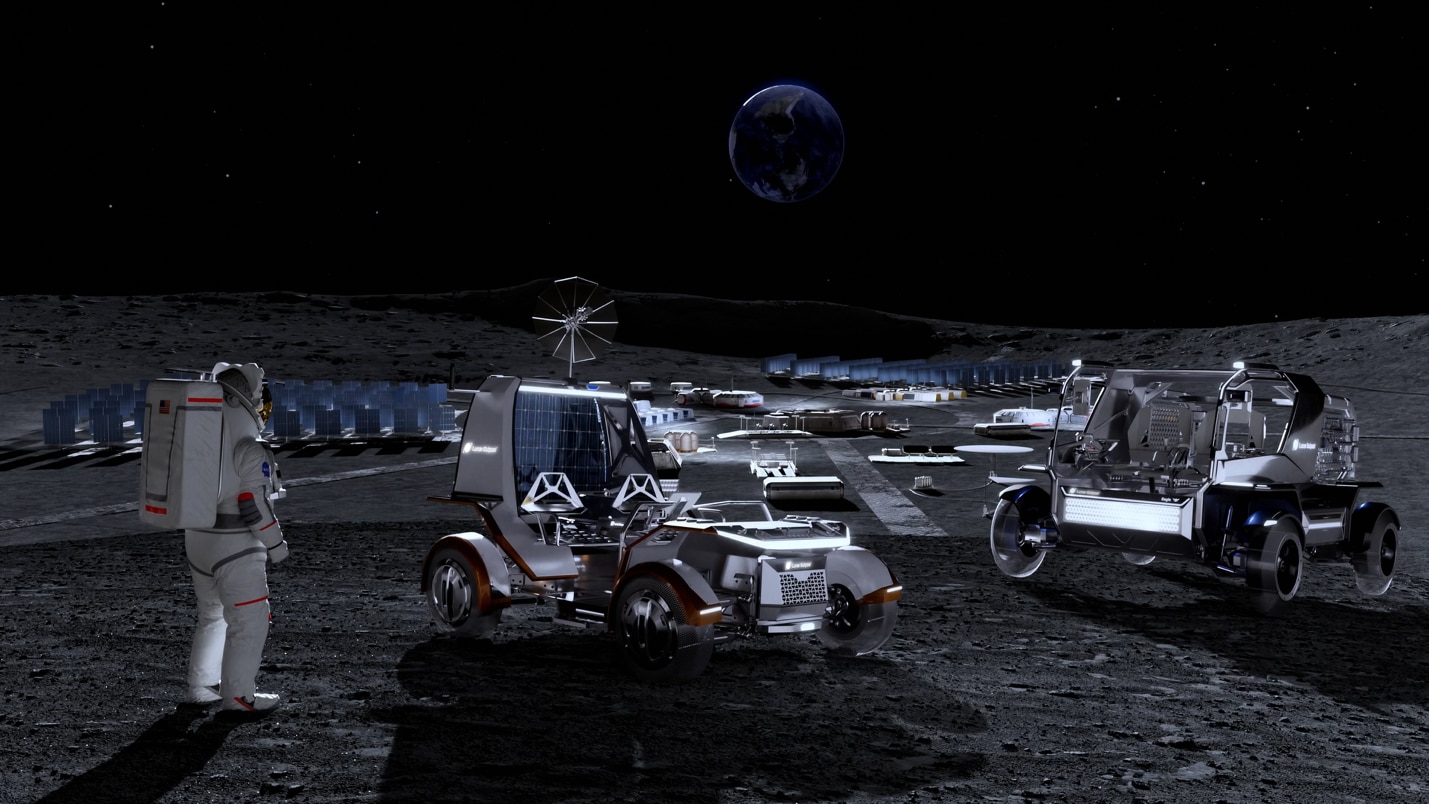
Landing astronauts on the Moon was an extraordinary achievement; building a permanent presence there is an entirely different challenge. Image: Lunar Outpost
- Record capital is shifting lunar exploration from brief visits to permanent surface infrastructure.
- Commercial mobility platforms provide the core foundation for surface construction and logistics.
- Service-based partnerships with private industry are establishing a multi-trillion-dollar space economy.
Fifty years after the Apollo missions, NASA’s Artemis programme marks a new era of space exploration: shifting the conversation from short-duration missions to permanent operations on the Moon. A permanent lunar presence sets the foundation for accessing space resources, developing new technologies and commercial models, and bringing their benefits back to Earth.
These ambitions are backed by unprecedented capital. Private investment in space hit a record $55.3 billion in 2025, up 65% from 2024, as investors and companies increasingly focus on practical space infrastructure, data and services. NASA has also doubled down, with plans to invest $20 billion over seven years to develop a Moon Base where humans can live and work on the lunar surface.
Yet building a base requires an entirely new approach to exploration. For decades, the defining question of lunar exploration was: How do we get there? Today, the industry is asking: How do we stay?
Landing astronauts on the Moon was an extraordinary achievement; building a permanent presence is an entirely different challenge. If rockets and landers are how humanity reaches the Moon, mobility is what enables sustained operations across it – supporting infrastructure, commerce, science and resource utilization while building capabilities for Mars and beyond.
The evolution of lunar mobility
The Apollo programme in the 1960s and 1970s demonstrated that mobility fundamentally changes what is possible beyond Earth. The Lunar Roving Vehicle allowed astronauts to travel farther from their landing sites, carry tools and samples, and expand the scientific return of each mission.
Across those missions, Apollo rovers travelled over 55 miles on the lunar surface. These rovers were transformative for their time, but they were designed for a very different era of exploration – short missions, limited payloads and no expectation of returning to the same locations to build lasting infrastructure. Today, Artemis requires vehicles that can support repeated operations, heavier payloads and autonomous work between crewed missions.
That means a new generation of mobility designed for permanence; exploration and science; but also construction, logistics and prospecting for resources – with a robotic workforce continuously building.
How Artemis raises the stakes
NASA’s blueprint for Moon Base envisions landers, lunar terrain vehicles and drones operating near the lunar South Pole, even before astronauts arrive. Its Lunar Terrain Vehicle programme asks commercial providers to deliver crew transportation alongside remotely operated infrastructure, science and logistics services.
Vehicles designed for this paradigm, such as Lunar Outpost’s Pegasus LTV, must transport astronauts while operating in extreme thermal conditions and working autonomously between crewed missions. Mobility becomes far more than a mode of transportation: it becomes the platform for construction, maintenance, communications, power and resource extraction.
Building and scaling these systems requires diverse expertise. For Pegasus, Lunar Outpost is leading a team of partners that calls back to the Apollo era: General Motors brings advanced electrification expertise; Goodyear contributes wire mesh wheels for extreme terrain; and Leidos adds systems integration and mission engineering experience. It is a collaborative effort showing how the future of space will be shaped by an ecosystem pushing boundaries together.
A new economy
The next era of space exploration will be defined by the markets that take shape as we establish a permanent presence. Recent estimates value the space economy at $686 billion, with expectations to reach $1.8 trillion by 2035. That growth will extend well beyond traditional aerospace into transportation, digital communications and logistics.
Apollo offered an early glimpse of that commercial potential when the Omega Speedmaster transitioned from a NASA-qualified mission tool to a global brand story. Artemis and modern commercial space are expanding that model across far more industries.
For example, rather than developing and owning every system, NASA is increasingly purchasing services from commercial providers. Through programmes like Commercial Lunar Payload Services, companies retain ownership of their landers and rovers, selling capacity – including transportation, power and data transmission – to NASA and commercial customers alike. Government serves as the anchor customer, while industry develops assets and business models to support a broader market.
Lunar Outpost demonstrated this approach with the MAPP (Mobile Autonomous Prospecting Platform) rover during Lunar Voyage 1, carrying payloads for partners such as Nokia and MIT to showcase how commercial platforms grant broad access to the lunar surface. Similar service models are accelerating across the sector, from Firefly Aerospace providing end-to-end lunar delivery to Nokia adapting terrestrial 4G/LTE technology for lunar communications networks. Other Lunar Outpost collaborations with LEGO on a rover set and adidas/Juventus on an apparel collection demonstrate how lunar innovation can also extend into consumer products, education and culture.
The next giant leap
The Moon is where humanity learns how to operate beyond Earth. Every capability developed there – from mobility and autonomous operations to thermal management and remote robotics – reduces the technical and operational risk of future missions to Mars and beyond.
It is also where the business models for an expansive space economy beyond Earth orbit will be proven. A permanent presence allows companies and governments to learn how to deliver services, sustain operations and make use of space resources. Water ice could support life and propulsion; helium-3 could fuel advanced fusion systems; and in-space building materials will enable permanent lunar and Martian outposts.
Investment in space has repeatedly transformed society. Apollo’s demand for compact, reliable integrated circuits helped accelerate semiconductor production and sparked the computing revolution, while government space programmes gave rise to GPS and modern weather forecasting.
History will remember Artemis for returning humans to the Moon. Its larger legacy will be proving that humanity can establish a permanent presence beyond Earth and unlock the resources of space for the betterment of life on our home planet.
Lunar mobility connects exploration to infrastructure, infrastructure to economic activity, and the Moon to humanity’s next destinations deeper into space. The next giant leap for humanity depends on it.
Don't miss any update on this topic
Create a free account and access your personalized content collection with our latest publications and analyses.
License and Republishing
World Economic Forum articles may be republished in accordance with the Creative Commons Attribution-NonCommercial-NoDerivatives 4.0 International Public License, and in accordance with our Terms of Use.
The views expressed in this article are those of the author alone and not the World Economic Forum.
Stay up to date:
Space


Forum Stories newsletter
Bringing you weekly curated insights and analysis on the global issues that matter.
More on Emerging TechnologiesSee all

Reese Wong
September 15, 2026