Just two countries, China and the US, are responsible for more than 40% of the world’s CO2 emissions.
With CO2 levels still on the rise, being able to track the global emissions hotspots is becoming more important than ever. Before the industrial revolution, levels of atmospheric CO2 were around 280 parts per million (ppm). By 2013, that level had breached the 400ppm mark for the first time.
On 3 June 2019 it stood at 414.40ppm.
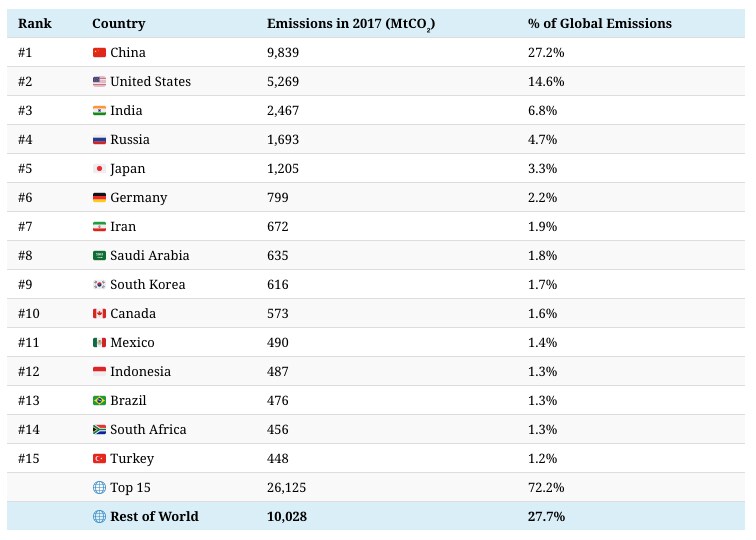
There are huge disparities between the world’s top 15 CO2 emissions-generating countries. China creates almost double the emissions of second-placed US, which is in turn responsible for more than twice the level of third-placed India.
How is the World Economic Forum facilitating the transition to clean energy?
The Centre for Energy and Materials connects leaders to make sense of the complex transitions reshaping energy, materials and industrial systems. It provides a platform to explore how energy security, affordability and sustainability intersect.
Through collaboration across value chains and regions, the Centre enables shared pathways that help partners align around practical solutions for a secure, low-carbon and equitable transition.
Collectively, the top 15 generate 72% of CO2 emissions. The rest of the world’s 180 countries produce nearly 28% of the global total – close to the amount China produces on its own.
Of course, aggregating emissions by country is just one way of assessing the problem and working out how to counter it. The per capita figures tell a different story.

Here, China doesn’t even make the top 20. The per capita No 1 spot goes to Qatar, with Gulf States making up 3 of the top 4. The US is ranked 8th, behind Australia at 7th.
Looking at per capita figures rather than national-level totals could help bring the reality of the climate crisis closer to individuals. For example, a person may feel their decision to use less-polluting forms of transport is pointless in comparison to the colossal Chinese and American CO2 figures.
But seeing how population size alters the rankings, and where their country appears, may encourage people to see a connection between their actions and the results they can help bring about.