With the absence of Russia's natural gas, Europe has noticed a shortage of energy leading to a boost in heating bills.
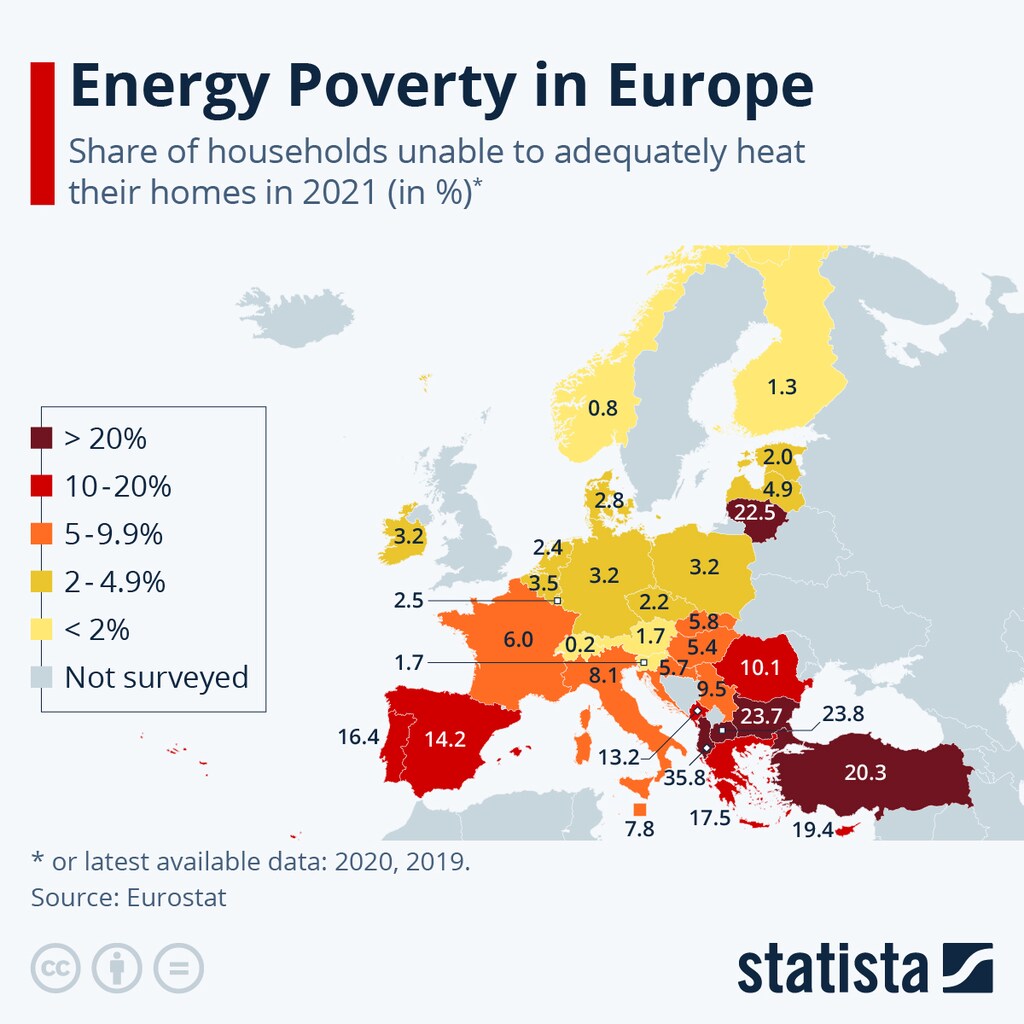
In the European Union, nearly 7% of the population was not able to heat their home properly in 2021.
The country most affected by fuel poverty was Bulgaria followed by Lithuania and Cyprus, according to Eurostat data.
Europe has a tough winter ahead. Without Russian natural gas, the bloc has a shortage of energy. This has ratcheted up heating bills, and as we’ve already seen, it’s households bearing the brunt of the costs. In the UK alone, one in three households are expected to be pushed into energy poverty this winter.

However, even before the energy crisis began, having a sufficiently heated home was not a given for everyone. In the European Union, nearly seven percent of the population was not able to heat their home properly in 2021. As our graph based on Eurostat data shows, the country most affected by fuel poverty was Bulgaria, where nearly one in four people (23.7 percent) were affected last year, followed by Lithuania (22.5 percent) and Cyprus (19.4 percent).
The lowest rates were recorded in Switzerland (0.2 percent) and Norway (0.8 percent). By contrast, countries in southern Europe showed a higher share of people unable to heat their homes properly in 2021. The European average was 6.9 percent. When data for 2022 comes out, we can expect these figures to be worse.
How is the World Economic Forum driving the energy transition?
The Centre for Energy and Materials connects leaders to make sense of the complex transitions reshaping energy, materials and industrial systems. It provides a platform to explore how energy security, affordability and sustainability intersect.
Through collaboration across value chains and regions, the Centre enables shared pathways that help partners align around practical solutions for a secure, low-carbon and equitable transition.