Urgent action is needed to combat the climate crisis and ensure energy security.
Buildings offer more energy saving potential than industry or transport.
Retrofitting existing buildings could reduce their energy intensity by almost 40%, according to the World Economic Forum’s Transforming Energy Demand report.
Making buildings more energy efficient offers the potential to reduce global energy demand by 12%. That’s a key finding in the 2024 edition of the World Economic Forum’s Transforming Energy Demand, released to coincide with the Forum’s Annual Meeting in Davos.
The report looks at the energy saving potential of three sectors; industry, transport and buildings. Together, these sectors currently represent 94% of global energy demand.
The key metric in the study is energy intensity, a measure of the energy required to produce each unit of gross domestic product. The research shows that buildings have the biggest energy-saving potential of the three sectors.
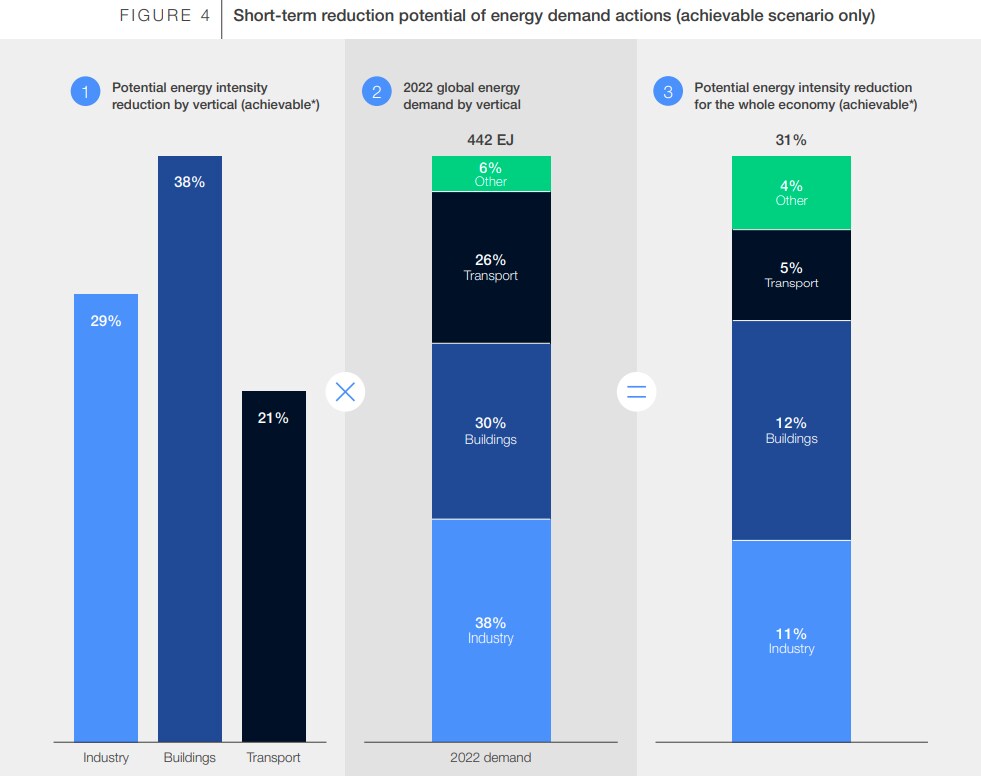
In 2022, buildings consumed 30% of the world’s energy. Industry used a 38% share with transport swallowing up 26% of total supplies.
When it comes to energy-saving potential, buildings are out in front with the possibility to reduce energy intensity by 38%. If those savings were achieved in full, global energy demand would be reduced by 12%.
5 ways to save energy in older buildings
Retrofitting older buildings will be key to unlocking the full energy saving potential of the buildings sector. As the report states; “75% of the buildings that will be standing in 2050 already exist”.
The cost of retrofitting buildings remains a barrier to progress, but innovative approaches to financing the renewal of energy and insulation systems could accelerate progress. They include:
1: Interest-free energy efficiency financing schemes, with repayments made via energy bills over a maximum of five years.
2: The development of energy-as-a-service models would eliminate upfront costs. They would also enable energy suppliers and customers to share the benefits and allow co-investment between building occupants.
3: Providing risk insurance policies to be held jointly by property owners, retrofitters and insurers would remove barriers created by parties feeling they have a lack of agency in the process.
4: Cooperation with city authorities, technical colleges and universities to ensure the availability of a skilled talent pool to carry out retrofitting projects.
5: Collaboration within regional industrial ecosystems to ensure a ready supply of materials and recycling services for material removed during retrofitting.
Beyond energy benefits
Retrofitting older buildings brings benefits beyond saving energy. The report identifies additional advantages including; reducing staff sickness by 20%, improving employee productivity (up to $7,500 per person per year) and the creation of 3.2 million new jobs per year. Additionally, asset values of retrofitted buildings increase by approximately 15%.
When it comes to pushing the energy transition forward, existing real estate presents a major opportunity that comes with benefits for a wide range of stakeholders.

How is the World Economic Forum facilitating the transition to clean energy?
The Centre for Energy and Materials connects leaders to make sense of the complex transitions reshaping energy, materials and industrial systems. It provides a platform to explore how energy security, affordability and sustainability intersect.
Through collaboration across value chains and regions, the Centre enables shared pathways that help partners align around practical solutions for a secure, low-carbon and equitable transition.