Businesses are adopting more inclusive-language practices and are undertaking other allyship efforts to attract a more diverse workforce.
But many members of the LGBTQ+ community still report feeling vulnerable, underrepresented and unable to bring their whole selves to the workplace, new McKinsey research shows.
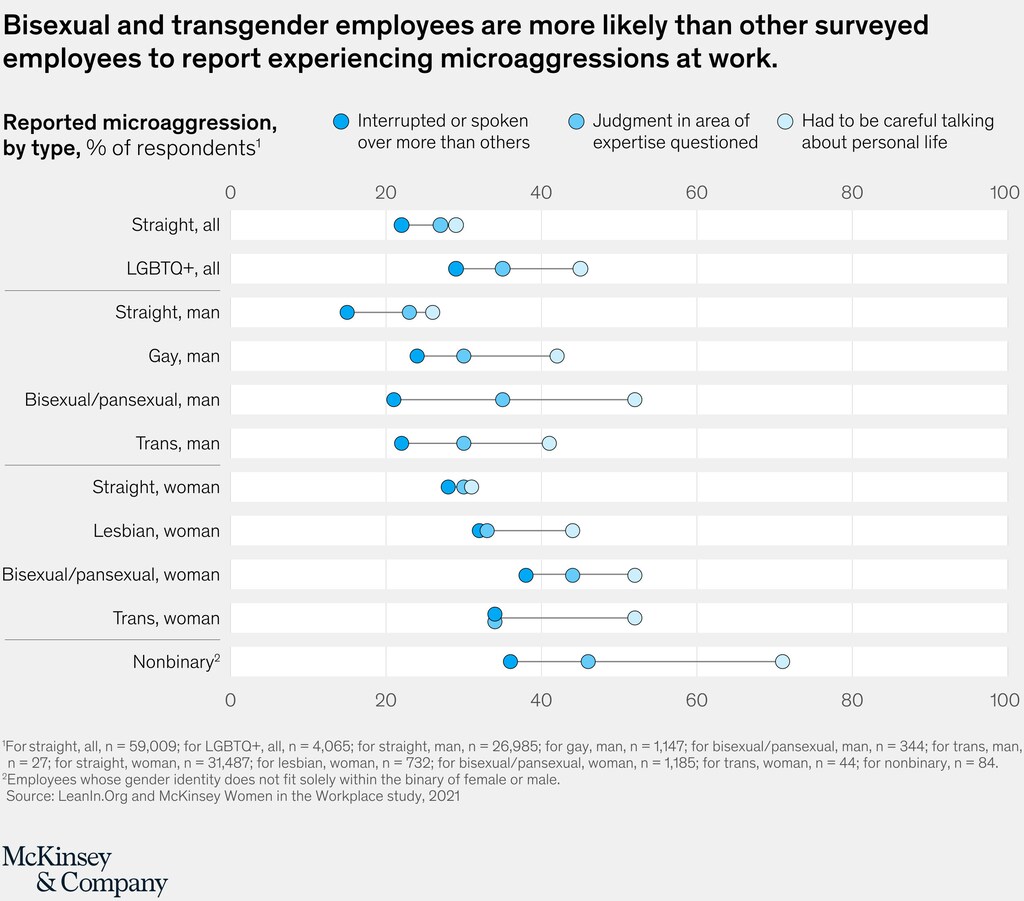
Nearly one-third of surveyed LGBTQ+ employees reported experiencing a microaggression, such as being interrupted or talked over.
Active allyship by all employees is vital for creating an inclusive environment in the workplace.
LGBTQ+ visibility has become more common in the media and across the private and public sectors in the United States in recent years. To keep up, businesses are becoming more adept at adopting inclusive-language practices and undertaking other allyship efforts to attract a more diverse workforce.
Despite these moves, there is a disconnect, as many members of the LGBTQ+ community report feeling vulnerable, underrepresented, and unable to bring their whole selves to the workplace, according to our research. And the issues that the community faces are as pressing as ever: there have recently been movements across the United States to limit the rights of the LGBTQ+ community and particularly those of transgender individuals.
McKinsey’s studies have helped uncover nuances in the experiences of the LGBTQ+ population. Our research analyzed data from the United States and includes responses from more than 4,000 LGBTQ+ employees among the more than 60,000 employees surveyed across industries, occupations, and geographies. The results highlight the need for companies to gain better understanding of and provide support for the populations that they employ. The following are some of the most striking findings.
Often an ‘only’
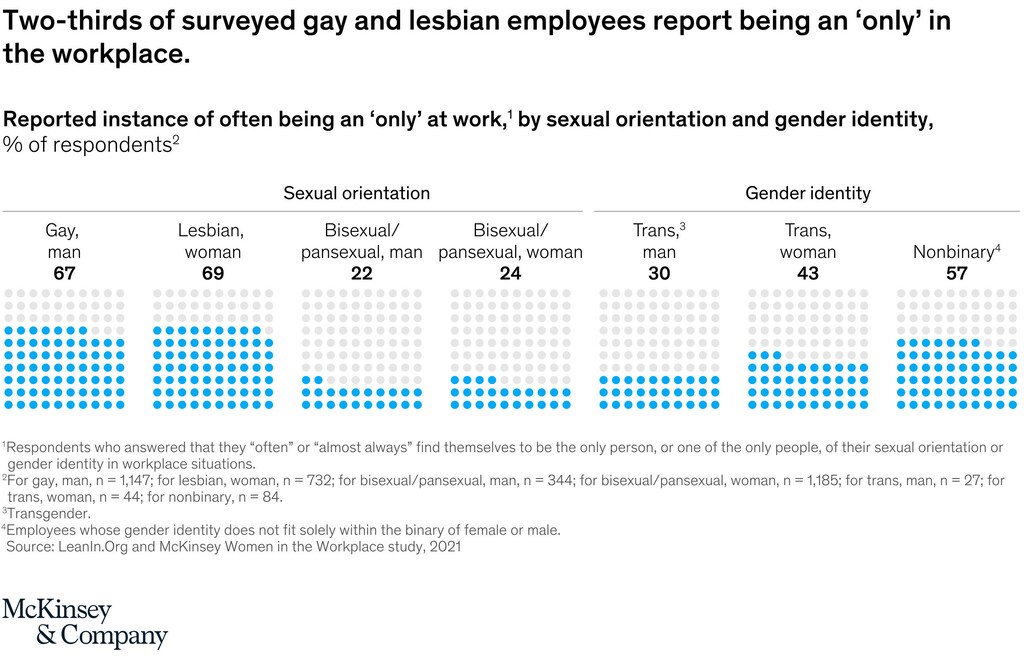
Allyship plays a crucial role within a workplace to ensure that LGBTQ+ employees don’t feel excluded or isolated. Members of underrepresented groups often report feeling left out or alone among the majority in any setting. For LGBTQ+ employees, our research showed that more than half of gay, lesbian, and nonbinary employees had stronger feelings of being an “only” (only person, or one of the only people, of their sexual orientation or gender identity) in the workplace than other employees did. And 45 percent of surveyed workers who identify as LGBTQ+ said they felt they had to be careful about discussing their personal lives in the workplace. While our data suggests that transgender employees are not as likely to perceive being the only of their gender identity, being the only transgender person in the workplace is a phenomenon they would experience on a much more frequent basis.
On guard against microaggressions
Nearly one-third of surveyed LGBTQ+ employees reported experiencing a microaggression, such as being interrupted or talked over, at the workplace. This figure jumps, however, depending on the different subsets within the LGBTQ+ community. For instance, as with straight employees, gender intersectionality matters—LGBTQ+ women and transgender employees were more likely than gay men to report experiencing microaggressions in the workplace.
Hybrid work may pose additional difficulties
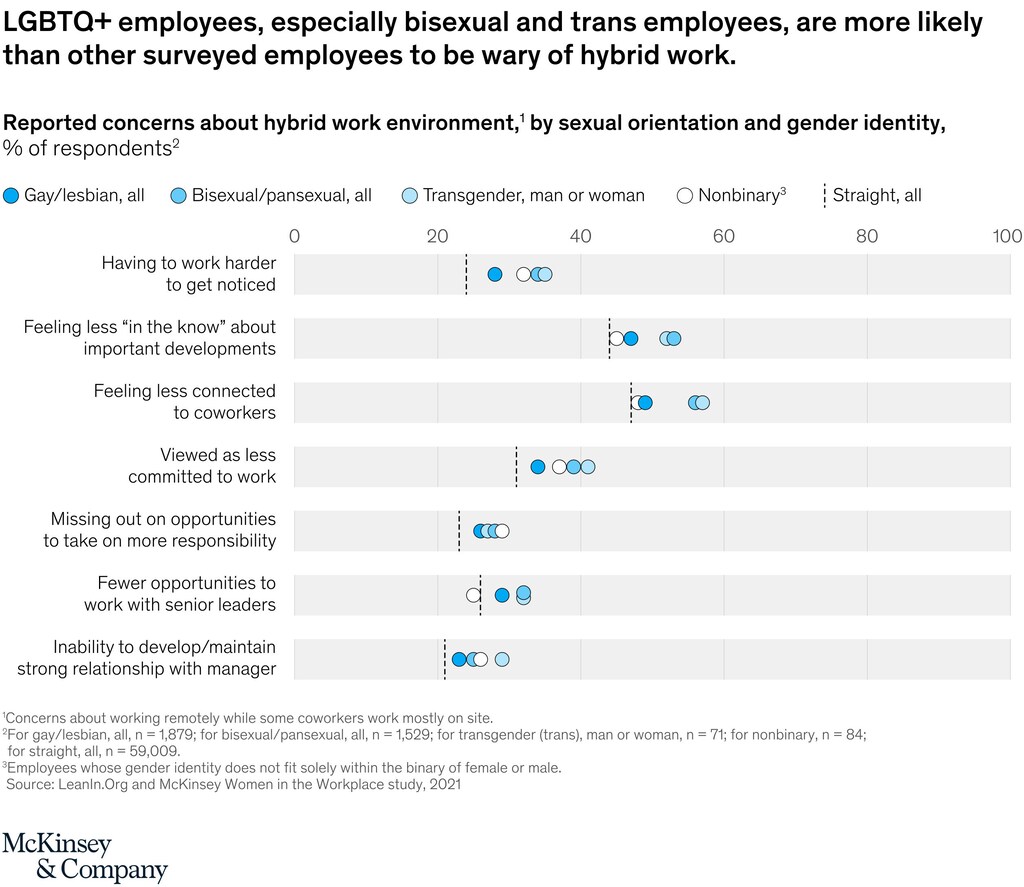
Hybrid work, a work model that blends in-office and remote work, has added a convenience factor for many employees, allowing workers to go to the office when it best suits their schedules. However, more companies have also begun to dictate when you have to be in-office rather than giving employees the choice. Members of the LGBTQ+ community, though, are less enthusiastic about the arrangement, according to our research. LGBTQ+ men, LGBTQ+ women, and nonbinary employees were more likely than their straight coworkers to indicate that they feel left out of important developments at work and less connected with others at work. More than one-third of surveyed transgender employees noted that it would be tougher in a hybrid environment to be noticed for their work.
Mental-health discussions off limits
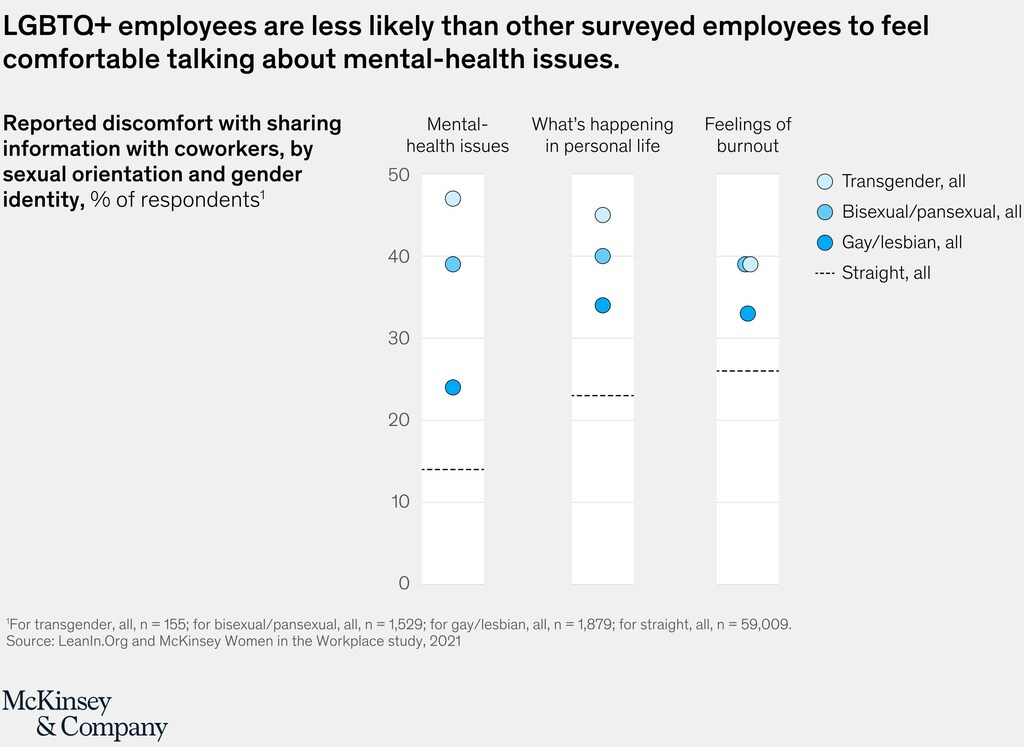
Burnout and mental health can be sensitive topics for any employee. They feel especially off limits for members of the LGBTQ+ community, according to our findings. Even though all responding employees reported experiencing similar levels of burnout, only 14 percent of surveyed straight employees said they were uncomfortable with sharing mental-health concerns with coworkers, compared with 29 percent of their LGBTQ+ counterparts. This figure soared to 47 percent for transgender employees.
How is the World Economic Forum promoting equality in the workplace?
The Future of Jobs Report 2023 found that 75% of companies surveyed expect to adopt AI, big data and cloud technologies in the next five years.
The Centre for the New Economy and Society provides a platform for leaders to share insights on the adoption and efficacy of new technologies, and the readiness of the workforce to use them. Our work includes developing insights and dialogue on growth, jobs, skills, equity and risks.
Learn more about our impact:
Gender parity: Since 2006, we have annually measured the state and evolution of gender parity in 101 economies, supporting decision-makers to identify the most effective policies to close gender gaps. In Chile, we helped establish gender parity accelerators and benefitted 728,000 women – reducing the gender gap by 37% in the participating companies.
Reskilling Revolution: With our partners, we are helping the global workforce future-proof their careers, working with over 350 organizations to provide 1 billion people with better education, skills and economic opportunities by 2030.
Disability inclusion: Working with the Valuable500, we are collaborating with the largest global network of CEOs committed to closing the disability inclusion gap. Members are making progress by increasing the adoption of digital accessibility best practices and including disability in diversity, equity and inclusion strategies.
Racial justice: We are collaborating with a global coalition of 55 organizations in 13 industries who are committed to building equitable and just workplaces for professionals from under-represented racial and ethnic identities.
Want to know more about our centre’s impact or get involved? Contact us.
Workplaces fall short on LGBTQ+ inclusion
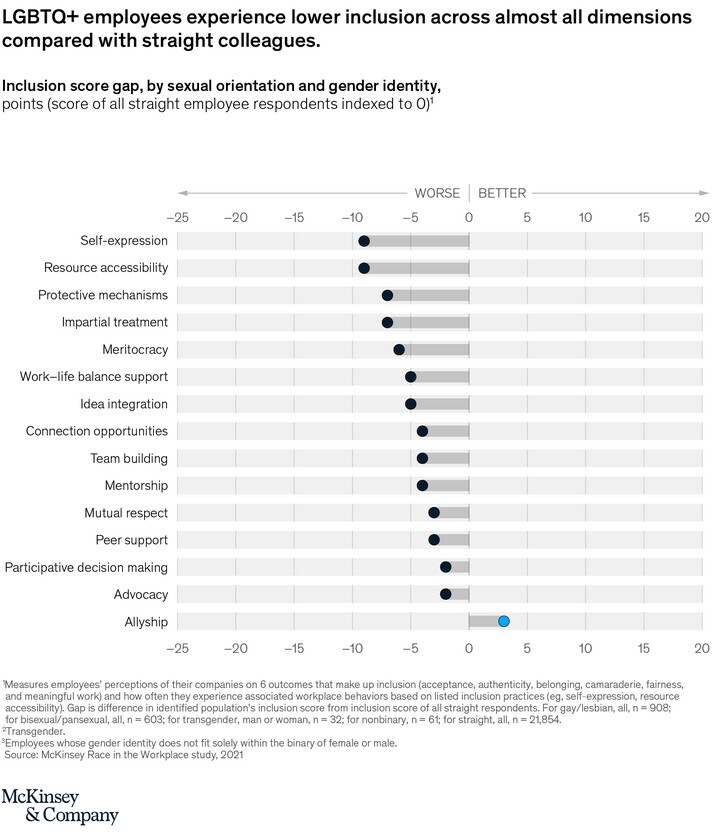
Surveyed LGBTQ+ employees reported a significantly lower level of inclusion compared with their straight counterparts. Bisexual and nonbinary employees in the study reported feeling even less inclusion than gay and lesbian respondents did, particularly as it relates to feeling connected to others at work. The largest reported gaps in the inclusion experience related to self-expression, resource accessibility, and protective mechanisms.
For a deeper dive, see our article on how McKinsey measures inclusion.
Straight allies can help through stronger allyship actions
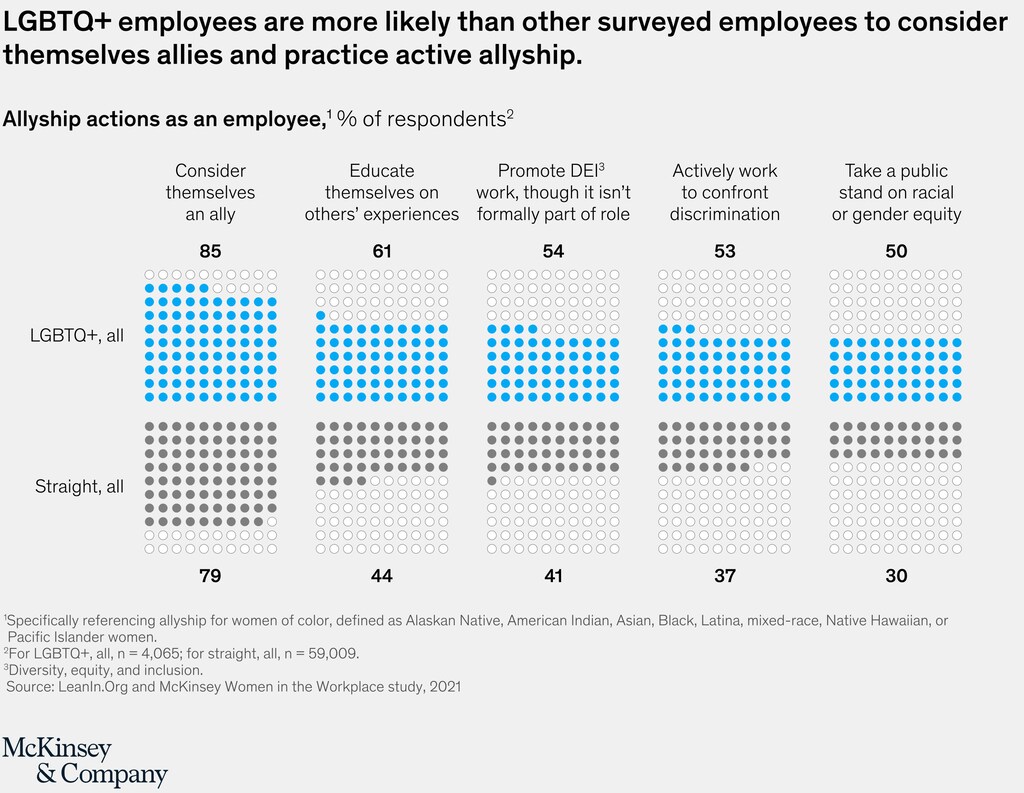
Active allyship is a necessary element in creating an inclusive environment. LGBTQ+ workers are more likely than their straight colleagues not only to consider themselves allies but also to take actions toward that commitment, per our study. In addition to usual job duties, 54 percent of surveyed LGBTQ+ employees spent time promoting diversity, equity, and inclusion (DEI) in the workplace. In comparison, 41 percent of straight employees reported participating in DEI efforts along with their regular work.
Additional contributions by Danny Hurvitz (they/them), Associate, McKinsey & Company.