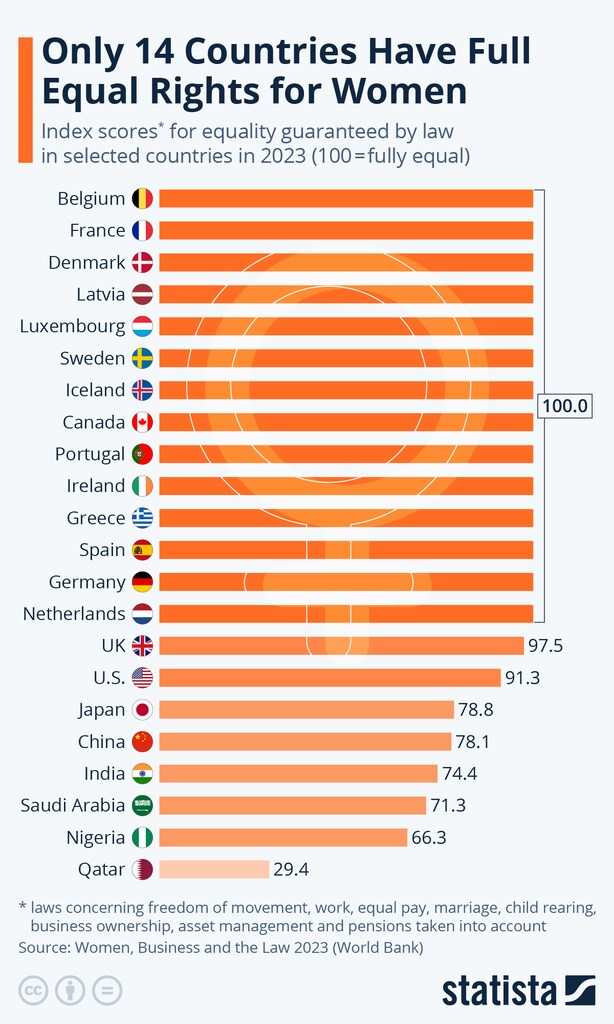
Germany and the Netherlands are the latest additions to a World Bank list of countries that offer full equal rights for women.
Countries are ranked on a scale where 100 means full equal rights – of 190 nations assessed, 99 have scores of 80 or above.
Some of the lowest-ranked countries have scores under 30.
There are only 14 countries in the world which offer full legal protections to women, according to the report Women, Business and the Law 2023, recently published by the World Bank. Belgium, Canada, Denmark, France, Greece, Iceland, Ireland, Latvia, Luxembourg, Portugal, Spain and Sweden as well as Germany and the Netherlands were the nations offering full equal rights for men and women, at least from a legal perspective.
Germany and the Netherlands were the newcomers among those rated at 100 points this year. Both countries equalized parental leave entitlements between the sexes. In the case of Germany, the law changes occurred before the past 12 months but the country received a revised score as part of this year's report, hitting 100 percent equality for the first time.
99 places out of the 190 assessed countries and territories ranked at 80 percent or above, up from 98 in 2022 and 94 in 2021. Saudi Arabia, which came in last as recently as 2019, has improved its score following new laws implemented in the country and now ranks 136th at 71.3 percent. The last place in the 2023 ranking went to the West Bank and Gaza (26.3 percent), ahead of Yemen (26.9 percent), Sudan (29.4 percent) and Qatar (29.4 percent).
How is the World Economic Forum promoting equality in the workplace?
The Future of Jobs Report 2023 found that 75% of companies surveyed expect to adopt AI, big data and cloud technologies in the next five years.
The Centre for the New Economy and Society provides a platform for leaders to share insights on the adoption and efficacy of new technologies, and the readiness of the workforce to use them. Our work includes developing insights and dialogue on growth, jobs, skills, equity and risks.
Learn more about our impact:
Gender parity: Since 2006, we have annually measured the state and evolution of gender parity in 101 economies, supporting decision-makers to identify the most effective policies to close gender gaps. In Chile, we helped establish gender parity accelerators and benefitted 728,000 women – reducing the gender gap by 37% in the participating companies.
Reskilling Revolution: With our partners, we are helping the global workforce future-proof their careers, working with over 350 organizations to provide 1 billion people with better education, skills and economic opportunities by 2030.
Disability inclusion: Working with the Valuable500, we are collaborating with the largest global network of CEOs committed to closing the disability inclusion gap. Members are making progress by increasing the adoption of digital accessibility best practices and including disability in diversity, equity and inclusion strategies.
Racial justice: We are collaborating with a global coalition of 55 organizations in 13 industries who are committed to building equitable and just workplaces for professionals from under-represented racial and ethnic identities.
Want to know more about our centre’s impact or get involved? Contact us.
The United States ranked at 91.3 percent below countries like Peru and Albania. It lost points because of a lack of laws guaranteeing equal pay and equal pensions in addition to having notoriously bad laws around parental leave.