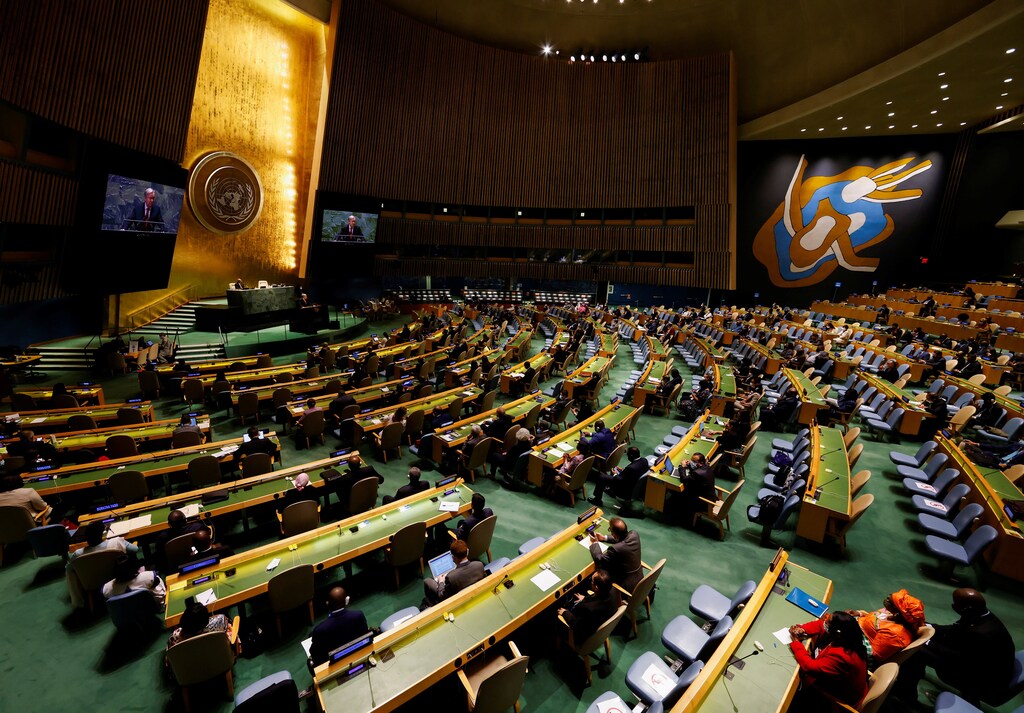
The United Nations has just adopted a resolution recognizing the social economy as driver of inclusive and sustainable economies.
It calls on member states to promote the social economy through national, regional and local strategies, policies and programming.
To fully unlock the potential of the social economy, more is needed in terms of public support and private investment and partnerships.
In this an era characterized as a “polycrisis”, we are in dire need of solutions to tackle the root causes of global risks such as geo-economic confrontation, the cost of living crisis, the erosion of social cohesion and a failure to mitigate climate change.
The social economy offers contributions and options for these solutions by working across sectors and underlining the primacy of people and social purpose over capital in the distribution and use of profits and assets.
On April 18, the United Nations (UN) General Assembly adopted a resolution promoting the social and solidarity economy for sustainable development. The UN Taskforce on the Social and Solidarity Economy finds that it advances all 17 Sustainable Development Goals.
This marked the first time that the social economy has been recognized in a UN resolution, which stated the need for “a deeper, more ambitious, transformative and integrated response to global risks”.
Social economy offers solutions to world's challenges
For decades, the social economy has been driving innovative solutions to solve the world's challenges.
By finding a new balance between economic efficiency and social and environmental impact, the social economy plays a key role in strengthening the productive capacities of people in vulnerable situations, as well as providing social services and environmental protection.
Globally, the social economy accounts for about 7% of gross domestic product and up to 12% of the employment rate in some countries.
This UN resolution is an important milestone, encouraging UN member states to recognize the social and solidarity economy and its contribution to sustainable development.
It calls on governments to promote and implement local, national and regional strategies, and policies and programmes for supporting and enhancing the social and solidarity economy. These strategies could include:
Developing specific legal frameworks
Collecting data in national statistics
Providing fiscal and public procurement incentives
Acknowledging the social and solidarity economy in education and research
Reinforcing entrepreneurship and business support
Facilitating access to financial services and funding
Encouraging the participation of social and solidarity economy actors in policymaking processes
Countries including Costa Rica, Senegal, France, Canada, Morocco, South Korea and Spain are already promoting the social economy through supportive legal frameworks in areas such as procurement, licensing and even tax reductions.
France passed a law in 2014 dedicated to supporting the development of the social and solidarity economy, which includes measures such as facilitating access to financing and public procurement.
Senegal has also adopted a framework law on the social and solidarity economy in 2021, which aims to produce a beneficial effect on the country’s society, to ensure an emancipating function and to strengthen the resilience of the economy.

In addition, international bodies such as the European Union and African Union have developed action plans on the social economy.
Last November, the African Union validated a a 10-year strategy for the Social and Solidarity Economy backed by an implementation plan (2023-2033). It aims to provide a comprehensive and coordinated policy framework to legitimize, support and develop the social economy in the regional economic communities and member states.
Corporates can also partner with and adopt the models of the social economy. In 2021, SAP launched 5 & 5 by ’25, a corporate initiative targeting 5% of addressable spend with social enterprises and with diverse businesses by 2025.
Microsoft runs the Global Social Entrepreneurship Program, supporting social impact start-ups with technology, connections and grants. And SK – the second-largest corporate conglomerate in South Korea – launched the Social Progress Credit (SPC) scheme, which has helped grow social entrepreneurs by providing financial incentives tied to their impact.
More support needed for the social economy
These are encouraging signs, but to fully unlock the potential of the social economy, much more is needed in terms of public support and private investment and partnerships.
In addition to the UN Taskforce on the Social and Solidarity Economy, there are multiple global initiatives and alliances supporting working on this agenda.
The World Economic Forum hosts the Global Alliance for Social Entrepreneurship which convenes public and private sector leaders to unlock the social economy. It published an insights report with concrete recommendations for governments and corporates on how to do so.
And the Pact for Impact alliance, launched on the initiative of France, convenes countries like Senegal and others to put the social economy at the heart of the international agenda. It has helped build international momentum for the social economy and supports its development across the world.
The recent UN resolution is one step in the right direction. The next step is for all member states to implement it.