This weekly round-up brings you the latest stories from the world of economics and finance.
Top economy stories: Warning on African debt; US growth figures revised; German inflation cools.
1. UN warning on African debt
Public debt in Africa is likely to stay above pre-pandemic levels this year and the next, Adam Elhiraika, the United Nations Commission for Africa's macroeconomics and governance director, told a conference this week.
He also warned that eight countries were already experiencing debt problems, with a further 13 "expected to be at risk of debt distress". The continent's debt-to-GDP ratio was 62.5% at the end of 2022, having doubled to 57% in the decade to 2020.
A recent International Monetary Fund report warned this ratio could rise a further 10 percentage points in the next five years if the fiscal trajectory doesn't change.
"There is need for African countries to work with international partners to address debt distress," Elhiraika said.
2. US issues revised fourth-quarter growth figures
The US Commerce Department has released updated growth figures for the fourth quarter. GDP was lowered slightly to 3.2% from the original 3.3% annualized rate. However, consumer spending, state and local government investment, and residential and business outlays were all upgraded.
Consumer spending, which accounts for two-thirds of the country's economic activity, was upgraded from an original 2.8% estimated growth to 3%.
Inflation was revised up slightly, with the personal consumption expenditures price index, which excludes volatile food and energy prices, rose at 2.1% compared to an original 2% estimate.
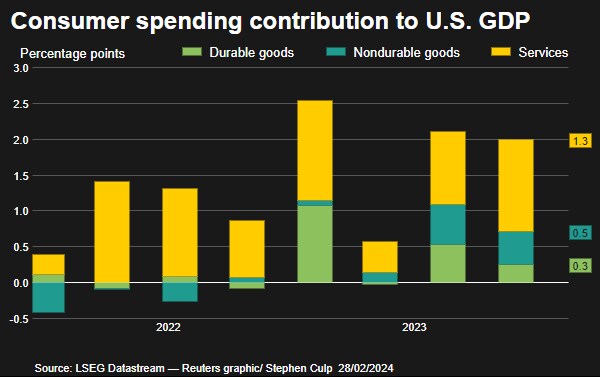
However, US consumer confidence fell in February following three months of increases. It comes amid concerns about the labour market and the domestic political environment. Inflation also increased in January, amid increasing costs of services, including housing and finance. Consumer spending also slowed in January.
3. News in brief: Stories on the economy from around the world
Goldman Sach's CEO has cautioned against overconfidence about a "soft landing" for the US economy, the Financial Times reports.
Japan’s retail sales increased 2.3% year-on-year in January, making it the 23rd consecutive month of rises.
The news comes as the country's core consumer inflation slowed for a third straight month, holding at the central bank’s target of 2%.
New government data shows the Indian economy grew 8.4% in the last quarter, compared to the same period in 2023.
How is the World Economic Forum improving the global financial system?
The Centre for Financial and Monetary Systems convenes leaders to make sense of transformation across global financial systems, from sustainability and resilience to innovation and digitalization.
By fostering cooperation and insight, the Centre helps partners align financial systems with long-term economic stability and shared prosperity.
German inflation fell to 2.7% in February, according to data released on 29 February, helped by cheaper energy and food prices.
Sri Lanka's key inflation rate fell in February, down to 5.9% compared to 6.4% in January. The country's inflation rate peaked at 70% in September 2022 amid a financial crisis.
South Korean exports continued to grow in February, with shipments increasing 12.5% from a year earlier.
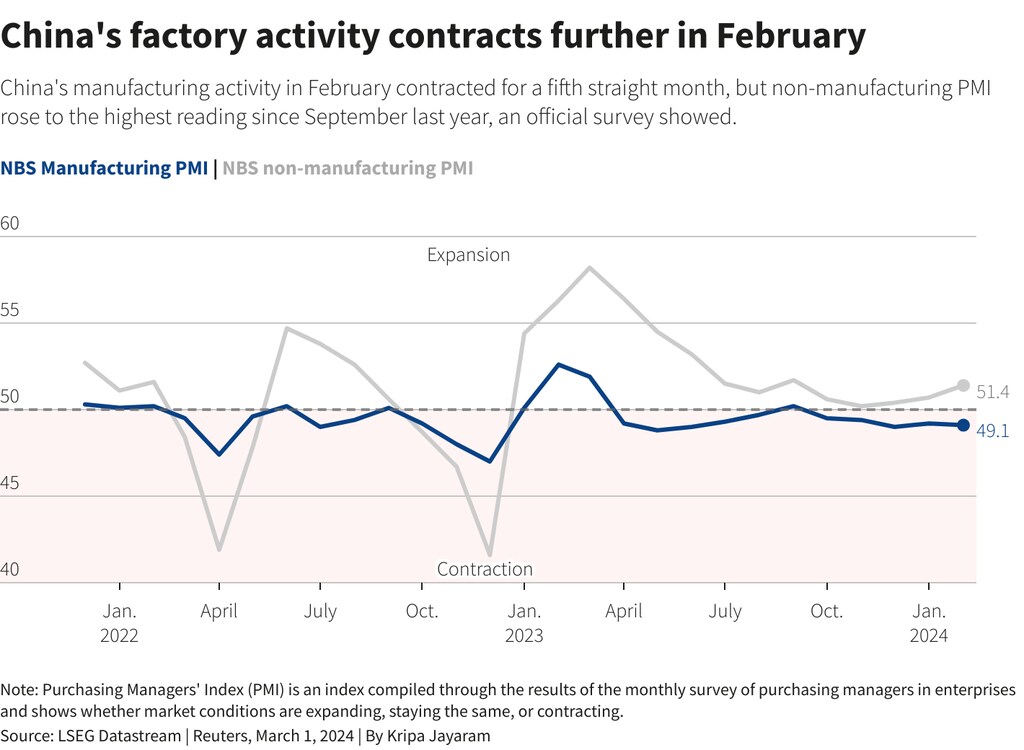
An official survey has shown that China's manufacturing activity shrank in February for a fifth straight month.
4. More on finance and the economy from our blog
Many current debt-restructuring efforts are failing to address Africa’s needs. Here's what African countries can do to help finance their development.
Reshoring and foreign direct investment present significant opportunities for economic growth. This is how Latin America and the Caribbean can benefit from it.
How do emerging economies avoid defaulting or debt restructuring? According to the World Bank, faster economic growth is needed.