
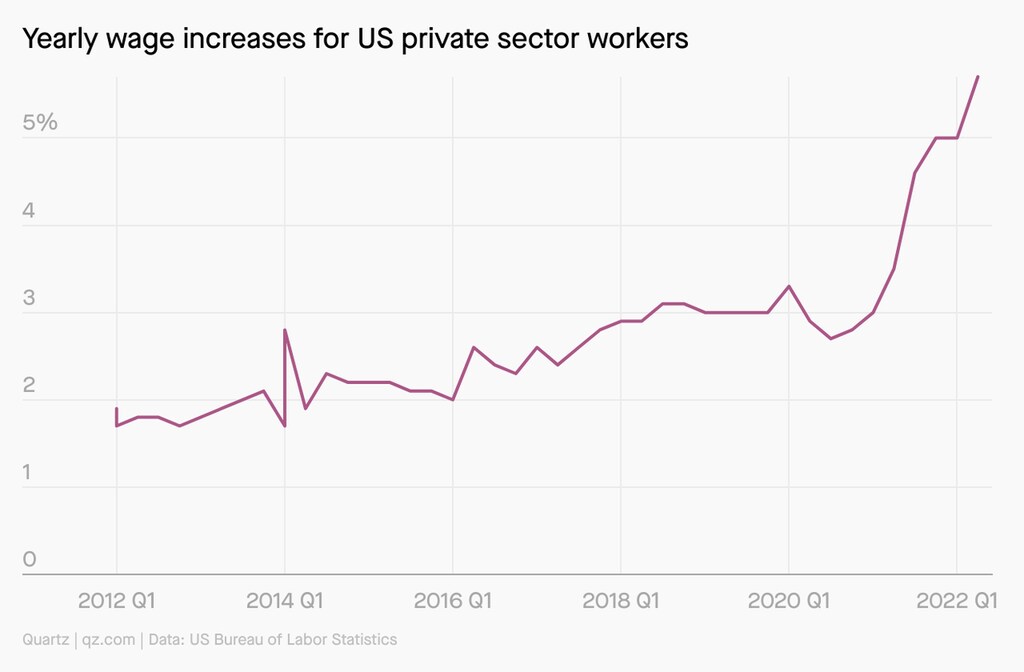
In the US, private sector wages and salaries have jumped 5.7%, even though the US economy is slowing down.
But, adjusted for inflation, wages actually fell by 3.1% over the same period.
Higher wages have implications for policymakers as they look to tackle rising inflation in the United States.
Prices keep going up and the US economy is slowing down, but workers are still seeing their wages rise.
Private sector wages and salaries jumped by 5.7% on a yearly basis in the second quarter, compared to 5% in the first quarter, according to employment cost data released by the US Bureau of Labor Statistics Friday.
The continued rise in wages signals that employers are still struggling to hire workers. Overall, the job market is holding strong even as business investment drops off. For now, that should bolster the economy.
That may be little comfort for workers—and for policymakers at the US Federal Reserve. Adjusted for inflation, wages dropped by 3.1% in the past year, meaning workers can buy less with their paychecks. At the Fed, officials are likely to see Friday’s data through the eyes of employers, which are now paying more for labor.
It was a rise in the employment cost index in the third quarter of 2021 that triggered the Fed’s current cycle of interest rate hikes. Higher wages will continue to put pressure on the central bank to continue on the same path.
A better measure of wages
Economists say the employment cost index is a more accurate indicator of where wages are headed than the jobs report’s hourly earnings data, which is released once a month instead of quarterly. Unlike hourly earnings, which have stagnated in recent months, the latest employment cost data show that private-sector wage growth is accelerating.
The biggest wage increases were in sales, finance, and retail trade. One industry that cooled off somewhat was leisure and hospitality. On a quarterly basis, wages only moved up by 1.7% for this sector in the second quarter versus 1.9% in the first.
But the strong wage growth data comes as the labor market slows down. For the three months ending in June, there were about 375,000 jobs added on average each month, down from 523,000 in the prior period.
Inflation remains unabated
Meanwhile, the Fed’s preferred inflation measure, the personal consumption expenditures price index or PCE, jumped by 6.9% on the year in June.
Higher wages and disposable income are helping Americans outpace rapidly rising prices—barely. Adjusted for inflation, consumer spending rose by 0.1% on the month in June, more than economists expected.
How is the World Economic Forum promoting equality in the workplace?
The Future of Jobs Report 2023 found that 75% of companies surveyed expect to adopt AI, big data and cloud technologies in the next five years.
The Centre for the New Economy and Society provides a platform for leaders to share insights on the adoption and efficacy of new technologies, and the readiness of the workforce to use them. Our work includes developing insights and dialogue on growth, jobs, skills, equity and risks.
Learn more about our impact:
Gender parity: Since 2006, we have annually measured the state and evolution of gender parity in 101 economies, supporting decision-makers to identify the most effective policies to close gender gaps. In Chile, we helped establish gender parity accelerators and benefitted 728,000 women – reducing the gender gap by 37% in the participating companies.
Reskilling Revolution: With our partners, we are helping the global workforce future-proof their careers, working with over 350 organizations to provide 1 billion people with better education, skills and economic opportunities by 2030.
Disability inclusion: Working with the Valuable500, we are collaborating with the largest global network of CEOs committed to closing the disability inclusion gap. Members are making progress by increasing the adoption of digital accessibility best practices and including disability in diversity, equity and inclusion strategies.
Racial justice: We are collaborating with a global coalition of 55 organizations in 13 industries who are committed to building equitable and just workplaces for professionals from under-represented racial and ethnic identities.
Want to know more about our centre’s impact or get involved? Contact us.