As companies take stock of the lessons learned during the COVID-19 pandemic, there is a chance to develop a new vision for the future of work.
Challenges have emerged around job quality that need to be addressed.
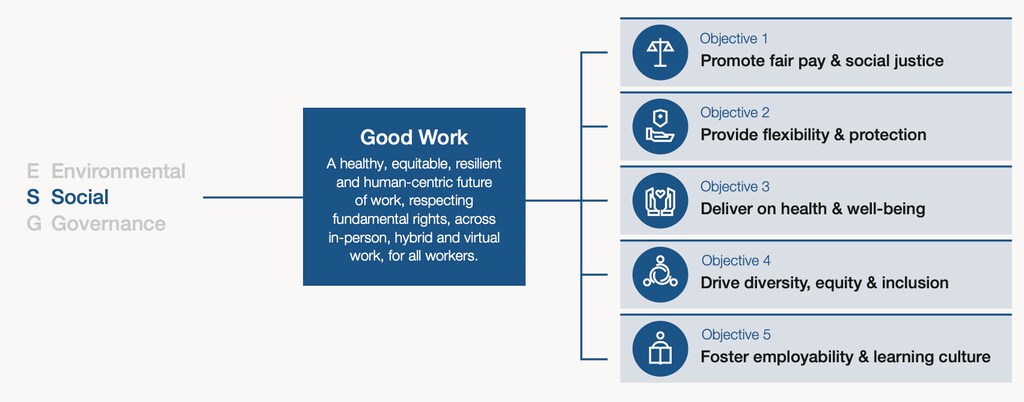
The Good Work Framework sets out five objectives to make good work a reality for all.
The nature of work has been changing through the impact of technological change, social transformation, the green transition and the impact of the COVID-19 pandemic. As companies emerging from the pandemic take stock of the lessons that have been learned and seek to redesign their people processes and work practices, there is an opportunity to develop a new vision for the future of work.
Challenges that impede the delivery of good work
A number of challenges have emerged around job quality since the pandemic, they include:
1. Divergence in wages
The pandemic put downward pressure on wages globally, compounding the previous prolonged misalignment of wage and productivity growth. In advanced economies, although wage growth has since re-emerged, the rising cost of living has eroded these gains.
2. Unequal access to flexibility
In 2020, 84% of global businesses accelerated the digitalization of work processes in response to the onset of the pandemic. Remote or hybrid work are now set to persist for a sizeable minority of the workforce. While they have the potential to be positive for work-life balance, they risk creating a new dimension of inequality, being primarily available to highly skilled workers. Estimates suggest that only 37% of jobs in the United States and the European Union could be performed entirely from home, and the proportion is lower in developing economies.
3. Decline in mental well-being
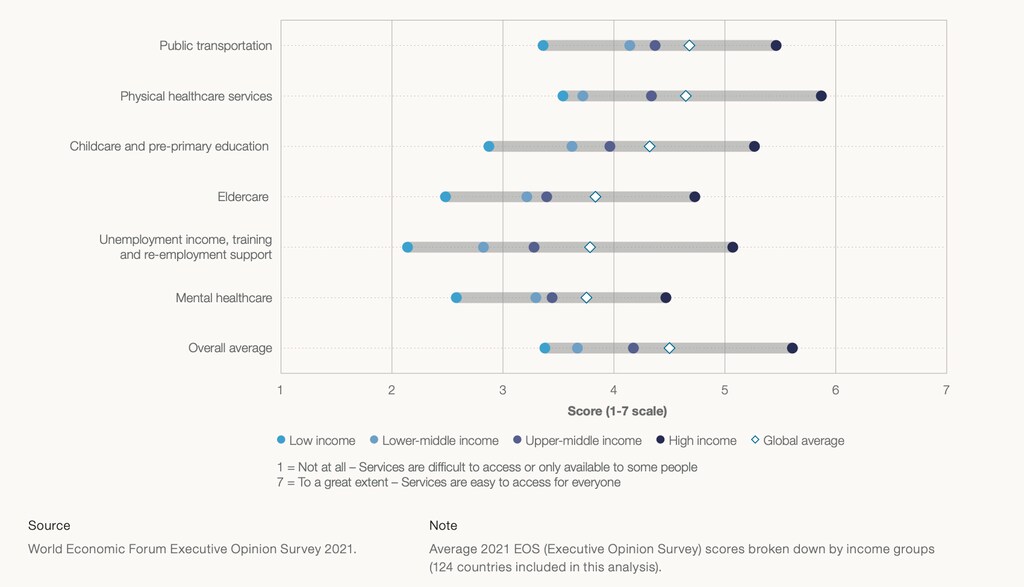
Over two-thirds of companies in the United States report having seen indications of employee burnout during the pandemic. Globally, access to safety nets and services for mental health lags significantly behind safety nets and services for physical health, especially in less advanced economies (Figure 1).
4. Slow progress in diversity, equity and inclusion
The impacts on employment and income were proportionally greater for women and many disadvantaged groups, and the rate of recovery slower. For instance, the ILO estimates that 4.2% of women lost their job due to the pandemic compared with 3% of men. Additionally, disabilities may increase as a result of long-COVID. The UK Office for National Statistics calculated in January 2022 that 2.4% of the population were experiencing ongoing symptoms.
How is the World Economic Forum promoting equality in the workplace?
The Future of Jobs Report 2023 found that 75% of companies surveyed expect to adopt AI, big data and cloud technologies in the next five years.
The Centre for the New Economy and Society provides a platform for leaders to share insights on the adoption and efficacy of new technologies, and the readiness of the workforce to use them. Our work includes developing insights and dialogue on growth, jobs, skills, equity and risks.
Learn more about our impact:
Gender parity: Since 2006, we have annually measured the state and evolution of gender parity in 101 economies, supporting decision-makers to identify the most effective policies to close gender gaps. In Chile, we helped establish gender parity accelerators and benefitted 728,000 women – reducing the gender gap by 37% in the participating companies.
Reskilling Revolution: With our partners, we are helping the global workforce future-proof their careers, working with over 350 organizations to provide 1 billion people with better education, skills and economic opportunities by 2030.
Disability inclusion: Working with the Valuable500, we are collaborating with the largest global network of CEOs committed to closing the disability inclusion gap. Members are making progress by increasing the adoption of digital accessibility best practices and including disability in diversity, equity and inclusion strategies.
Racial justice: We are collaborating with a global coalition of 55 organizations in 13 industries who are committed to building equitable and just workplaces for professionals from under-represented racial and ethnic identities.
Want to know more about our centre’s impact or get involved? Contact us.
5. People will have to learn new skills
The automation and digitalization of work, a more diverse workforce, new work formats and the green transition will require many people to learn new skills. According to the World Economic Forum’s 2020 Future of Jobs Report, the skills required for existing jobs will change by 40% on average from 2020 to 2025, and companies estimate that half of workers will require reskilling.
What are the benefits of addressing these issues?
Workplaces and economies cannot function well without addressing these issues. Markets and investors have become increasingly conscious of the risks: the percentage of institutional investors in the United States who agreed that the S in environmental, social and governance (ESG) was very important rose by 15 points to 69% between 2019 and 2020, bringing it above environmental concerns (61%) and governance (68%) for the first time.
Ensuring good work would have wide-ranging benefits for economies, societies and businesses. It would raise workers’ spending power, especially as inflation and supply disruptions risk creating a cost-of-living crisis. It would encourage people back into the labour market after a rise in inactivity during the pandemic. For employers, providing good work leads to: more motivated, engaged and healthy employees; better productivity; and better attractiveness to talent – especially important in the context of the “Great Resignation”. Finally, a backdrop of rising inequality makes a fairer deal for workers an important component of a new social contract.
How can the Good Work Framework help?
The Good Work Framework proposes enhancing job quality through five objectives and associated goals (Figure 2). It can help organisations set a new benchmark for job quality and provide a goal-oriented guide to measurable actions to promote good work.
The Framework was created in collaboration with Mercer and with the Good Work Alliance, a global, cross-industry group of forward-thinking companies. It also includes the inputs of other stakeholders such as the Forum’s Community of Chief Human Resources Officers and Global Future Council on Work, Wages and Job Creation. The endorsement of Alliance members is the start of a movement towards the wider adoption of the framework as a holistic ambition for a new future of work for all.
The Alliance will subsequently work to support the development of relevant metrics, promote measurable commitments by companies towards core good work goals, and provide insights and best-practice sharing to support implementation.
There is a need to promote good work across the full post-pandemic landscape of in-person, hybrid and virtual work and covering all categories of employment. Seizing this opportunity will determine whether the post-pandemic recovery leads to positive outcomes for both business and society at large.