
Businesses across the world are forecast to spend more than $15.4 billion on diversity, equity and inclusion (DEI)-related efforts by 2026.
But progress on DEI is slow and in order to accelerate change worldwide we need greater clarity on what works, and what does not.
The Global Parity Alliance's DEI Lighthouse report outlines five success factors across initiatives that had the most sustained impact.
Companies across the world spent an estimated $7.5 billion on diversity, equity and inclusion (DEI)-related efforts in 2020, and this figure is projected to more than double to $15.4 billion by 2026.
There is positive intent and increased discussion and activity, yet progress is slow. It will take another 151 years to close the global economic gender gap at all levels at the current rate of progress, according to the World Economic Forum’s Global Gender Gap report.
Meanwhile, data is still too sparse to systematically estimate global gaps for racial equity and LGBTQIA+ and disability inclusion, which presents a challenge in itself.
To bring faster change, there is a need for greater clarity on what works – and what does not.
The Global Parity Alliance (GPA) – a cross-industry group committed to advancing DEI, launched in 2022 by the Forum in collaboration with McKinsey & Company – set up the DEI Lighthouse Programme to identify initiatives that have driven significant, quantifiable, scalable and sustainable impact, and identify what those initiatives have in common.
The ambition is to equip leaders with these best practices, focusing DEI efforts on what works best and ultimately contributing to faster, scalable impact across the global business community.
The recently-published Diversity, Equity and Inclusion Lighthouses 2023 report lays out the common success factors that emerged from the DEI Lighthouse Programme and shares eight case studies of initiatives that were selected by an expert panel to become the first cohort of DEI Lighthouses.
The eight selected initiatives were developed and implemented by EY, Limak, PwC UK, Randstad, Schneider Electric, Shiseido, Tata Steel and Walmart.
The report further highlights innovative design and execution approaches from seven additional initiatives by Boston Consulting Group, Bridgewater Associates, Cisco, Regeneron, McKinsey & Company, Nokia and Salesforce.
Five success factors common among DEI initiatives
While the state of DEI efforts varies by company, industry and geography, a growing number of management teams recognize the importance and urgency of leading conversations within their organizations and taking action to drive progress.
The DEI Lighthouse Programme identified five success factors common across the initiatives that yielded the most significant, scalable, quantifiable and sustained impact for underrepresented groups.
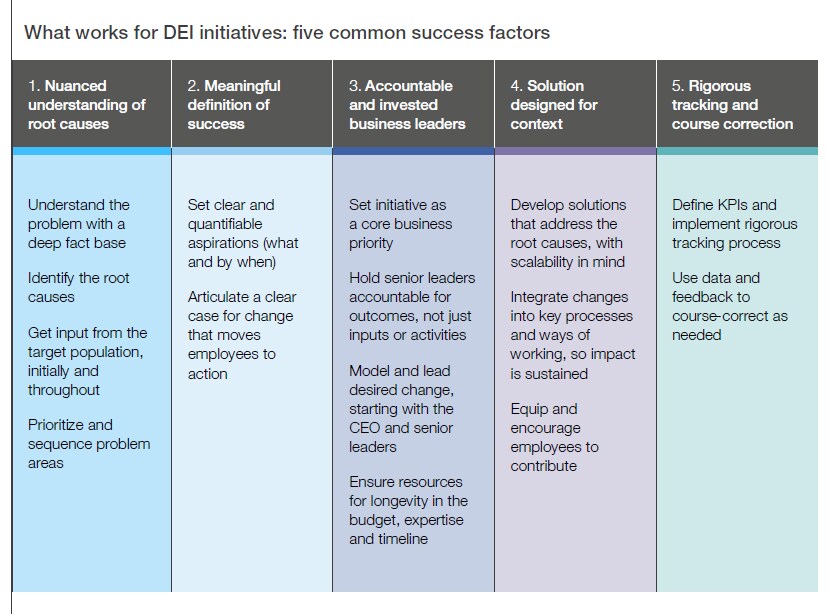
Here are details of the the five common success factors, as identified by the DEI Lighthouse initiatives:
1. Nuanced understanding of root causes
Identifying company-specific DEI opportunity areas helped inform prioritization of efforts and investment, goal setting and solution design. This began by analyzing relevant data and sources of insight to deeply understand the challenges and root causes from the perspective of those most impacted. The fact base often included employee feedback surveys and input from the target population obtained through focus groups and interviews.
2. Meaningful definition of success
After prioritizing an opportunity area, defining success by setting clear, measurable near- and long-term goals helped guide the effort and measure effectiveness. Then, articulating a case for change – the rationale for why the organization is focusing on the effort and how it connects to the company’s values, mission and business outcomes – helped move employees to action.

3. Accountable and invested business leaders
Deep commitment from executive management helped signal the importance of, and appropriately resource, DEI initiatives. Support from the CEO and senior business leaders included: setting the effort as a core business priority; being held accountable for outcomes, not just inputs or activities; role modelling and leading desired change; and allocating sufficient resources to the initiative through budget, expertise and timeline.
4. Solution designed for context
Designing solutions to address the root causes of the problem, including by making any needed changes to key processes and ways of working, helped drive initiative effectiveness and sustainability. Setting the solution up for success also included equipping employees with the knowledge and skills to support the desired change and encouraging their contributions.
5. Rigorous tracking and course correction
Finally, measuring progress against the aspiration allowed leaders to monitor the solution’s effectiveness, adjust the approach to increase impact, as needed, and more accurately direct the use of company resources.
What's the World Economic Forum doing about diversity, equity and inclusion?
The Centre for New Economy and Society connects leaders to make sense of how economic and technological change is reshaping jobs, skills and opportunity.
Through shared insight and collaboration, the Centre enables partners to explore inclusive economic models that support people and societies through transition.
If your organization has implemented an initiative that has achieved significant impact, we invite you to consider submitting it as part of the 2023/24 DEI Lighthouse Programme.