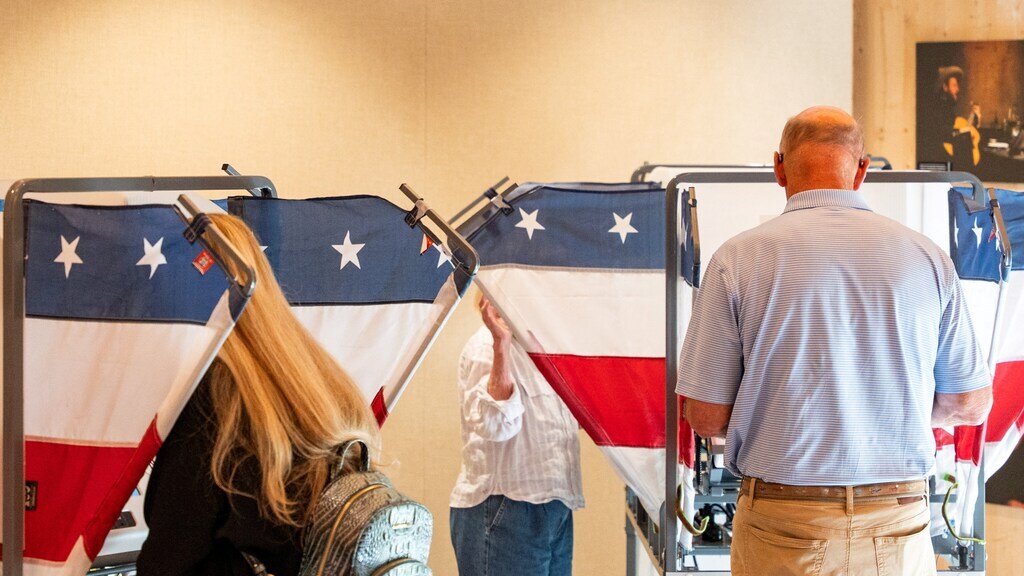
Next week, Americans will vote in the country’s first nationwide election since the 2024 presidential race.
On 3 November, voters will decide control of the US Congress, 36 governorships and thousands of state and local offices, with millions of ballots already cast in early voting by mail or in person.
These are the midterm elections, held halfway through a president’s four-year term. The presidency itself is not on the ballot, but the results will decide who controls Congress and many state capitals for the rest of President Donald Trump’s term. In 20 of the last 22 midterm elections, the president’s party has lost ground.
So, what can we expect from this year's vote?
Who’s on the ballot?
All 435 seats in the House of Representatives are up for election, along with 35 of the 100 Senate seats, including special elections in Florida and Ohio.
Republicans currently control both chambers, with the Senate divided 53-47 and the House 219-214, with two vacancies. Thirty-six states will elect governors, split evenly between seats currently held by each party. Republicans currently control the majority of governorships, 26-24.
House of Representatives: Democrats need a net gain of only a handful of seats to win the majority, and nonpartisan forecasters, including the Cook Political Report, now rate them as favored to do so.
Democrats have led the generic congressional ballot all year, and their advantage now stands at around nine points in most polling averages. Voters consistently rank the cost of living, health care and the war with Iran among their top concerns.
Redistricting will also play an outsized factor during this year’s elections. US House districts are normally redrawn once a decade, after the national census. This cycle was different. Starting with Texas in 2025, 10 states redrew their congressional maps mid-decade, a pace not seen since the 1800s. Together, those states hold roughly 40% of all House seats.
US Senate: The outcomes of the races that will determine control of the US Senate are based on factors that are much more dynamic, and thus more unpredictable, than in the House.
Democrats need a net gain of four seats to gain a majority in the upper chamber. Cook Political Report now estimates they will likely gain somewhere between one and six, with highly competitive races in Maine, Michigan, Texas, Alaska, Iowa, and Ohio likely to determine the outcome. These contests are also driving record spending: ad-tracking firm AdImpact projects nearly $3.4 billion in Senate advertising this cycle, part of a projected $11.6 billion across all races that would make 2026 the most expensive election cycle on record, with the Texas Senate race alone expected to draw about $446 million.
Governorships and local votes: Among the most closely watched gubernatorial races are open seats in Georgia, Michigan, Ohio and Wisconsin, and governors with growing national profiles seeking re-election in Illinois, Pennsylvania, Maryland, and Arkansas.
Voters will also elect thousands of state and local officials and decide 145 statewide ballot measures on a wide range of issues. Many measures concern how elections themselves are run: voters in at least seven states are deciding voter ID laws, the most in a single year, while six states will vote on citizenship requirements for voting and Alaska and Massachusetts will weigh changes to primaries and ranked-choice voting. Other measures address income taxes and campaign finance laws.
Will turnout be high?
Early signs point to strong engagement. As of this week, more than 32 million Americans have already voted by mail or in person, according to the University of Florida’s Election Lab. More than 59 million mail ballots have been requested or sent.
In North Carolina, first-day in-person turnout was up nearly 47% compared with the same point in 2022. Meanwhile, Harris County, the most populated county in Texas, recorded more than 104,000 in-person votes on its first day of early voting, a midterm record.
Turnout in midterm years is typically lower than in presidential years. In 2018, roughly half of eligible voters cast a ballot, the highest midterm turnout in more than a century. Primary turnout this year ran ahead of 2022 in several states, including Iowa and Colorado, which suggests 2026 could approach that level.
However, early numbers come with a caveat. Early voters tend to be older than the electorate as a whole, so early totals do not reliably predict who will win.
When will the results be in?
Most races will be called on election night as results become clear, but control of the House may not be confirmed for several days.
Each state sets its own rules for when mail ballots can be processed. Some count them before Election Day, others only after polls close. In June, the US Supreme Court ruled that states may count mail ballots that arrive after Election Day, if their laws allow it. In close races, those late-arriving ballots can take days to tally. In 2024, it took more than a week for seven states to reach the threshold of 95% of votes counted.
After all votes are eventually counted, states will certify their results over the following weeks. Recounts or legal challenges could extend that timeline in the closest contests. The new Congress will be sworn in on 3 January 2027.
What could different outcomes mean?
What if Republicans keep both chambers? Unified government would continue for the final two years of President Trump’s term. Congress would be positioned to advance the administration’s priorities on foreign and domestic policy, taxes, trade and spending. Senate Republicans would keep control of confirmations for judges and executive nominees.
What if Democrats win the House only? Divided government would return for the first time since 2024. A Democratic House would gain the power to block or reshape legislation, control spending bills, and launch investigations through its committees. Senate Republicans would still confirm the president’s nominees, and major legislation would likely require bipartisan compromise.
What if Democrats win both chambers? Democrats would control the legislative agenda and the confirmation process in the Senate. Any legislation they pass would still face a presidential veto, which Congress can override only with two-thirds majorities in both chambers. That makes negotiation with the White House likely on most major bills, though the prospects of enacting significant legislation outside of “must pass” items would be quite low.
Looking ahead
In the event of divided government in Washington, states will continue to play an outsized role in shaping the direction of travel on issues of national strategic importance. Governors and legislatures are already setting the pace on AI, building the workforce for a manufacturing renaissance, and modernizing power grids to meet surging energy demand. Whatever the outcome on 3 November, that momentum is likely to grow.
Moreover, once the last ballots from next week's vote are counted, the next race begins, as candidates in both parties start testing the waters and the field for the 2028 presidential election begins to take shape.