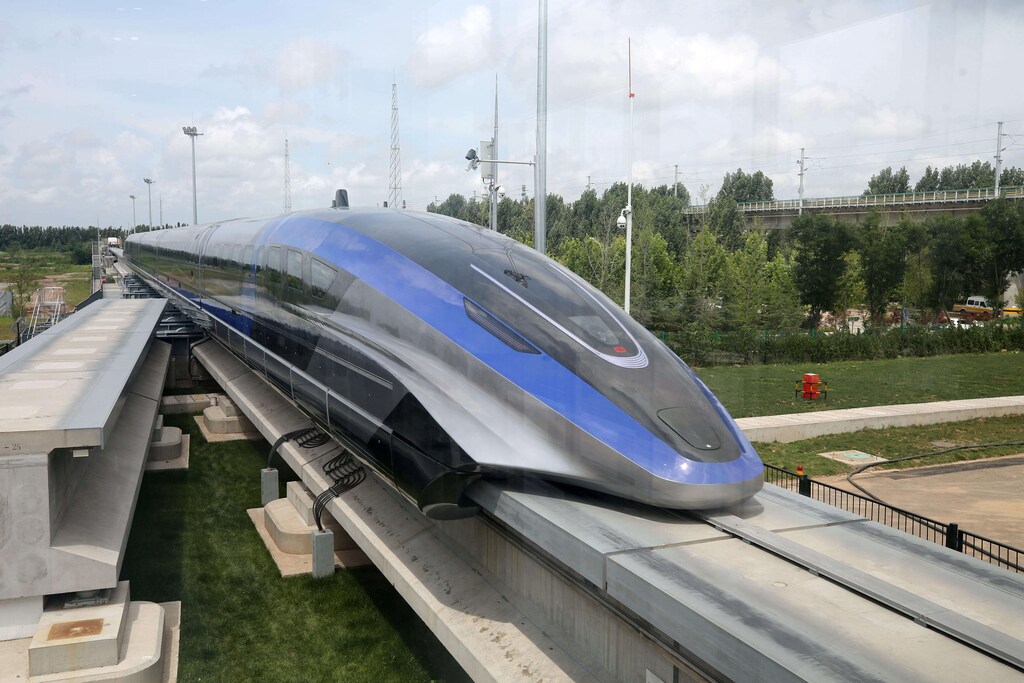
China has unveiled a new maglev train capable of a top speed of 600 kph.
The top speed makes the train the fastest ground vehicle in the world.
The train uses electro-magnetic force, meaning it "levitates" above the track with no contact between body and rail.
At 600 kph, it would only take 2.5 hours to travel from Beijing to Shanghai, a journey of more than 1,000 km or 620 miles.
By comparison, the journey would take 3 hours by plane and 5.5 hours by high-speed rail.
China has unveiled a maglev train capable of a top speed of 600 kph, state media said.
The maximum speed would make the train, self-developed by China and manufactured in the coastal city of Qingdao, the fastest ground vehicle globally.
Using electro-magnetic force, the maglev train "levitates" above the track with no contact between body and rail.
China has been using the technology for almost two decades on a very limited scale. Shanghai has a short maglev line running from one of its airports to town.
While there are no inter-city or inter-province maglev lines yet in China that could make good use of the higher speeds, some cities including Shanghai and Chengdu have started to conduct research.
At 600 kph, it would only take 2.5 hours to travel from Beijing to Shanghai by train - a journey of more than 1,000 km (620 miles).
What is the World Economic Forum doing to promote sustainable urban development?
Cities are responsible for 75% of global greenhouse gas emissions and are home to over half of the world’s population—a number that will grow to two-thirds by 2050. By prioritizing cleaner energy, cities could contribute more than half of the emissions cuts needed to keep global warming to less than 2°c, which would be in line with the Paris Agreement.

To achieve net-zero and nature-positive cities and communities by 2050, the World Economic Forum is partnering with public and private sector stakeholders on initiatives that drive global ambition through local action. Here are just a few:
Davos Baukultur Alliance: Advancing high-quality planning, construction and management of buildings, infrastructure, and public spaces using principles based on climate resilience, sustainability and circularity in the built environment. Learn more.
Global New Mobility Coalition: Exploring new solutions to reduce congestion and emissions, enhance EV infrastructure and transform urban mobility and deliveries. Learn more.
Alliance for Urban Innovation: Connecting innovators and entrepreneurs to new markets and opportunities that reimagine and reshape quality of life and local economies. Learn more.
G20 Global Smart Cities Alliance: Accelerating intelligent, practical solutions to build climate resilience, enhance public well-being and tackle the most pressing challenges facing cities and local communities. Learn more.
Future of Travel and Tourism: Driving inclusive and sustainable economic growth while preserving cultural heritage and protecting natural ecosystems. Learn more..
Discover how you can be a part of our efforts to create more sustainable and livable cities and communities. Contact us here.
By comparison, the journey would take 3 hours by plane and 5.5 hours by high-speed rail.
Countries from Japan to Germany are also looking to build maglev networks, although high costs and incompatibility with current track infrastructure remain hurdles to rapid development.