Using the most recent Census Bureau data, this visualization explores how each U.S. state's population has evolved over the last decade.
Research suggests that population growth trends are often determined by the nation's economic state.
For example, the country’s 10-year population growth rate plummeted to just 7.3% due to the Great Depression.
By contrast, from 2010 - 2010, the U.S. population grew by the percentage equivalent of 22.7 million people.
Some states are growing faster than others; by 2025, California will be home to five of the fastest-growing U.S. cities.
For the full, interactive visualization, click here.
U.S. population change in the last decade, by state
The U.S. is the third most-populated country in the world, behind only two Asian giants of China and India respectively. But within the country, a lot can change in 10 years, and populations are especially mutable in nature.
As people moved in and out of certain areas for both lifestyle and economic reasons, which U.S. state populations fluctuated the most?
Drawing from the latest Census Bureau data, we look at how each state’s resident populations evolved over the past decade. But first, a blast from the past.
Historical trends: U.S. population since the 1930s
Population growth trends in the U.S. have been closely tied to the economic ebbs and flows experienced by the nation. In one stark example, the country’s 10-year population growth rate plummeted to just 7.3% due to the Great Depression.
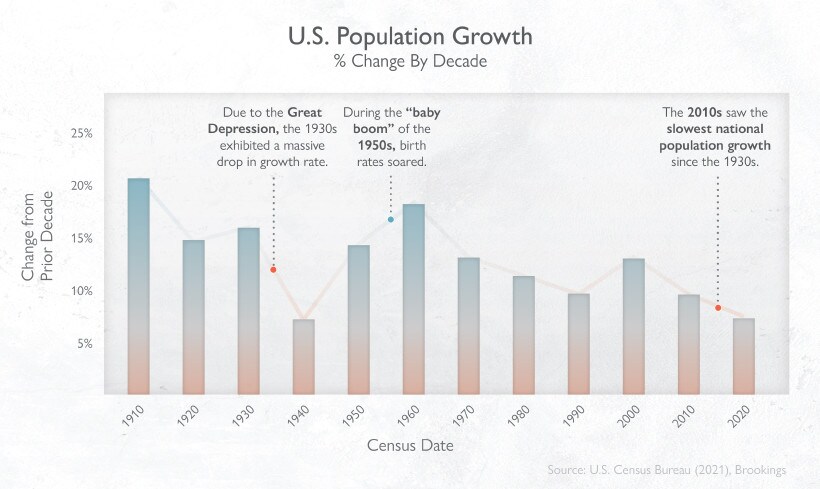
This was later offset by the post-WWII “Baby Boom”, during which birth rates soared once more, bumping up the population 10-year growth rate to 18.5% in the 1950s. The Baby Boomer generation now wields the most influence over the U.S. economy and society thanks to the favorable economic conditions in which they were born.
However, U.S. population growth rates recently hit new lows—the slower pace in the 2010s is rivalling that of the 1930s. According to Brookings, there area few factors at play:
Falling fertility rate
An increase in deaths (aging population, overdose deaths)
Lower immigration rate
With all this in mind, how does the current landscape of the U.S. population by state look?
The entire U.S. population by state in 2020
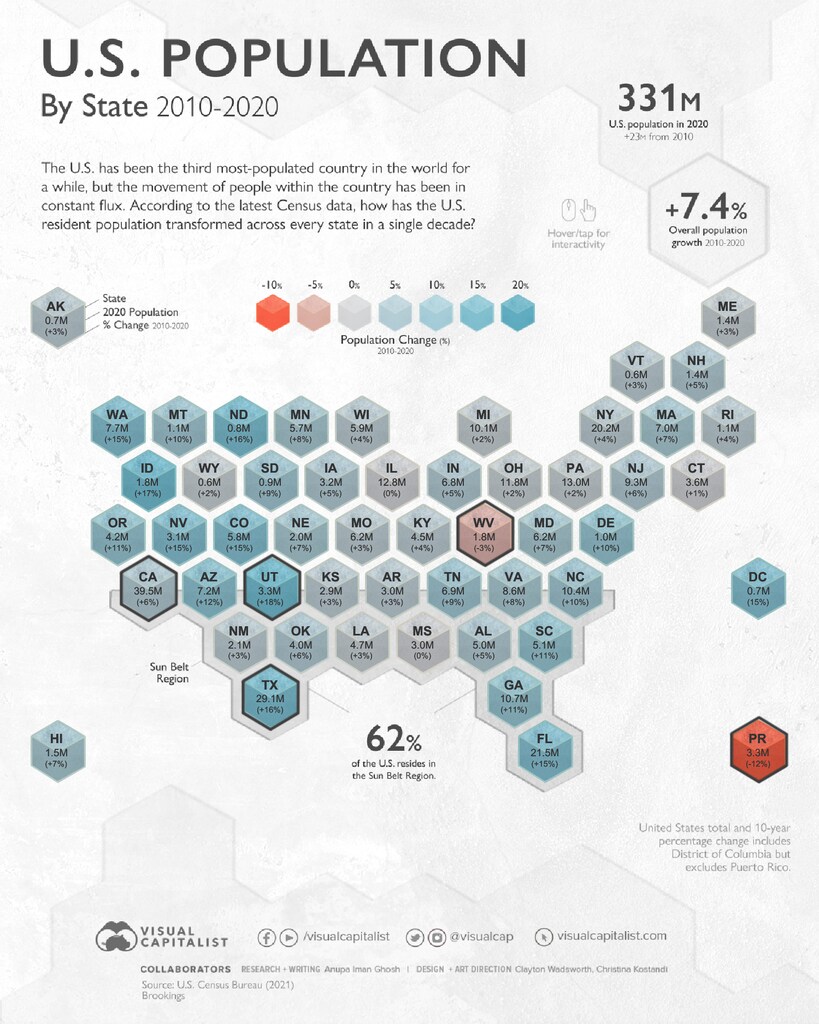
The U.S. experienced 7.4% population growth between 2010-2020, which equates to the addition of 22.7 million people.
An impressive one-tenth of this growth occurred in California, and it remains the most populous state, rising above 39.5 million people in 2020. The SoCal megaregion—Los Angeles and San Diego—alone contributes more than $1.4 trillion to global economic output.
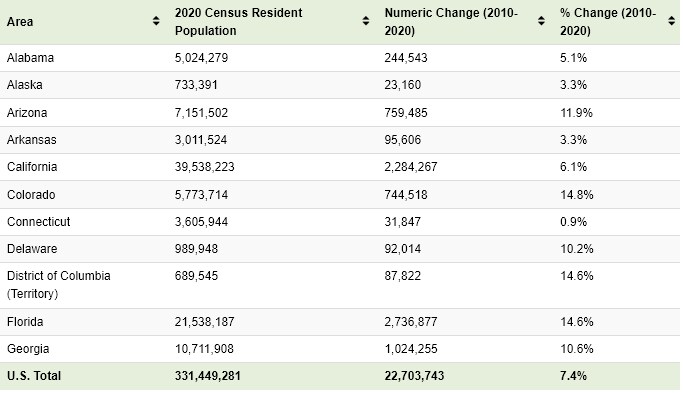
*Note: U.S. total and 10-year percentage change includes District of Columbia but excludes Puerto Rico.
To see the full interactive chart, click here.
Overall, there’s been a significant shift in population towards the Sun Belt region (stretching from Southeast to Southwest), where 62% of the U.S. now resides. Let’s take a closer look at the biggest gainers and decliners over time.
Gainers: Utah, Texas
Utah saw the quickest population growth rate of 18.4% in the last decade. Drawn in by strong economic prospects, net migration into the state is balancing out a decline in births. What’s interesting is that 80% of Utah’s population is concentrated in the Wasatch Front – a metro area anchored by Salt Lake City and the chain of cities and towns running north and south of Utah’s largest city.
A little further south, Texas swelled by almost 4 million residents in the last 10 years. Much of this growth took place in the “Texas Triangle”, which contains Dallas, Houston, San Antonio, and Austin. This booming region of the country contributes over $1.2 trillion to global economic output.
Decliners: West Virginia, Puerto Rico
West Virginia lost the most people in a decade, seeing a numeric population decline of 59,278. This may be explained by an aging population—16% of West Virginians are 65 years old and above.
When territories are also taken into account, Puerto Rico saw the biggest percentage decline of 11.8%, or close to 44,000 people over 10 years. Many of them moved into the mainland, and especially into Florida, after two hurricanes hit the island in 2017.
What is the World Economic Forum doing to promote sustainable urban development?
Cities are responsible for 75% of global greenhouse gas emissions and are home to over half of the world’s population—a number that will grow to two-thirds by 2050. By prioritizing cleaner energy, cities could contribute more than half of the emissions cuts needed to keep global warming to less than 2°c, which would be in line with the Paris Agreement.

To achieve net-zero and nature-positive cities and communities by 2050, the World Economic Forum is partnering with public and private sector stakeholders on initiatives that drive global ambition through local action. Here are just a few:
Davos Baukultur Alliance: Advancing high-quality planning, construction and management of buildings, infrastructure, and public spaces using principles based on climate resilience, sustainability and circularity in the built environment. Learn more.
Global New Mobility Coalition: Exploring new solutions to reduce congestion and emissions, enhance EV infrastructure and transform urban mobility and deliveries. Learn more.
Alliance for Urban Innovation: Connecting innovators and entrepreneurs to new markets and opportunities that reimagine and reshape quality of life and local economies. Learn more.
G20 Global Smart Cities Alliance: Accelerating intelligent, practical solutions to build climate resilience, enhance public well-being and tackle the most pressing challenges facing cities and local communities. Learn more.
Future of Travel and Tourism: Driving inclusive and sustainable economic growth while preserving cultural heritage and protecting natural ecosystems. Learn more..
Discover how you can be a part of our efforts to create more sustainable and livable cities and communities. Contact us here.
Full speed ahead: states competing on forward momentum
By 2025, California will be home to five of the fastest-growing urban U.S. cities. The unstoppable growth of the tech industry in Silicon Valley is partly behind this, as many people flock to the West Coast to fill the shoes of highly skilled jobs required.
But could Silicon Valley one day lose its steam? Current and projected population growth in Texas is bolstering its tech potential too—in fact, it’s been dubbed the next “Silicon Hills”, with many tech companies from SpaceX to Oracle choosing to camp out in Austin instead.