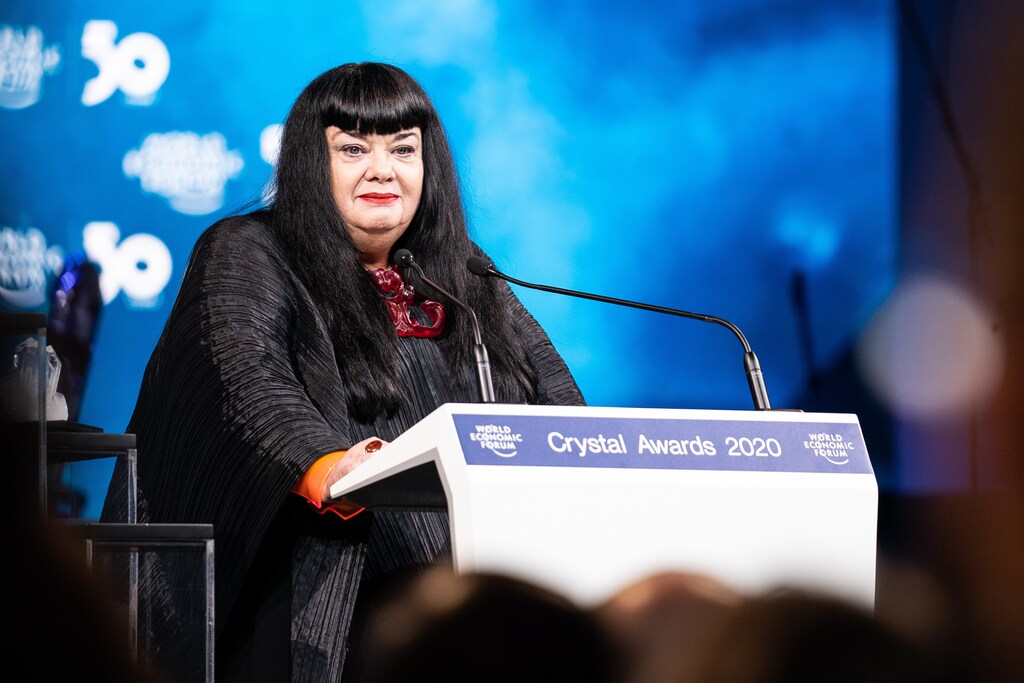
While accepting her Crystal Award on the opening day of the 2020 World Economic Forum Annual Meeting in Davos, Australian artist and filmmaker Lynette Wallworth set the tone for the week's discussions on climate change.
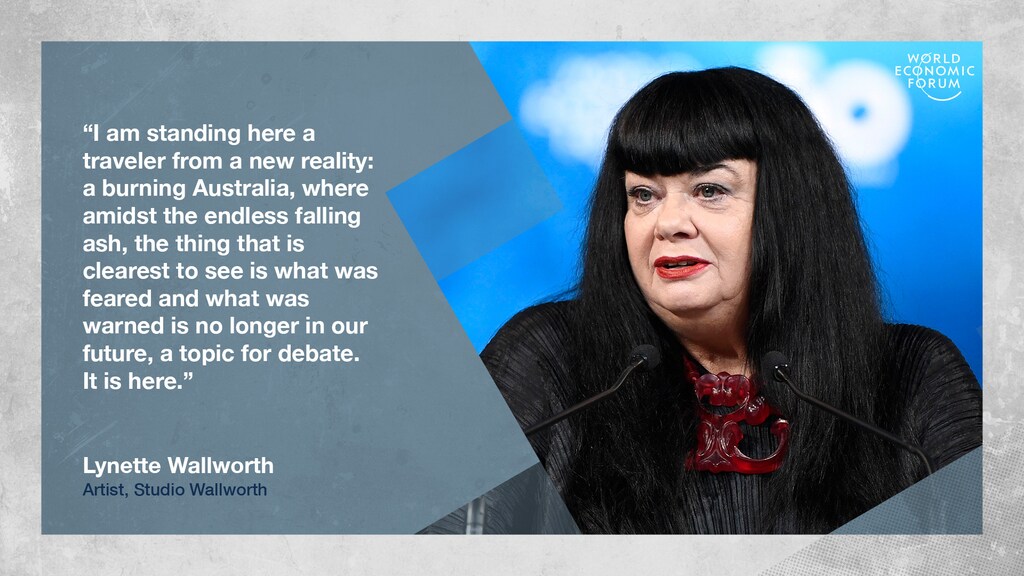
“I am standing here a traveller from a new reality: a burning Australia, where amidst the endless falling ash, the thing that is clearest to see is what was feared and what was warned is no longer in our future, a topic for debate. It is here.”
“We have seen the unfolding wings of climate change,” she continued. “And to face what this new reality brings, we need leaders to match this moment.”
Known for her immersive installations and films exploring connections between people and nature, Wallworth won an Emmy for her 2016 film Collisions, which tells the story of the UK’s atomic bomb tests in the Australian outback in the 1950s and the impact they had on the land and indigenous tribes who had lived there for centuries.
Originally commissioned by the World Economic Forum, the film uses virtual reality to bring viewers up close to the scene of one bomb test with Nyarri Morgan, an elder in the Martu tribe in Western Australia’s Pilbara desert, located about 2,000km northeast of Perth. He explains what he saw and felt when the bomb went off in his homeland – which was his first encounter with Western technology, and indeed with a culture other than his own.
“I thought it was the spirit of my gods rising up to speak with me. And the water holes boiled," he says in the film.
Australia's still burning
It’s impossible to miss the comparison to the situation in Australia more than six decades later, where still-raging bushfires have scorched more than 10.3 million hectares of land and killed 30 people and an estimated 1 billion animals.
The size, speed and scale of Australia’s fires are particularly alarming. The total area burned in the state of New South Wales alone is larger than the area burned by recent fires in California, Indonesia and Brazil combined. The fires started earlier in the season and spread rapidly. And despite recent heavy rains, officials warn there are “many months to go” in this fire season.
Scientists now say there is “no doubt whatsoever” that climate change has caused the exceptionally hot, dry conditions feeding the fires in Australia and other parts of the world. And with temperatures higher than ever before – and rising – fire seasons will get worse if we don’t take urgent action to control the warming temperatures.
“A time for new leaders”
On 20 January, 2020, the World Economic Forum presented the 26th Annual Crystal Award to four artists who are improving the state of the world through their contributions to inclusive and sustainable change.
The ceremony kicked off the 50th Annual Meeting of the World Economic Forum, with the theme, Stakeholders for a Cohesive and Sustainable World.
Climate change, and how governments and corporations should respond to it, is a key topic of debate among the 3,000 participants across government, business and civil society.
Wallworth had some advice.
“This is a time for new leaders – for youth leaders, for women leaders and indigenous leaders, and for those who can work with them,” she continued in her acceptance speech. “Because the world has already changed. It is unutterably altered. And that momentous shift will continue. To what degree – literally – we don’t yet know.”
She closed with a powerful warning: “But what we do know is that those who led us here aligned themselves with corporations over community, with privilege and power over shared humanity, and with ledgers over values. There is an extinction going on: it is the death of a worn-out way that no longer serves. As powerful as their last rampant thrashing will appear, the dinosaur industries will die – they are dying now.
Wallworth is a member of the World Economic Forum’s Global Future Council on Virtual and Augmented Reality.