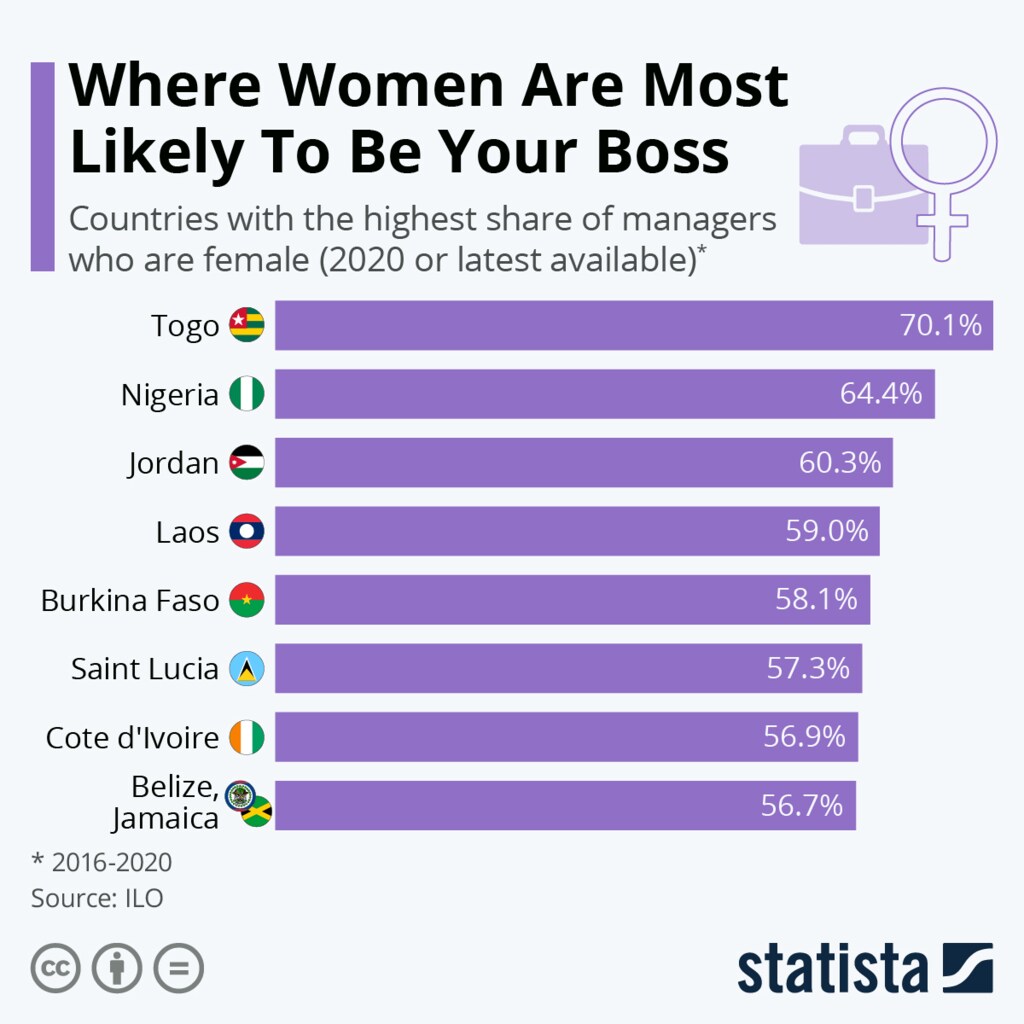
In African and Caribbean countries women are more likely to have managerial jobs than in other parts of the world, according to the International Labor Organization.
Belarus ranks highest among the European countries listed, coming in 13th, with 50.5% of female managers.
Women are most likely to hold managerial positions in human resources, administration, finance, marketing, or public relations.
If you are working in Togo, Nigeria, Jordan or a number of countries included in the below list, it is actually more likely that your boss is a woman than a man. This is according to numbers released by the International Labor Organization. Togo led the pack with more than 70 percent of all managerial positions filled by women in 2017. But the numbers also show that only 13 out of all countries reporting these figures to the ILO between 2016 and 2020 have achieved gender parity in leadership positions.
The highest-ranking European country is Belarus in rank 13, with 50.5 percent of female managers. Generally, Eastern European countries and former Soviet Republics score high in the ranking as do African and Caribbean nations.
How is the World Economic Forum promoting equality in the workplace?
The Future of Jobs Report 2023 found that 75% of companies surveyed expect to adopt AI, big data and cloud technologies in the next five years.
The Centre for the New Economy and Society provides a platform for leaders to share insights on the adoption and efficacy of new technologies, and the readiness of the workforce to use them. Our work includes developing insights and dialogue on growth, jobs, skills, equity and risks.
Learn more about our impact:
Gender parity: Since 2006, we have annually measured the state and evolution of gender parity in 101 economies, supporting decision-makers to identify the most effective policies to close gender gaps. In Chile, we helped establish gender parity accelerators and benefitted 728,000 women – reducing the gender gap by 37% in the participating companies.
Reskilling Revolution: With our partners, we are helping the global workforce future-proof their careers, working with over 350 organizations to provide 1 billion people with better education, skills and economic opportunities by 2030.
Disability inclusion: Working with the Valuable500, we are collaborating with the largest global network of CEOs committed to closing the disability inclusion gap. Members are making progress by increasing the adoption of digital accessibility best practices and including disability in diversity, equity and inclusion strategies.
Racial justice: We are collaborating with a global coalition of 55 organizations in 13 industries who are committed to building equitable and just workplaces for professionals from under-represented racial and ethnic identities.
Want to know more about our centre’s impact or get involved? Contact us.
Laos in rank four and the Philippines in rank 11 are also outliers as the highest-ranked Asian countries. While Laos' success is in part achieved by its socialist government, the situation is different in the Philippines. The ILO notes that women are most likely to hold managerial positions in human resources, administration, finance, marketing or public relations – areas the organization defines as business support functions. The success of female managers in the Philippines therefore ties in with the strong local business process outsourcing industry. Women are over-represented in the sector as a whole and make up as many as two-thirds of employees in data processing and around three-quarters of those working in medical transcription, according to the Philippines Statistics Authority.