Africa will shortly be home to the world's largest working age population and a burgeoning consumer class; it’s also rich in natural resources.
Despite such human capital and natural resources, Africa’s economic growth and productivity has slowed over the past decade.
If nations across the continent deploy their diverse strengths, it could help reimagine Africa’s growth and lead to greater sustainability and prosperity for everyone.
Headlines about Africa tend to overlook its considerable assets. At a time when established economies are beginning to fret about labour shortages, Africa will soon be home to the world’s largest working age population and a burgeoning consumer class.
It is also rich in the natural resources needed to help the world transition to net zero. Yet despite such bounty, the continent’s economy slowed over the past decade after a promising start to the millennium.
What is the World Economic Forum doing to promote sustainable urban development?
Cities are responsible for 75% of global greenhouse gas emissions and are home to over half of the world’s population—a number that will grow to two-thirds by 2050. By prioritizing cleaner energy, cities could contribute more than half of the emissions cuts needed to keep global warming to less than 2°c, which would be in line with the Paris Agreement.

To achieve net-zero and nature-positive cities and communities by 2050, the World Economic Forum is partnering with public and private sector stakeholders on initiatives that drive global ambition through local action. Here are just a few:
Davos Baukultur Alliance: Advancing high-quality planning, construction and management of buildings, infrastructure, and public spaces using principles based on climate resilience, sustainability and circularity in the built environment. Learn more.
Global New Mobility Coalition: Exploring new solutions to reduce congestion and emissions, enhance EV infrastructure and transform urban mobility and deliveries. Learn more.
Alliance for Urban Innovation: Connecting innovators and entrepreneurs to new markets and opportunities that reimagine and reshape quality of life and local economies. Learn more.
G20 Global Smart Cities Alliance: Accelerating intelligent, practical solutions to build climate resilience, enhance public well-being and tackle the most pressing challenges facing cities and local communities. Learn more.
Future of Travel and Tourism: Driving inclusive and sustainable economic growth while preserving cultural heritage and protecting natural ecosystems. Learn more..
Discover how you can be a part of our efforts to create more sustainable and livable cities and communities. Contact us here.
Africa entered the 21st century with a burst of economic growth that lasted from 2000 to 2010, when real gross domestic product (GDP) grew at an average rate of 5.1% annually, up from an annual average of just 2.5% in the prior decade.
Then the continent’s economy sputtered, as economic growth in the next decade slowed to an average of 3.3% a year. The three largest economies, Egypt, Nigeria, and South Africa together accounted for 65% of the total economic deceleration.
Africa is a ‘mosaic and not a monolith’
Yet looking at the continent as a mosaic rather than a monolith makes it clear that there is no ‘one Africa’.
Almost half of its people live in countries where economies grew faster than the continental average between 2010 and 2019, continuing the rapid growth they enjoyed in the previous decade, or accelerating economic growth over those past 10 years.
In our recent report, Reimagining economic growth in Africa: Turning diversity into opportunity, we examine Africa at a more granular level to study the patterns of economic growth and productivity in all its countries, cities and companies.
Economies that exceeded the continent’s average growth rate of 4.2% from 2000 to 2019 offer valuable lessons that other African countries can adapt to their own context.
These countries, largely in East and West Africa, have had above-average growth in urbanization, in levels of capital investment, and in exports, albeit off a low base. Per capita consumption in these countries also grew steadily, by 3% annually on average.
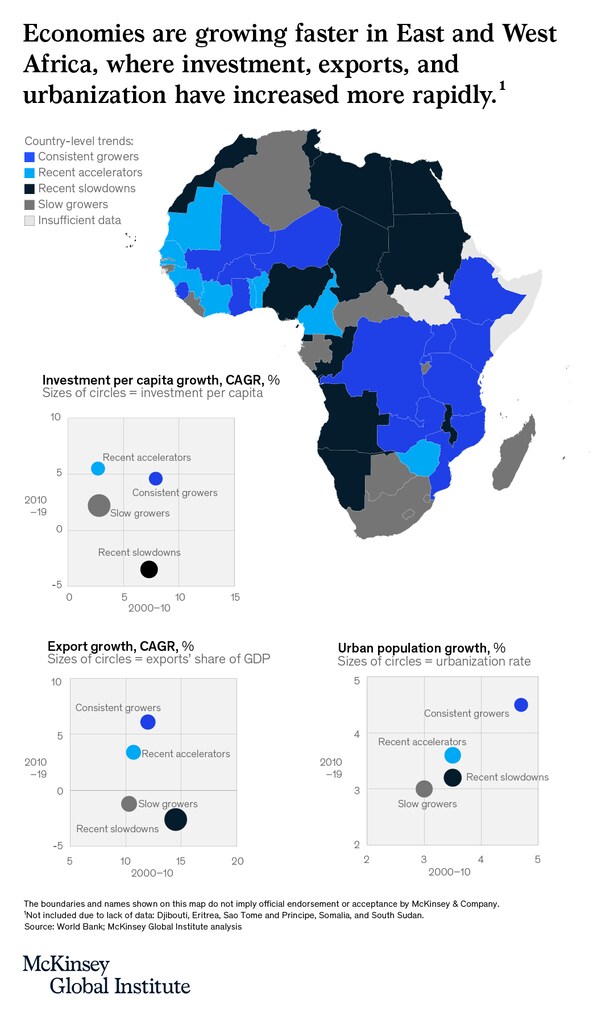
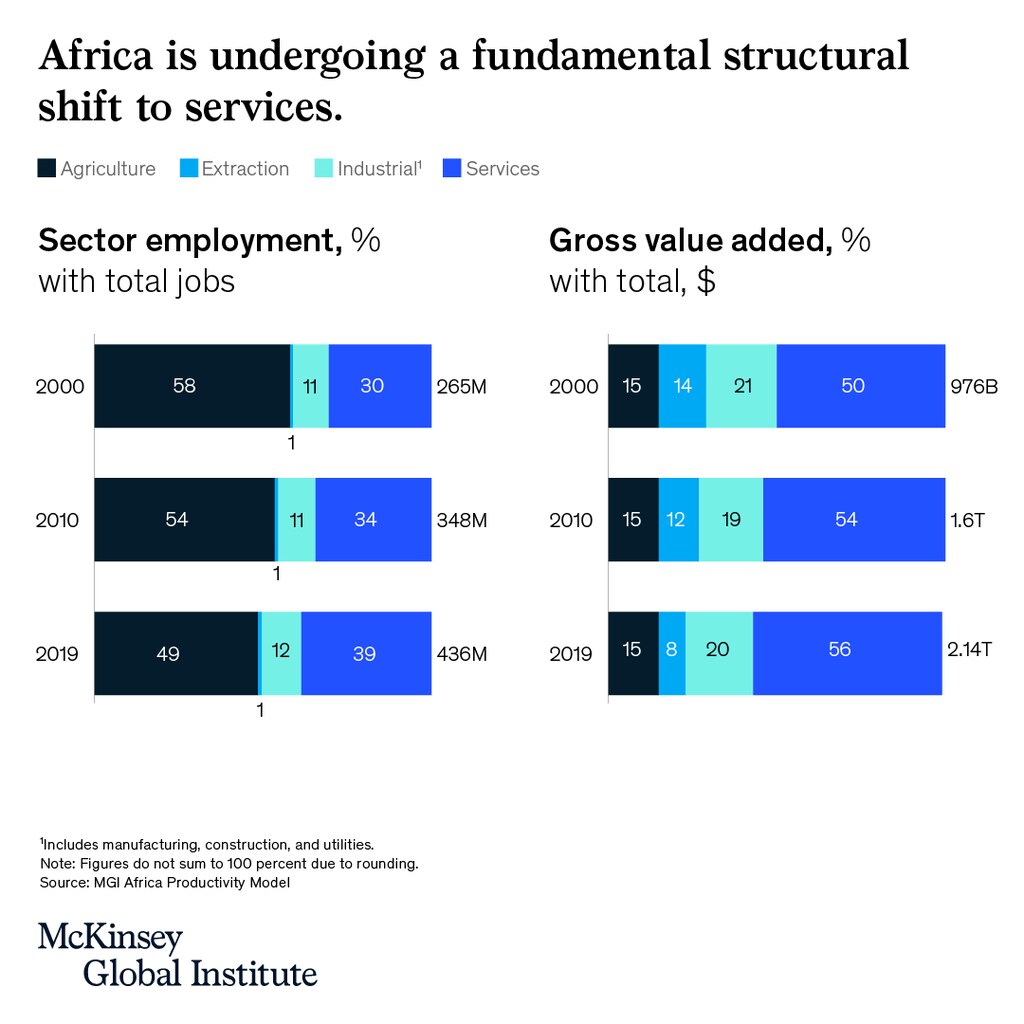
Their fortunes also illustrate a structural economic shift that has occurred over the past 20 years across the continent, as people have left work in the fields for more productive jobs in trade and other services in cities.
Employment in services increased from 30% to 39% from 2000 to 2019, securing the service sector’s place as the major driver of economic output across the continent.
Services jobs typically deliver high productivity, yet at $7,200 in 2019, the real productivity of Africa’s services sector was the lowest of any region in the world. Most of the people leaving work in the fields for cities ended up in low productivity service jobs in trade.
Productivity in the sector fell by 0.1% on average each year between 2010 to 2019. Simply returning productivity growth to the 2000 to 2010 annual average of 1.8% would increase the sector’s gross value added by $400 billion by 2030.
If the productivity growth of the services sector were to match that of Asia’s strongest services hubs, it would add $1.4 trillion to the continent’s economy and create 225 million jobs by 2030 – a crucial consideration in the light of Africa’s rapidly growing workforce.
Opportunities for greater productivity across Africa
The same migration that tamped down productivity in Africa’s services sector contributed to growing productivity across the continent’s agricultural sector over the past two decades, partially because fewer people farmed the same land.
Improving the yields of that land will help ensure food supplies and improve the incomes of many smallholder farmers, many of whom live at or below the poverty line.
The industrial sector, spanning manufacturing, construction, and utilities, also offers opportunities to raise productivity. The size of the industrial sector has remained constant, accounting for about 12% of employment and 20% of economic output.
Nonetheless, the sector had the highest productivity growth of any sector in Africa over that period – 1% a year on average compared with 0.8% across sectors – and is the only sector in which productivity growth did not decline over the 20-year period.
Increasing and improving manufacturing output for African markets as well as for export markets beyond the continent could add to the continent’s productivity.

Meanwhile, increased local manufacturing that identifies key products needed in African countries and produces them to meet local demand is another way that African companies can improve productivity.
If African countries were to match India’s rate of production for domestic markets, they would unlock $140 billion in additional economic value by 2030.
Enhancing the competitiveness of the African manufacturing sector can also make African products more attractive internationally.
At a time when multinational companies are working to diversify supply chains, African companies and industries have opportunities to gain a greater role as suppliers, particularly if they work to add value to products with export potential.
For example, Cote d’Ivoire and Ghana, which together grow more than 60% of the world’s cocoa, doubled the share of locally processed cocoa beans to almost 30% from 2000 to 2019.
Understanding diversity key to rekindling growth
The successes apparent in many African countries can provide examples to establish productivity as the bedrock of Africa’s economic growth.
Understanding and attending to their diversity of qualities and in outcomes are critical to any effort to rekindle productivity and growth across the continent – there is no ‘one Africa’.
Each African nation can deploy its particular strengths and capabilities in ways that promote productivity-led growth and improve lives across the continent at large. Reimagining Africa’s growth is achievable and can lead to greater sustainability and prosperity for its people.