In this daily round-up, we'll bring you a selection of the latest news updates on the COVID-19 coronavirus pandemic, as well as tips and tools to help you stay informed and protected.
Today's big stories: Cases surge in Singapore; Immunity cards issued in Chile and oil prices drop below $0 a barrel.
1. How COVID-19 is affecting the globe
Confirmed cases of the COVID-19 coronavirus are now at nearly 2.5 million worldwide, according to the latest figures from Johns Hopkins University. Over 171,000 people are known to have died from the virus. Roughly 660,000 have recovered.
The price of crude oil has dropped below $0 a barrel, a record low, further highlighting the toll the pandemic is taking on the global economy.
Turkey sees a rise in cases and will face a four-day curfew later this week.
Immunity passports in Chile will allow recovered patients to return to work.
Cases surge in Singapore, a country that seemed to have suppressed the virus.
2. Why the WHO says the "worst could yet be ahead of us"
Political division is fueling the COVID-19 coronavirus pandemic, said Dr Tedros Adhanom Ghebreyesus, Director-General of the World Health Organization (WHO), at a briefing Monday.
The virus, he said, exploits personal differences, especially those between ideologies or political parties. “This virus is dangerous. It exploits cracks between us."
These squabbles, he said, will lead to more deaths and "this virus will stay longer with us to kill more people and we will lose more precious lives”.
"Without national unity and global solidarity ... trust us: the worst is yet ahead of us", he said.
3. These countries are lifting coronavirus lockdowns and other restrictions
Curves are flattening and infection rates are falling, leading countries such as Denmark, Germany, Switzerland, and others to take steps to end their lockdowns or further relax social distancing measures.
For instance, Denmark opened its daycare centres and primary schools last week. This week, other professions such as hairdressers and psychologists were allowed to open their doors.
South Korea, which managed to contain the virus and sidestep many harsh stay-at-home measures faced by some countries, relaxed some social distancing measures this week for religious and sports facilities while many firms are starting to allow employees to return to work.
“This will probably be a bit like walking the tightrope,” Danish Prime Minister Mette Frederiksen said at a recent press conference. “If we stand still along the way we could fall and if we go too fast it can go wrong. Therefore, we must take one cautious step at a time.”
4. Global supply chains moving is key to overcoming COVID-19
Anabel González, a Senior Fellow at the Peterson Institute for International Economics says trade policies should be put in place throughout the pandemic to ensure developing and emerging economies have access to affordable medical supplies.
The world’s poorest countries, says González, are extremely vulnerable especially given just a handful of countries exporting key medical equipment supply 65 to 80% of the total world imports of those products." Any restrictions on exports risk leaving most of the world without access to vital supplies, with catastrophic consequences," says González.
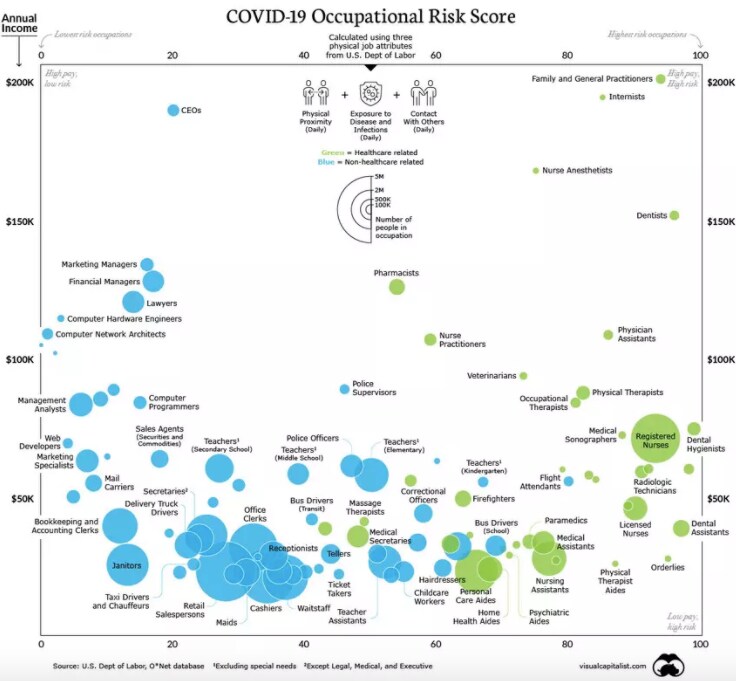
5. These are the occupations with the highest COVID-19 risk
Only around a third of American workers can work from home and social distancing can only protect a fraction of workers. This graphic shows the workers most at risk to infection by coronavirus.