This daily round-up brings you a selection of the latest news updates on the COVID-19 coronavirus pandemic, as well as tips and tools to help you stay informed and protected.
Today's top stories: How Germany contained coronavirus; South America becomes the new COVID-19 epicenter; global fiscal support during COVID-19, in one chart.
1. How COVID-19 is affecting the globe
Confirmed coronavirus cases have surpassed 5.3 million worldwide, according to Johns Hopkins University. More than 342,000 people have died from the virus, while over 2 million have recovered.
Russia reports 153 coronavirus deaths, highest daily toll yet.
China reports three new coronavirus cases after first day with none.
US states reopening for summer, celebrates Memorial Day weekend.
South America a new COVID-19 epicenter, Africa reaches 100,000 cases.
Muslims around the world celebrate Eid al-Fitr in the shadow of COVID-19.
2. How Germany contained the coronavirus
"Germany is often referred to as a positive example of how to manage the COVID-19 pandemic. We were successful in preventing the overburdening of our health system. The curve of infections is clearly flattening. And the proportion of severe cases and fatalities is lower in Germany than in many other countries. But this makes us humble, rather than overconfident," writes Jens Spahn, the country's health minister.
Spahn lists three reasons why he believes Germany has navigated the pandemic relatively well.
"First, the German health-care system was in good shape going into the crisis; everyone has had full access to medical care," he says.
"Second, Germany was not the first country to be hit by the virus, and thus had time to prepare. While we have always kept a relatively large number of hospital beds available, particularly in intensive-care units, we also took the COVID-19 threat seriously from the beginning.
"Third, Germany is home to many laboratories that can test for the virus, and to many distinguished researchers in the field, which helps to explain why the first rapid COVID-19 test was developed here."
3. Global fiscal support during the COVID pandemic, in one chart
Governments have put forward swift and significant emergency lifelines to protect people in response to the pandemic.
But just how much, exactly?
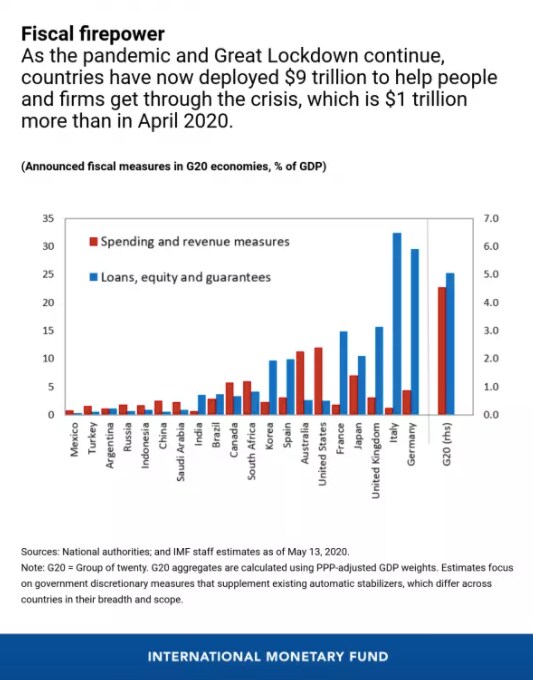
"The total is about $9 trillion, or $1 trillion more than the estimates just over a month ago," write IMF economists Bryn Battersby, W. Raphael Lam and Elif Ture.
"The breakdown looks like this: direct budget support is currently estimated at $4.4 trillion globally, and additional public sector loans and equity injections, guarantees, and other quasi-fiscal operations (such as non-commercial activity of public corporations) amount to another $4.6 trillion."
Here's a handy IMF chart which shows just where these financial lifelines have come from.
4. Top science reads of the week
If you're in need of some Sunday reading, take a look at this COVID-19 round-up from the science experts on the World Economic Forum's Programe Team.
From old antibodies to new vaccines, they've selected some of the biggest coronavirus-related science stories you may have missed last week.
And don't forget to listen to the latest edition of our podcast, World vs Virus, which features an in-depth interview with the IMF's Chief Economist, Gita Gopinath.