This daily round-up brings you a selection of the latest news updates on the COVID-19 pandemic, as well as tips and tools to help you stay informed and protected.
Top stories: India passes 3.2 million confirmed cases; re-infection cases in Europe; German economy suffers record contraction.
1. How COVID-19 is affecting the globe
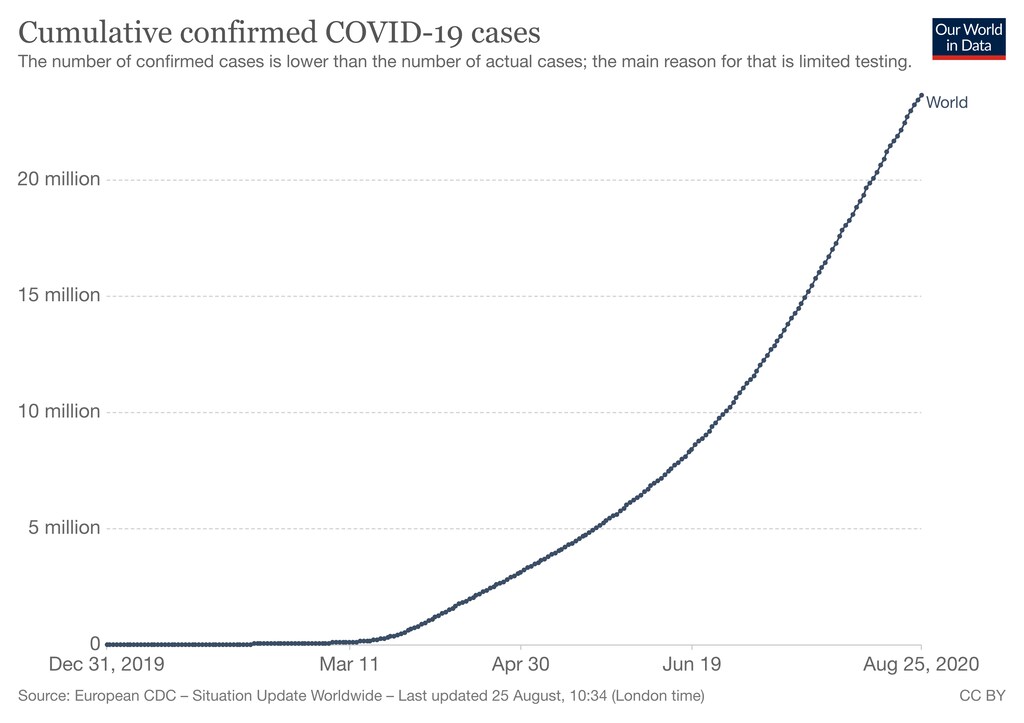
Confirmed cases of COVID-19 have now reached more than 23.9 million globally, according to the Johns Hopkins Coronavirus Resource Center. The number of confirmed coronavirus deaths now stands at more than 819,000.
Confirmed cases of COVID-19 have gone past 3.2 million in India.
The Confederation of British Industry says British retailers have cut the most jobs since the 2009 global financial crisis. It also warned the pace of losses could accelerate.
New cases in Turkey jumped to their highest level since mid-June, according to health ministry data.
The German economy contracted at a record 9.7% in the second quarter of 2020. Coalition parties agreed yesterday to extend economic relief measures.
Myanmar has reported its biggest daily rise in new cases - 70. It has reported six deaths and 574 infections since March.
Researchers in Australia hope to launch trials of an antibody therapy early next year. A large-scale trial of a vaccine could start before the end of 2020.
US colleges are grappling with an increase in coronavirus cases as classes resume.
2. German antibody study
Around 6% of residents of a German town that was an early COVID-19 hotspot, had antibodies to the virus.
Researchers from the Robert Koch Institute for infectious diseases tested people in Bad Feilnbach, in the south of the country, between 23 June and 4 July. They found 2.6 times more infections that previously reported.
Of those who had antibodies, 14.5% had shown no symptoms. The highest prevalence of the virus was among 18-34 year-olds, at 8%.
The study is part of ongoing research of towns in Germany, and the Institute said it would wait for more results before drawing broader conclusions.
3. Re-infections in Europe
Two patients - one in Belgium and one in the Netherlands - are confirmed to have been re-infected with coronavirus.
The cases follow a report of re-infection from Hong Kong. The Belgian case saw a woman first contract COVID-19 in March before contracting a different strain in June.
The Dutch case saw an elderly patient contract a different strain.
“It is clear there has been a first and a second infection with a substantial quantity of virus. Enough to be able to determine the genetic code of the virus, that is what showed they were indeed different,” said Marion Koopmans, a leading virologist in the Netherlands and a member of the World Health Organization’s scientific advisory group.
But, she also cautioned that the patient had a weakened immune system, and that she didn't think re-infection was 'standard'.
The World Health Organization, in reference to the Hong Kong case, has also cautioned that more research is needed before conclusions can be drawn.