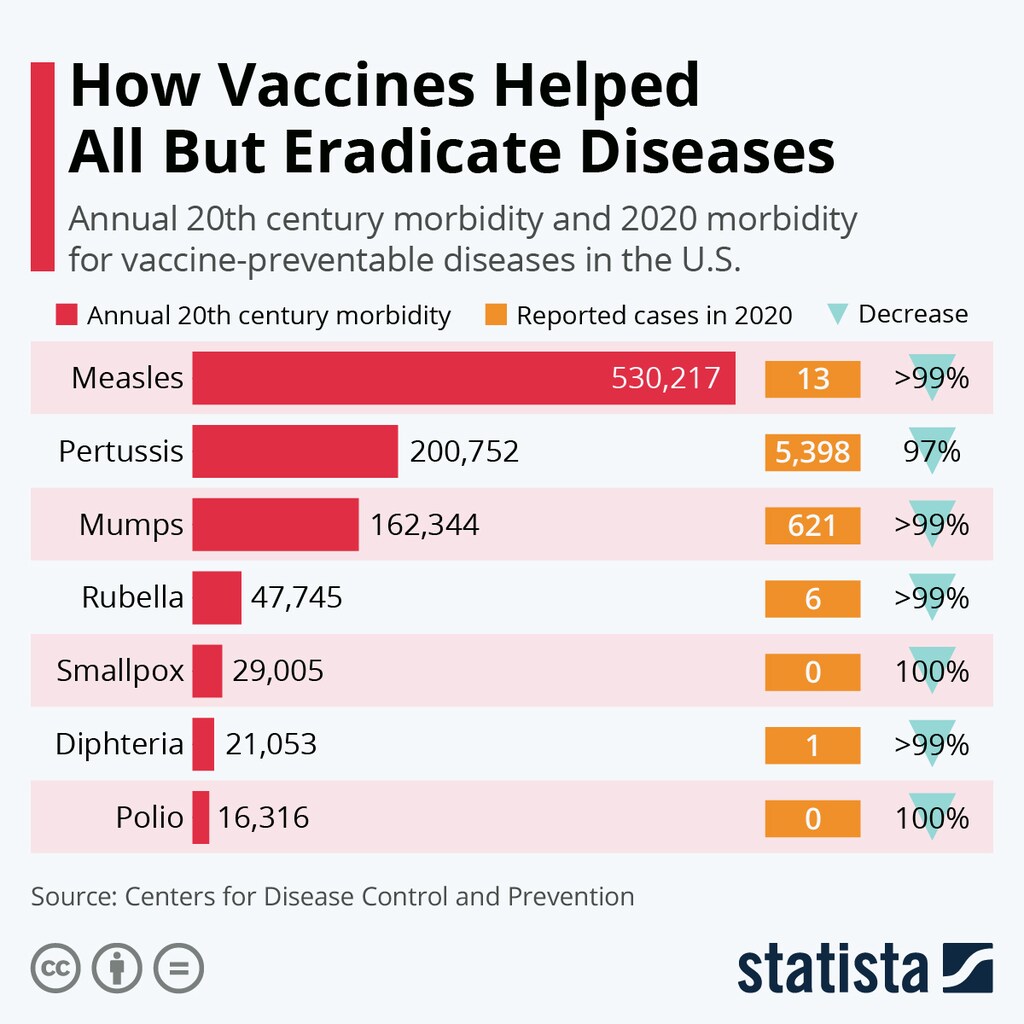
Vaccines have helped to eradicate major diseases in the US, this Statista chart shows.
Diseases like smallpox and polio saw no recorded cases in the US in 2020.
But progress in eradicating other diseases has slowed, partially due to vaccine scepticism.
The last week of April marks World Immunization Week, celebrated by the World Health Organization to promote the use of vaccines to protect people of all ages against diseases. Vaccines have been around for a long time and the first one is generally credited to Edward Jenner, an English doctor who injected pus from a cowpox pustule into an incision on an eight-year old's arm on May 14, 1796. The boy then proved immune to smallpox, one of the deadliest diseases at that time.
Data from the Centers for Disease Control and Prevention shows just how effective vaccines have been in all but eradicating major diseases in the United States. In 2020, there were no reported cases of small pox and paralytic polio for example, compared to an annual average of 29,005 cases and 16,316 cases in the 20th century, respectively. And even though progress in eradicating measles has stalled in recent years (due in part to growing vaccine skepticism), its morbidity is nowhere near the annual case load seen in the 20th century, when half a million people were infected in an average year. Its prevalence has fallen by more than 99 percent due to vaccinations, along with a whole host of other diseases such as pertussis (whooping cough), mumps, rubella and diphtheria.