The newly appointed Women’s Health Ambassador for England is on a mission to close the gender health gap.
Dame Lesley Regan says she wants to end taboos on topics like periods and the menopause.
Overall stress levels were 4% higher in women than in men between 2020 and 2021, according to the World Economic Forum’s Global Gender Gap Report 2022.
“I’m a great believer that when you get it right for women, the whole of the rest of society benefits.”
So says Dame Lesley Regan, the newly appointed Women’s Health Ambassador for England, who is on a mission to close the gender health gap.
She wants to end taboos on certain women’s health topics that we shy away from, including periods and menopause.
“My main focus initially is going to be to look at those areas of health and wellbeing that really affect almost every woman’s life. So all the common things that so often we don’t talk about: problem periods and really good, easy access to contraception.
“The menopause has suddenly got an airing in the public domain again - and I want to be able to do that for all areas that affect women.”
Women’s health strategy
Dame Lesley, a doctor and Professor of Obstetrics and Gynaecology at Imperial College London St Mary’s Hospital Campus, will implement the UK Government’s Women’s Health Strategy for England, which promises to “reset the dial on women’s health”.
Her appointment comes after a UK Menopause Taskforce was set up in February 2022, following a bill through parliament calling for free Hormone Replacement Therapy (HRT).
Nearly 100,000 women wrote to the government in response to a Call for Evidence. They said taboos and stigmas around health can stop them from seeking help, and “reinforce beliefs that debilitating symptoms are ‘normal’ or something that must be endured”.
They felt more comfortable speaking about general health concerns including diabetes and heart disease, than women-specific conditions such as menopause and post-natal depression.
Through its Women’s Health Strategy, the government wants to achieve these five goals:
Enable all women to feel comfortable talking about their health and to no longer face taboos when they do talk about their health
Provide access to services that meet women’s needs across the life course
Provide access to high-quality information and education from childhood through to adulthood
Enable all women to feel supported in the workplace and reach their full potential at work
Embed routine collection of demographic data of participants in research trials to make sure it research reflects society.
Lack of data on women can perpetuate the gender health gap, according to the UN, partly because men are often the default in medical research and then policy design - and globally more work needs to be done to close the gap.
The global health gender gap
In the World Economic Forum’s Global Gender Gap Report 2022, which measures gender parity in 146 countries, the Health and Survival gender gap was shown to have varied only slightly over time, reaching its lowest point in 2018 and recovering marginally since then.
The report noted a recent gender gap in stress levels.
Between 2020 and 2021, overall levels of stress, sadness, worry and anger increased by 1% among women, and were 4% higher in women than in men.
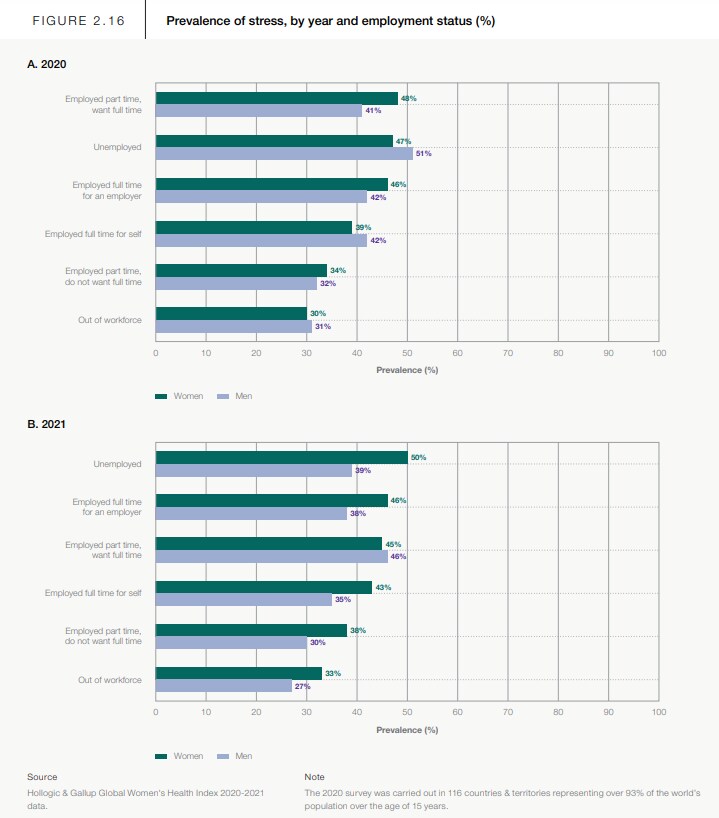
Stress increased for nearly all women regardless of employment status: unemployed women (+3%), women in self-employment (+4%), women in part-time employment not seeking full-time employment (+4%), as well as for women out of the workforce (+3%).
The one category in which stress among women decreased was among those employed part-time and seeking full-time work. In contrast, stress decreased for almost all men in 2021, increasing only among men in part-time work seeking full-time work.
Back in England, Dame Lesley is just getting to work on the key goals for initiatives for the Women’s Health Strategy - time will tell if the strategy succeeds in closing the country’s health gender gap.