This global round-up brings you health stories from the past month.
Top stories: AI among 17 threats to human health, Lancet Commission finds; How selfies can reveal our biological age; and Ebola spreads to fourth African country.
1. Experts declare 17 catastrophic threats to human health this century
Using AI for malicious purposes and nuclear war top a list of risks to human health – and indeed survival – over the remainder of this century, according to experts from the fields of health, economics, security, governance and technology.
The Lancet Commission on 21st Century Global Threats to Health identifies 17 “interconnected dangers to humanity”, including air pollution, climate change, pandemics and childhood malnutrition, that need to be tackled as a whole “to protect and strengthen the future of health”.
Each of the threats is projected to contribute at least 1 billion years of healthy life lost by 2100 – or disability-adjusted life years (DALYs) – if successful interventions are not achieved. Two of the threats – nuclear conflict and the malicious use of AI – carry “extinction potential”, says The Lancet.
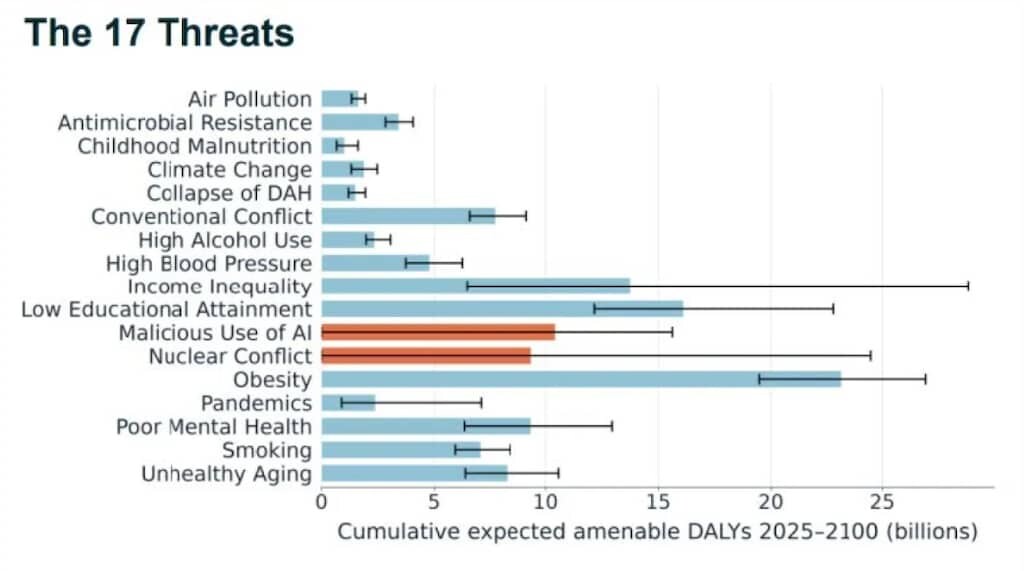
While alarming, the point of the analysis, which draws on Global Burden of Disease data from the Institute for Health Metrics and Evaluation, is to provide governments with quantitative data about major health threats and what action can be taken now to change the current trajectory.
This is particularly important when the impacts will not be evenly shared. Sub-Saharan Africa would bear 70% of the health toll from a collapse in development assistance for health, the Commission finds. And while people are expected to live longer, quality of life could be compromised. By 2100, people could spend about 13 years in poor health, compared to around eight years in 1990.
The Commission has put forward three actions that governments and societies can take to avoid these outcomes:
Build in readiness: Threat-ready, resilient health systems that can anticipate and mitigate risks before they escalate must be backed by sustained financing.
Invest in innovation: Breakthrough innovations in health require dramatic increases in investment, alongside governance to ensure the safe deployment of AI as a scientific tool.
Track threats over time: Progress needs monitoring, and establishing a Lancet Monitor of 21st Century Global Threats to Health would ensure risks are not forgotten between crises.
2. Your face can predict your cancer survival rate, new study finds
An AI tool can predict the survival outcomes of cancer patients from a photograph of their face, according to US researchers.
Trained on over 40 million faces of both healthy people and cancer patients of varying ages and ethnicities, the Face Age Health Recognition (FAHR) model “improved prognostic accuracy” in trials, reports The Lancet.
Doctors are already aware that the face can reveal “valuable insights into an individual's health status”, say the researchers, but quantitative data to back this up has been lacking. The AI tool was configured to carry out two different but interlinked tasks: biological age estimation (FAHR-FaceAge) and cancer survival prediction (FAHR-FaceSurvival).
Among cancer patients in the trial, those who looked five or more years older than their actual age were found to have a 21% higher risk of dying, while the patients who looked five or more years younger had a 17% lower risk. Lifestyle factors were significantly associated with biological age discrepancies. Smoking was confirmed to age the face, as was heavy alcohol and drug use, but smoking was also linked consistently to both smoking-related and non-smoking-related cancers.
While the technology is not ready for wider deployment, the researchers say it will help doctors make more tailored and effective decisions about the best treatment pathways for cancer patients. Dr Raymond Mak, lead researcher of the study, told The Guardian: “As the population ages, physicians need better ways to estimate physical reserve and frailty before recommending intensive treatments such as radiation, surgery or systemic therapy.”

3. News in brief: Health stories from around the world
Ebola spreads to fourth African country: Nigeria’s first Ebola patient in over a decade was identified in October, making it the fourth nation in Africa to fall prey to the disease, following the initial outbreak of Ebola in Democratic Republic of the Congo in May. "We need to consider that no one is safe today," Dr Jean Kaseya, head of Africa's top public health body, told Reuters.
Europe’s record West Nile Virus cases: Extreme summer heat in mainland Europe brought a record number of cases of the mosquito-borne disease, West Nile Virus. The European Centre for Disease Prevention and Control reported 1,715 cases so far this year, compared to 989 cases at the same point last year. Italy has been hardest hit, with 748 cases and 56 deaths, reports the Telegraph.
HIV medicines running dangerously low: Aid cuts have impacted global supplies for HIV prevention and testing, reports the Guardian. One international network of organizations said that 40% of its member associations had run out of at least one HIV-related product and 60% had at least one product at low stock levels.
Tap water undrinkable in Norwegian village: Thawing permafrost caused by the climate crisis has contaminated drinking water in a remote village in Norway. Prolonged exposure to the high levels of manganese and other contaminants leaching from the bedrock can cause neurological problems, so temporary tanks of free purified water have been installed in the village.
New health security agreement signed: INTERPOL and the World Health Organization have cooperated on a framework to tackle health threats that intertwine with security and crime, such as falsified medical products and the misuse of chemical materials. “Crime and health are increasingly interconnected,” said INTERPOL Secretary-General, Valdecy Urquiza. “This agreement strengthens our ability … to protect communities and ensure that those who threaten them are brought to justice.”
Russia reports five Mpox patients: In the Russian city of St Petersburg, five patients tested positive for the virus Mpox in October, says Reuters. Contacts are being traced and anti-epidemic measures are being put in place.
US hit by early flu season: The West Coast of America has seen an unusually early influx of flu cases and doctors are urging everyone to get vaccinated as soon as possible. Virologists are not yet sure why the cases have started early, or in the west (when usually they start in the south), but suggest an “immunological gap” could be to blame.
4. More on health from Forum Stories
Who should be responsible when AI systems make mistakes in healthcare? I recently joined CNN's Becky Anderson on her Intelligent Future series to discuss the need for shared responsibility among healthcare workers, hospitals and technology companies, supported by clear government policies and international cooperation.
At the World Bio Summit 2026 in Seoul, I was honoured to speak on the role of public-private partnerships in scaling healthcare innovation. South Korea joined the Forum's Pandemic Preparedness Engine (PPX) as its first exemplar. Developed with CEPI and research and industry partners, PPX aims to accelerate vaccine development through AI, supporting the 100 Days Mission to develop vaccines against emerging pandemic threats within 100 days.
Japan recently announced it now has over 100,000 centenarians, but a longer life doesn’t necessarily equate to a healthier one. The country is embracing technology like AI cognitive checks, mobile supermarkets and ‘digital co-living’, as well as later retirement ages, to facilitate healthier ageing. In this article, the Forum’s Naoko Tochibayashi explains how Japan is marrying technology and human connection – and how the approach could be a blueprint for the world’s ageing societies.
The world loses around $6 trillion every year from the largely invisible health effects of lead poisoning – and more than a billion children have dangerous levels of lead in their blood. Yet the issue rarely makes the headlines. With lead exposure coming from everyday products like toys, cookware and cosmetics, UNICEF lead-free strategists make the case that the issue is a multi-sector blind spot that must be urgently tackled.
With more people aged 65 and over than under-fives in the world, three experts explore how we can ensure our later years remain healthy and meaningful in the video below:

How the Forum helps leaders strengthen health systems through collaboration
The Centre for Health and Healthcare connects leaders to make sense of challenges facing health systems worldwide, including access, equity, resilience and preparedness.
Through trusted dialogue and public-private collaboration, the Centre enables partners to align around shared priorities and advance collective action to improve health outcomes.