
Researchers can't agree whether the world's population will increase or decrease over the next century.
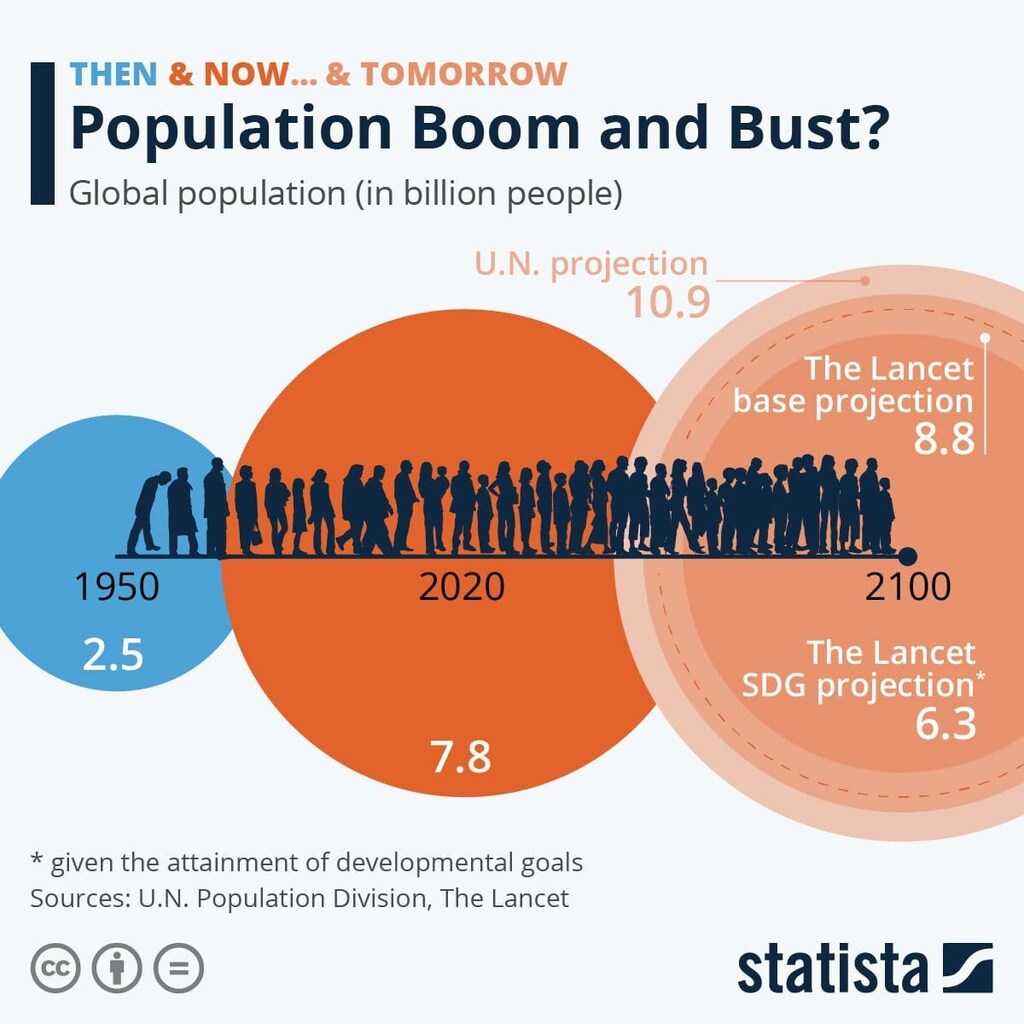
The U.N. population division assume that by 2100 they'll be 10.9 billion people on the planet.
Researchers of the University of Washington however believe that the population of the world will be between 6.3 and 8.8 billion people.
It also assumes the global population will peak in 2064 at 9.7 billion people.
The world has already set the course for a future population decline - while experts agree on this, they haven't been on the same page about just how fast the number of people on this Earth will shrink.
In an article published in medical journal The Lancet, researchers of the University of Washington, for example, challenge the U.N. population division's view that world populations will rise beyond the end of this century. They assume that by 2100, the population of the world will be between 6.3 and 8.8 billion people - so potentially fewer than in the year 2020. The researchers conclude that the speed of population decline is linked to the speed of the attainment of developmental goals, most notably education for women and girls and access to contraception. Furthermore, the Lancet authors point out that models of population growth have proven to be very stable while those dealing with population decline were much less reliable.
What is the World Economic Forum doing to promote sustainable urban development?
Cities are responsible for 75% of global greenhouse gas emissions and are home to over half of the world’s population—a number that will grow to two-thirds by 2050. By prioritizing cleaner energy, cities could contribute more than half of the emissions cuts needed to keep global warming to less than 2°c, which would be in line with the Paris Agreement.

To achieve net-zero and nature-positive cities and communities by 2050, the World Economic Forum is partnering with public and private sector stakeholders on initiatives that drive global ambition through local action. Here are just a few:
Davos Baukultur Alliance: Advancing high-quality planning, construction and management of buildings, infrastructure, and public spaces using principles based on climate resilience, sustainability and circularity in the built environment. Learn more.
Global New Mobility Coalition: Exploring new solutions to reduce congestion and emissions, enhance EV infrastructure and transform urban mobility and deliveries. Learn more.
Alliance for Urban Innovation: Connecting innovators and entrepreneurs to new markets and opportunities that reimagine and reshape quality of life and local economies. Learn more.
G20 Global Smart Cities Alliance: Accelerating intelligent, practical solutions to build climate resilience, enhance public well-being and tackle the most pressing challenges facing cities and local communities. Learn more.
Future of Travel and Tourism: Driving inclusive and sustainable economic growth while preserving cultural heritage and protecting natural ecosystems. Learn more..
Discover how you can be a part of our efforts to create more sustainable and livable cities and communities. Contact us here.
While the U.N. predicts that the world population will continue to grow past 2100, the Lancet article's base scenario assumes it will peak in 2064 at 9.7 billion people. According to the researchers, populations in Europe and Central Asia would already peak in 2023, while that date would be 2032 in East and Southeast Asia, 2049 in South Asia, 2055 in Latin America, 2064 in the U.S. and Canada as well as 2084 in North Africa and the Middle East and 2100 in Sub-Saharan Africa (taking into account migration patterns).