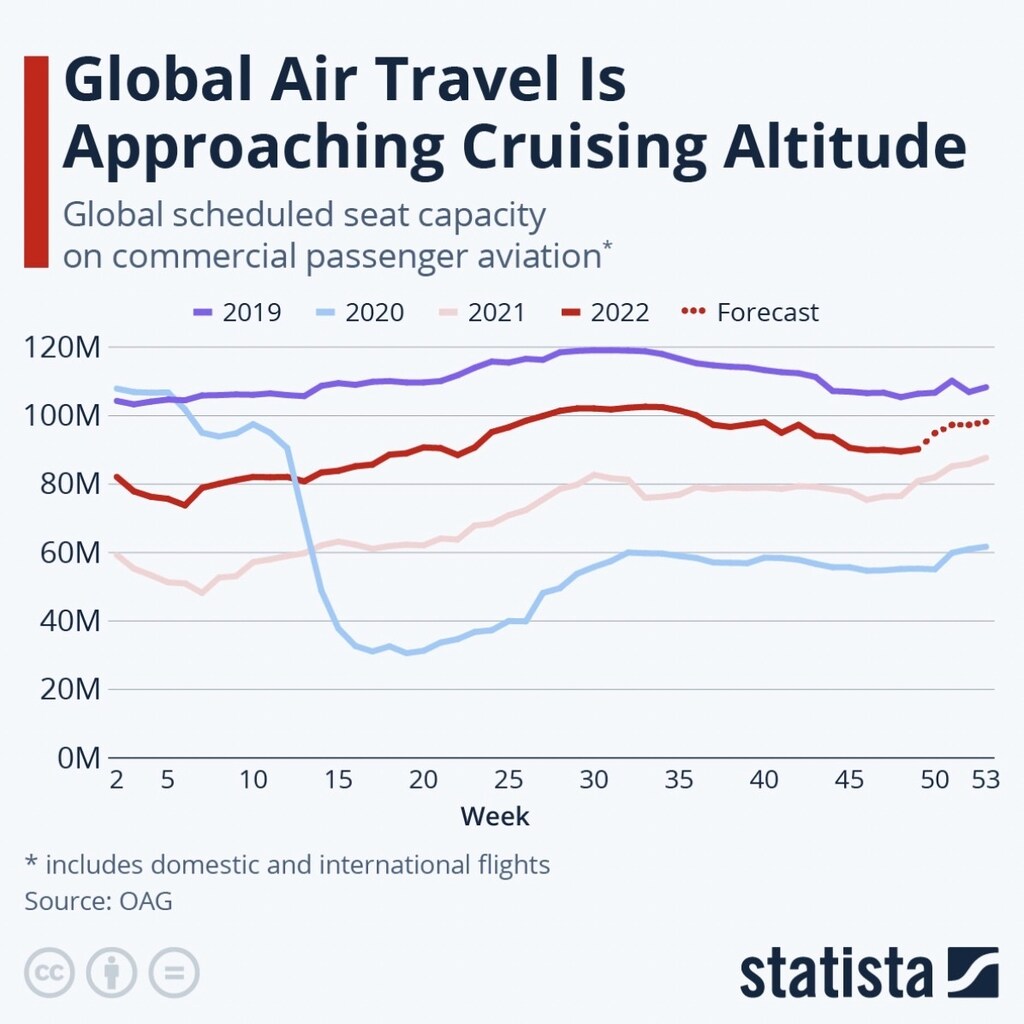
Air travel has picked up this year following COVID-19 disruptions in 2020 and 2021.
However, weekly seat capacity on commercial passenger airlines is still some way below 2019 levels.
There are also regional differences in how airlines have recovered following the pandemic.
As international travel was brought to an abrupt halt in 2020 at the onset of the Covid-19 pandemic, the aviation industry suffered “the worst year in history for air travel demand”. While 2021 was still mired by travel restrictions, turbulence gradually eased in 2022 as more and more passengers returned to the skies.

According to data from OAG, weekly seat capacity on commercial passenger airlines averaged 90.7 million so far this year, up from 61 million during the same period in 2020 but still some way below the 2019 level of 110.9 million. The gap is gradually closing, however, and global capacity exceeded 100 million for the first time since the pandemic hit for a couple of weeks this summer.
There are significant regional differences in how far passenger airlines have recovered from the Covid-19 shock. While capacity remains far below pre-pandemic levels in large parts of Asia, especially in terms of international flights, capacity in North America is very close to 2019 levels.