
Companies need to create good job posts in order to attract the best employees.
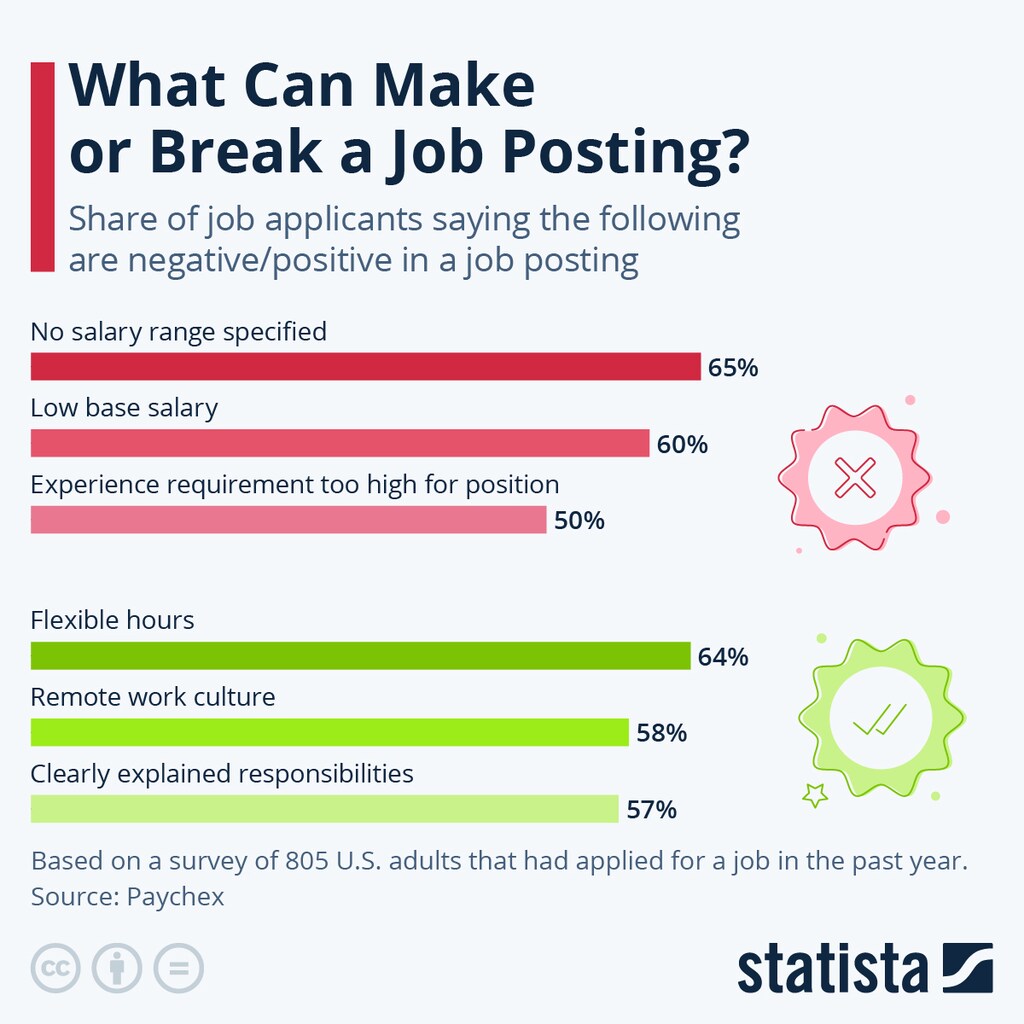
Not specifying a salary range is the top dislike named by job applicants in the US.
But jobseekers like adverts that mention flexible hours and a remote work culture.
So often, the focus is placed on the expectations a job applicant should fulfil in order to get the role they are looking for, but recruitment is a two-way street. The vital importance of a good job posting can't be underestimated if a company wants to attract the best and the most fitting potential employees.
As a recent survey by Paychex has revealed, one of the top red flags for job applicants in the U.S. is the lack of a specified salary range. Underlining the importance, employers in New York City will be required by law from November to include pay information in their ads in order to promote pay equity. While a low base salary is an unsurprising turn-off which may be out of the recruiter's control, the third most-cited issue is when the experience requirement is perceived to be too high for position.
On the other side, employers are now increasingly under pressure to offer genuinely flexible working models. The biggest green flags for the survey respondents were flexible hours and a remote work culture. Clearly explained responsibilities were also of high value to more than half of applicants.
How is the World Economic Forum promoting equality in the workplace?
The Future of Jobs Report 2023 found that 75% of companies surveyed expect to adopt AI, big data and cloud technologies in the next five years.
The Centre for the New Economy and Society provides a platform for leaders to share insights on the adoption and efficacy of new technologies, and the readiness of the workforce to use them. Our work includes developing insights and dialogue on growth, jobs, skills, equity and risks.
Learn more about our impact:
Gender parity: Since 2006, we have annually measured the state and evolution of gender parity in 101 economies, supporting decision-makers to identify the most effective policies to close gender gaps. In Chile, we helped establish gender parity accelerators and benefitted 728,000 women – reducing the gender gap by 37% in the participating companies.
Reskilling Revolution: With our partners, we are helping the global workforce future-proof their careers, working with over 350 organizations to provide 1 billion people with better education, skills and economic opportunities by 2030.
Disability inclusion: Working with the Valuable500, we are collaborating with the largest global network of CEOs committed to closing the disability inclusion gap. Members are making progress by increasing the adoption of digital accessibility best practices and including disability in diversity, equity and inclusion strategies.
Racial justice: We are collaborating with a global coalition of 55 organizations in 13 industries who are committed to building equitable and just workplaces for professionals from under-represented racial and ethnic identities.
Want to know more about our centre’s impact or get involved? Contact us.