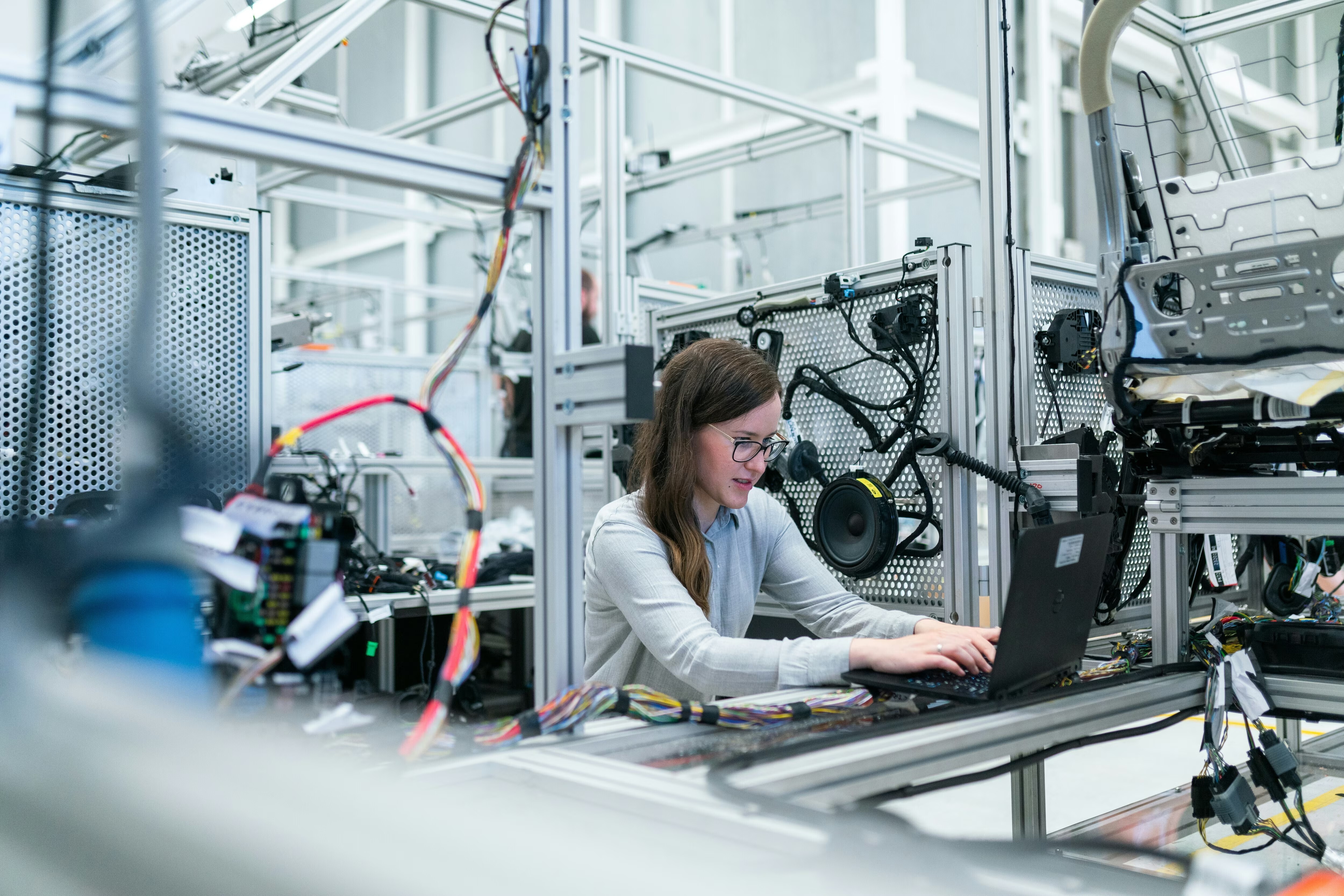
Women now account for more than half of the college-educated labour force in the United States, according to Pew Research Center.
There are 2.2 million more women aged 25 and older with at least a bachelor’s degree in the US labour force than before the pandemic.
But the COVID-19 pandemic disproportionately impacted labour market activity for adults without a bachelor’s degree, especially among women.
So, while women have increased their representation in the college-educated labour force since 2019, there has not been much change in the gender composition of the labour force that has some college education or less.
Women have overtaken men and now account for more than half (50.7%) of the college-educated labor force in the United States, according to a Pew Research Center analysis of government data. The change occurred in the fourth quarter of 2019 and remains the case today, even though the COVID-19 pandemic resulted in a sharp recession and an overall decline in the size of the nation’s labor force.
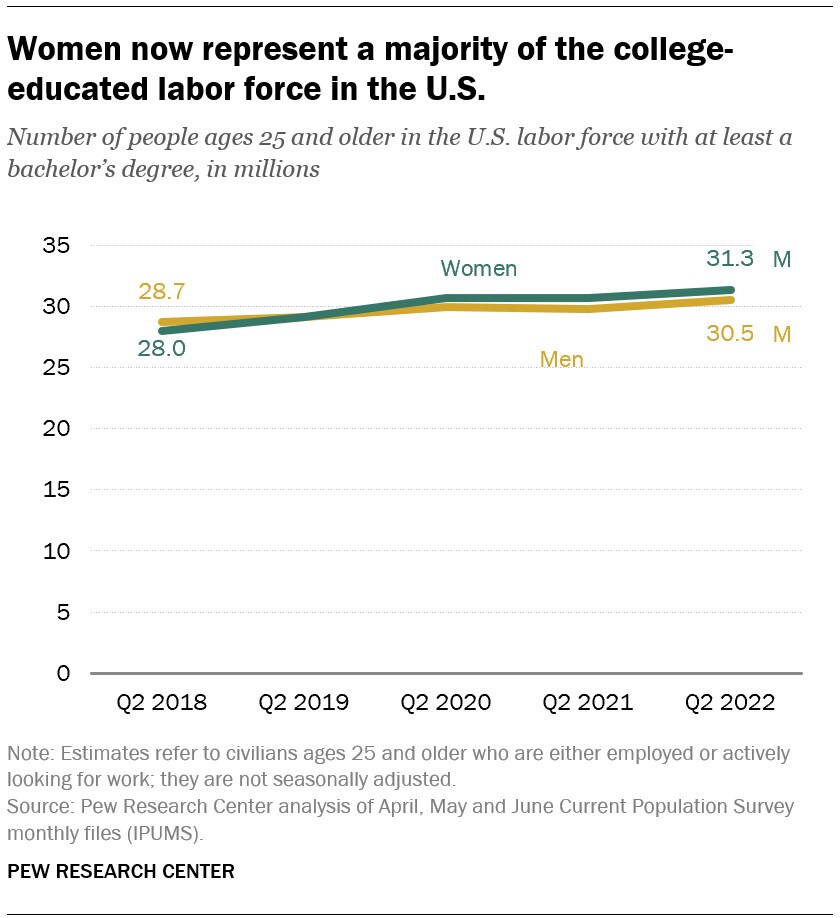
Today, there are more women ages 25 and older with a bachelor’s degree or more education in the labor force than before the pandemic: 31.3 million in the second quarter of 2022, compared with 29.1 million in the same quarter of 2019. The number of college-educated men ages 25 and older in the labor force is also greater than before the pandemic – 30.5 million, up from 29.1 million – though their ranks have not increased as quickly as those of women.
The pandemic disproportionately impacted labor market activity for adults without a bachelor’s degree, especially among women. The number of women with some college or less education in the labor force has declined 4.6% since the second quarter of 2019, compared with a smaller change among men with some college or less education (-1.3%).
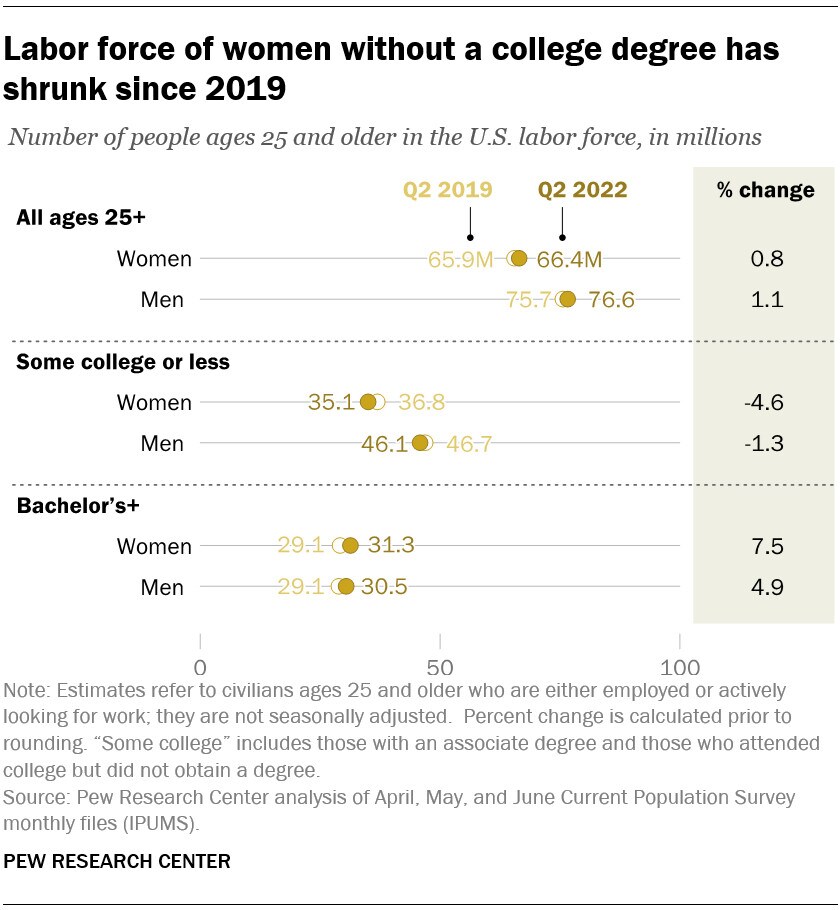
The upshot of these disparate changes in the labor force by gender and education is that women have increased their representation in the college-educated labor force since 2019. At the same time, there has not been much change in the gender composition of the labor force that has some college or less education.
Changes in the composition of the U.S. population, along with changes in labor force participation, help account for these trends. The number of women and men in the labor force depends on the size of each group and the percent of that group who are working or seeking work.
How is the World Economic Forum promoting equality in the workplace?
The Future of Jobs Report 2023 found that 75% of companies surveyed expect to adopt AI, big data and cloud technologies in the next five years.
The Centre for the New Economy and Society provides a platform for leaders to share insights on the adoption and efficacy of new technologies, and the readiness of the workforce to use them. Our work includes developing insights and dialogue on growth, jobs, skills, equity and risks.
Learn more about our impact:
Gender parity: Since 2006, we have annually measured the state and evolution of gender parity in 101 economies, supporting decision-makers to identify the most effective policies to close gender gaps. In Chile, we helped establish gender parity accelerators and benefitted 728,000 women – reducing the gender gap by 37% in the participating companies.
Reskilling Revolution: With our partners, we are helping the global workforce future-proof their careers, working with over 350 organizations to provide 1 billion people with better education, skills and economic opportunities by 2030.
Disability inclusion: Working with the Valuable500, we are collaborating with the largest global network of CEOs committed to closing the disability inclusion gap. Members are making progress by increasing the adoption of digital accessibility best practices and including disability in diversity, equity and inclusion strategies.
Racial justice: We are collaborating with a global coalition of 55 organizations in 13 industries who are committed to building equitable and just workplaces for professionals from under-represented racial and ethnic identities.
Want to know more about our centre’s impact or get involved? Contact us.
The number of women and men in the U.S. with at least a bachelor’s degree has increased since the second quarter of 2019. But the share of college-educated women who are in the labor force has not changed since before the pandemic, while the share of college-educated men who are working or looking for work has declined.
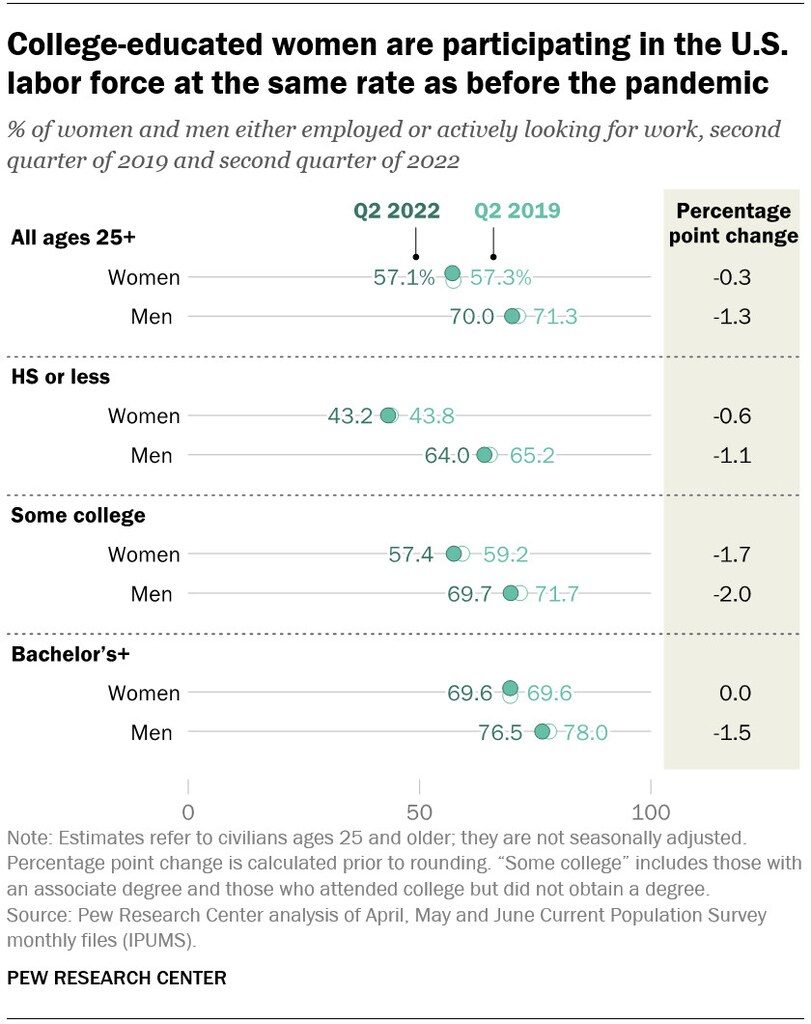
In the second quarter of 2022, the labor force participation rate for college-educated women was 69.6%, the same as in the second quarter of 2019. In contrast, men and most other educational groups now have lower rates of labor force participation than they did in the second quarter of 2019.
This shift in the college-educated labor force – as women now comprise a majority – comes around four decades after women surpassed men in the number of Americans earning a bachelor’s degree each year.