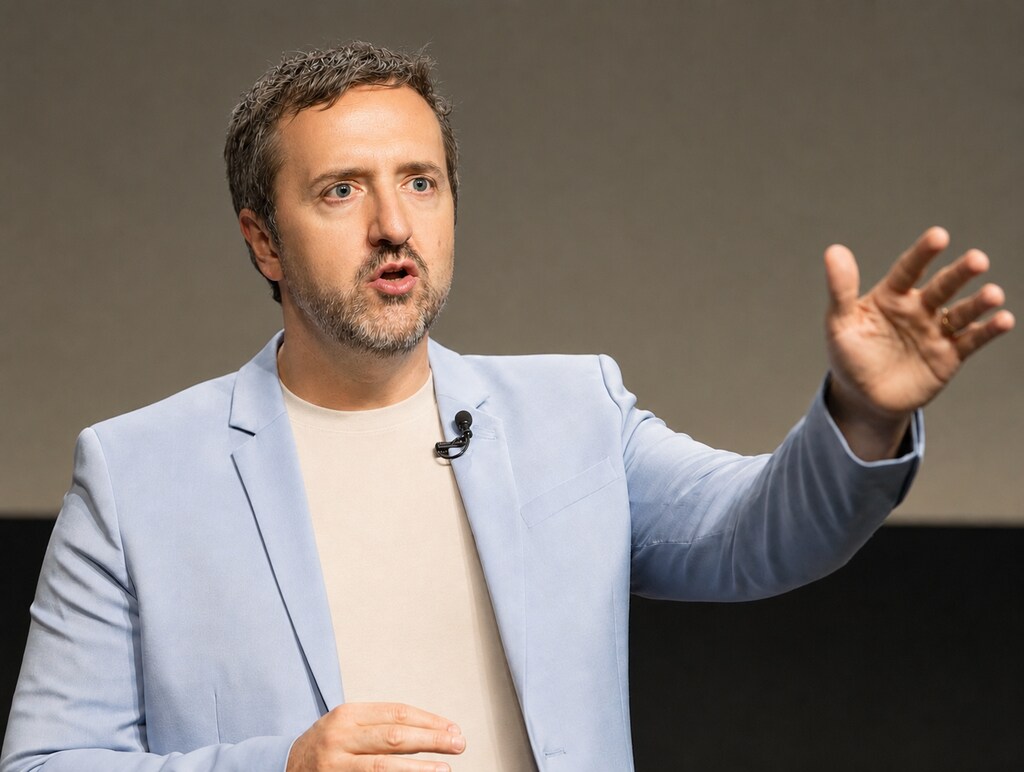
Robin de Haas, IMD Executive Fellow, coaches leaders on the idea that voice and body – not words alone – are the missing link between strategy and its impact.
The World Economic Forum finds that eroding trust in leaders is a symptom of leadership training that hasn't kept pace with a transforming world.
De Haas' answer is disarmingly simple: notice how you breathe and speak, and you change how you lead.
When Robin de Haas was born with a congenital condition, doctors told his parents, "Voice will never be his thing", and warned he should avoid customer-facing work altogether.
Only his sister could understand what he said and, at school, he was bullied relentlessly. Aged eight, he climbed to the top of a barn loft, looked down at the machinery below, and thought about ending things. Instead, he set about overcoming his disability and helping others.
Decades later, Swiss-born de Haas coaches UN executives, heads of government and CEOs on the theory he calls 'vocal leadership': the idea that before people process our words, they respond to their perceptions of the state of our nervous system.
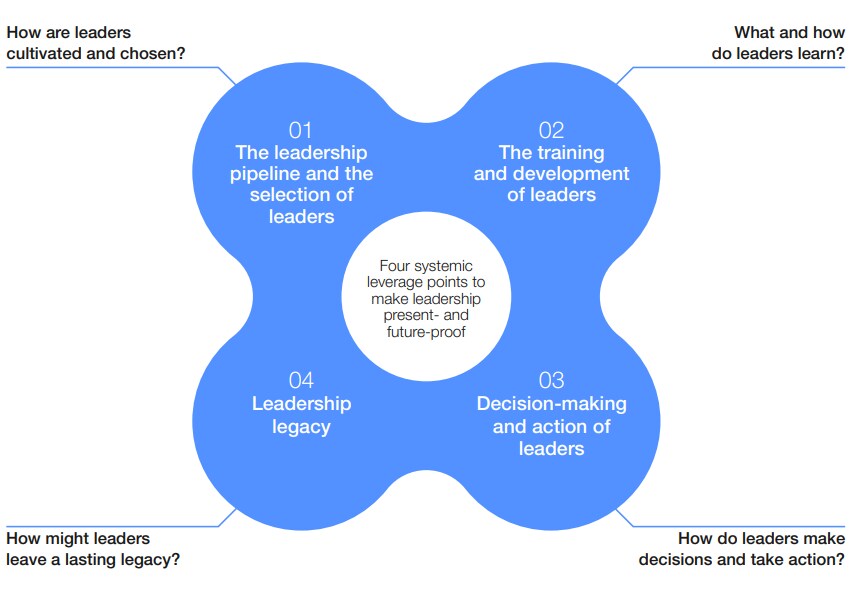
His work speaks to a challenge the World Economic Forum has identified: that widespread erosion of trust in leaders is not the cause of today's turbulence, but a symptom of leadership models that have failed to keep pace with a rapidly transforming world. Rebuilding trust requires rewiring how leaders are selected, trained and supported to make decisions – not just refining strategy.
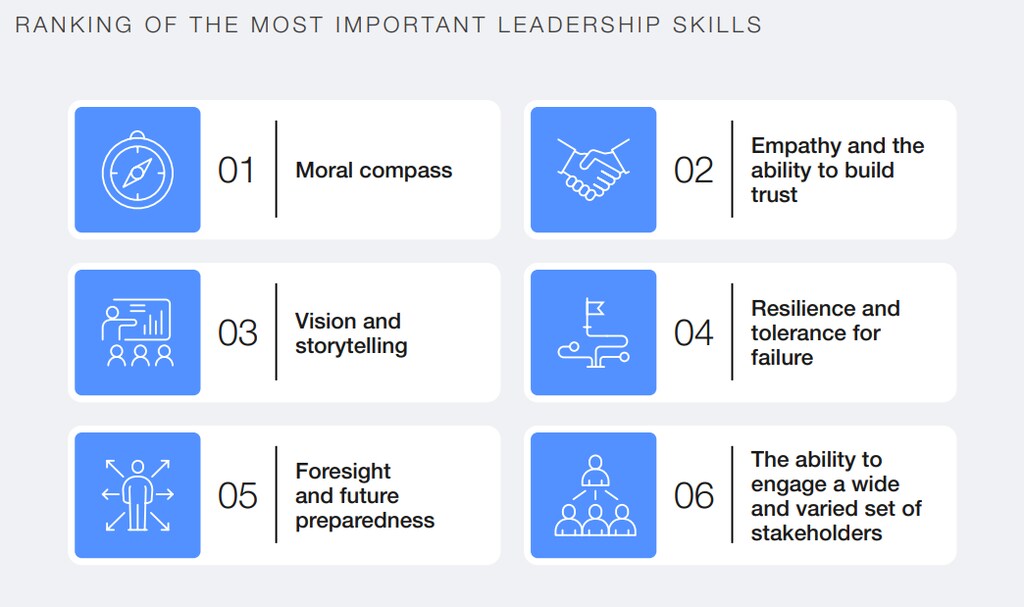
The Young Global Leaders (YGL) Leadership Survey found vision and storytelling were second only to moral compass and empathy as the most important leadership skills. But, for de Haas, how you deliver a message is just as important as what you say.
Here, in his own words, de Haas explains what authentic leadership really sounds like, why the human nervous system may be the one advantage AI can't replicate – and the simple breathing practice he says can help shift anyone out of fight-or-flight mode and into genuine leadership.
You were told your voice would never be your strength. What changed?
I thought, "If I go on, I have to look for love everywhere." To find love, I had to connect with others. I became obsessed with fixing my voice. I started paying attention like mad during speech therapy sessions. I thought, "The hardest thing to do with the voice is singing opera", so that's what I studied all the way to my Masters.
I started providing school support after class for children who were struggling. I kept looking for ways to help, and that brought me all the way to what is happening now.
It started with a friend who was too shy to sing in front of anyone. She sang in front of me, and I could see her body tensing in different places. I realized I could identify where she was holding tension. This came from the school courtyard, where I had learned to read body language to work out which child was going to hit me. What was obvious to me, I later discovered, was not obvious to others.
When did you realize this was about leadership, not just voice?
Around 2008, a senior executive at an international organization asked for help with his voice. I looked at videos of him and compared them with videos of great public speakers. Everything that was different. I could see the jaw retraction, compression in the neck.
At the start of our third session, I was stopped by his two secretaries and his bodyguard. They said, "Robin, what have you done with him? He is no longer yelling at us. We understand what he wants. He is pleasant to work with."
He had a discoordination between his airflow and his vocal cords. His vocal cords were closing much sooner than the airflow arrived, which created a semi-cough at the beginning of his sentences. People perceived this as aggression. That triggered a thought: so much more comes through the voice than simply words.
Over the years, I developed the hypothesis that the human voice is the fundamental manifestation of archaic leadership. Before cognition, before frameworks and before we developed ideas about leadership, we led through our voice.
Your voice is the most direct manifestation of the movement of your nervous system. The same is true for mammals. Even among pigeons, chickens and horses, there is a dominant individual who uses their voice and body differently.
The voice and breath are signals of leadership. This is why you can have the best strategy and still have little impact. Voice and body are the missing link between strategy and the effect of that strategy.
What exactly is 'vocal leadership'?
Previous approaches to voice have been normative. They have prescribed speech patterns, resonance patterns and movement patterns that should be adopted. Vocal leadership is the opposite.
Vocal leadership studies how the voice, in your own terms and through your own personality, manifests the movements of your nervous system.
We assess how to help you access the right part of your nervous system, outside of fight or flight, that can communicate direction. We assess which part of your identity is expressing itself and then connect you to the truth of yourself.
It is called vocal leadership because it is about leading. The voice is used as a barometer, not as a set of rules to imitate.
I often see very smart leaders who are smart in their heads, while their bodies are in fight-or-flight mode. They ultimately drive their companies in the wrong direction, for instance, in a way that is not sustainable for the planet. If you are trapped in this mode, you experience a much stronger archaic reaction that demands action. You move towards what you think is safe for you, such as wealth accumulation.
But you can exit fight or flight. For me, this is done by unlocking the biomarkers we have identified and mobilizing the body.
How the Forum helps leaders make sense of AI and collaborate on responsible innovation
The Centre for AI Excellence connects leaders across sectors to make sense of the rapid evolution of artificial intelligence and its implications for economies and societies. It supports informed dialogue on opportunities, risks and trade-offs linked to AI adoption.
Through trusted spaces and collaborative initiatives, the Centre enables partners to build shared understanding and work together on responsible approaches to AI innovation and use.
How are voice and stress connected?
Lynn Martin, a functional anatomist who taught at New York University, observed how the human breathing mechanism behaved under stress and during peak performance.
She identified six areas that appeared to change under stress, which I later named the biomarkers of fight or flight, with her approval.
The first is the psoas, a hip flexor. In fight-or-flight mode, it spontaneously contracts to help you run. The second is the shoulder girdle. The muscles around the shoulders contract and lift, so the ribs no longer move freely. The third is the spine, especially the neck area, which contracts to protect you from attack or injury. The fourth is the rib cage, which pulls in and stops moving freely, both to potentially appear dead and to brace the body for a fight.
I have also identified that the vocal cord system starts contracting in fight or flight. We lose a great deal of resonance and variation, which are biomarkers five and six. We might speak very loudly all the time, remain extremely quiet, feel as if we are vocally disappearing or sound constantly hesitant. We lose the music of the message, and we no longer inspire and mobilize people.
Why is voice important for leaders in building trust?
It is the most direct translation of your nervous system. Your nervous system is very close to the one we had when we were, and still are, big monkeys. It is always assessing whether you are safe, and it communicates that to others through the cues in your voice.
Take syllable duration. When syllables become shorter, that signals agitation. You have probably had the experience of entering a shop and hearing somebody say 'hello' in a way that makes you feel they do not want to be there. Or the opposite, when their voice makes you feel very welcome.
The voice always has two layers: the words being said and the nervous system that is speaking. If that matters when you enter a shop to purchase something, imagine how crucial it becomes when it is about leading.
When you learn to regulate yourself, which may be the most important part of leadership, and then connect to your purpose, your system moves into parasympathetic activation. Your 'big monkey' is calm.
When people exit fight or flight, they can express their thoughts without triggering that mode in others. Consequently, they are heard. Vocal leadership is the art of giving everyone a voice.
What is the future for vocal leadership in the age of AI?
I believe vocal leadership will become a new category in leadership and executive education – and it will be one of the elements that remain distinctly human. With AI, we will have more founder-led businesses with much smaller teams.
How the founder shows up as the face of the company will become much more important. It will not primarily be about their cognitive ability to strategize, because they can put that into a machine. It will be about how they mobilize others and how they show up.
My prediction is that, over the next 20 years, human communication will become much more important than it is now. We will not want an AI agent to communicate with us. We will want the human element.
As AI develops, what is the one thing only humans have? Their nervous system. A nervous system that has seen the sunrise and sunset, admired the rain, danced under love, felt goosebumps on hearing a song and experienced the creative joy of developing a product that might change the world. This is what we bring to the table as humans, and that will never end.
Vocal leadership will become a new category in executive education – and it will be one of the elements that remains distinctly human.
Robin de Haas, IMD Executive Fellow
Can you recommend a five-minute daily practice?
Stand and gently shake your legs, arms and spine while exhaling on a quiet hiss. Do that for about one minute. You are imitating what animals do in nature once a predator is gone. It creates a very quick release of the biomarkers.
Now imagine how you will feel when the project succeeds. Whatever it is, how will you feel when you have accomplished it?
With those two steps, you are less likely to remain in fight or flight and have a clear direction.
Then, although this practice takes more time, I would invite every executive to journal. Executives often put a tremendous amount of pressure on themselves, which triggers an inner fight-or-flight response and can slow down their careers.
Journalling allows you to reread your thoughts and observe them from an outside perspective. If you journal on your phone, you could even copy the text into an AI tool and ask, "How am I speaking to myself? Am I being a good leader to myself?"
This allows you to orient yourself within the maze of your mind towards direction. What is the direction I want to give to my life and to others? How do I want to lead myself? Leadership starts within.
This interview has been lightly edited.