By 2030, three billion people will need improved housing.
That means building 96,000 new homes every day.
3D-printing technology can create high-quality homes in a fraction of the time and cost of traditional construction.
A couple recently moved into Europe’s first 3D-printed house.
In India, a 3D home was built in just five days.
By the end of this decade, as many as three billion people will be in need of better housing. Meeting that need would mean building 96,000 new homes every day, according to UN Habitat.
Could giant 3D printers be one of the solutions?
They can produce houses cheaper and faster than traditional building techniques and have already provided homes for people around the world. If adopted at scale, this approach could put roofs over millions of people’s heads.
Here are three examples of 3D-house-printing in action that show the promise of this revolutionary construction method.
India: A single-storey home in just five days
In the city of Chennai, a collaboration between a construction firm and a charity has resulted in the creation of the country’s first 3D-printed home. It is around 56m2 in size, and was built with efficiency in mind, according to Tvasta Manufacturing Solutions.

“Traditional construction is tedious and time-consuming,” said Adithya Jain, Tvasta’s CEO and co-founder. “People are increasingly getting left out as affordability is limited, or settling for low-quality homes.”
As well as completing the house in just five days, the finished building is estimated to be 30% cheaper to make and to have generated less waste in the process.
The Netherlands: A European first
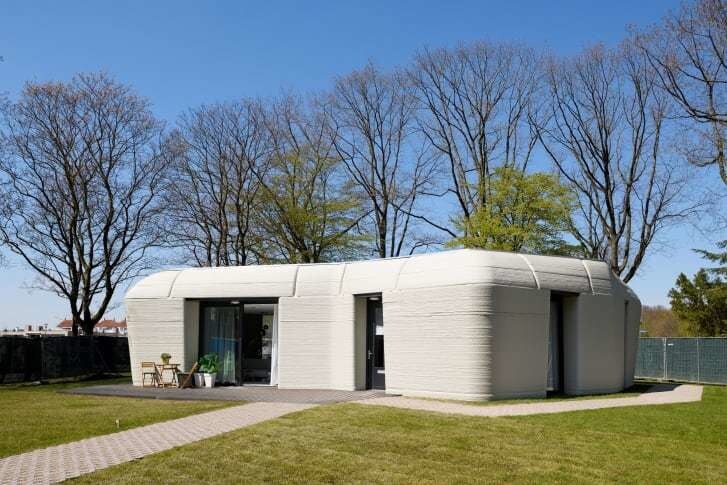
Project Milestone is a five-house project in the Dutch city of Eindhoven. The first completed house already has occupants – Harrie Dekkers and Elize Lutz – and is the first legally habitable 3D-printed house in Europe.

Their home has 94m2 of floorspace on one storey, and was built as part of a collaboration between Eindhoven University of Technology, the municipality of Eindhoven and private sector businesses.
The house has been designed to resemble the shape of a large boulder and blend in sympathetically with its natural surroundings. Being able to easily create curves is just one advantage 3D printing has over traditional construction methods.
What is the World Economic Forum doing to promote sustainable urban development?
Cities are responsible for 75% of global greenhouse gas emissions and are home to over half of the world’s population—a number that will grow to two-thirds by 2050. By prioritizing cleaner energy, cities could contribute more than half of the emissions cuts needed to keep global warming to less than 2°c, which would be in line with the Paris Agreement.

To achieve net-zero and nature-positive cities and communities by 2050, the World Economic Forum is partnering with public and private sector stakeholders on initiatives that drive global ambition through local action. Here are just a few:
Davos Baukultur Alliance: Advancing high-quality planning, construction and management of buildings, infrastructure, and public spaces using principles based on climate resilience, sustainability and circularity in the built environment. Learn more.
Global New Mobility Coalition: Exploring new solutions to reduce congestion and emissions, enhance EV infrastructure and transform urban mobility and deliveries. Learn more.
Alliance for Urban Innovation: Connecting innovators and entrepreneurs to new markets and opportunities that reimagine and reshape quality of life and local economies. Learn more.
G20 Global Smart Cities Alliance: Accelerating intelligent, practical solutions to build climate resilience, enhance public well-being and tackle the most pressing challenges facing cities and local communities. Learn more.
Future of Travel and Tourism: Driving inclusive and sustainable economic growth while preserving cultural heritage and protecting natural ecosystems. Learn more..
Discover how you can be a part of our efforts to create more sustainable and livable cities and communities. Contact us here.
US: Mixed-material homes in Texas
A development of two- to four-bedroom homes is being built in Austin, Texas, using a combination of 3D-printed and traditional construction.
The ground-level storey of the houses have been 3D-printed, with the rooftops made of conventional materials. Using Lavacrete, a form of cement, the houses are designed to withstand fire, flood, wind and other natural disasters better than conventionally built homes, according to ICON, the 3D-printing company involved in the project.
Gary O’Dell, Co-founder and CEO of the development, 3Strands, said: “We want to change the way we build, own and how we live in community together. This project represents a big step forward, pushing the boundaries of new technologies, such as 3D-printed homes.”