3 ways leading manufacturers are preparing their workforce for AI

Global Lighthouse Network manufacturers show why successful AI adoption starts with people. Image: Getty Images/iStockphoto
Melanie Azetmüller
Initiative and Community Specialist, Advanced Manufacturing and Supply Chains, World Economic ForumAarushi Singhania
Initiatives Lead, People Centric Pillar, Advanced Manufacturing, World Economic Forum- Three in four industrial jobs are expected to evolve over the next decade, requiring workers to exercise greater judgement and oversee AI-enabled systems.
- Leading manufacturers show that successful transformation depends on investing in people – through workforce planning, AI skills training and stronger routes into technical careers.
- Four sites recognized by the World Economic Forum’s Global Lighthouse Network – a community of factories leading the way in advanced manufacturing – offer three lessons for transforming the workforce.
Three in four industrial jobs are going to evolve in the next decade. As autonomous systems and artificial intelligence (AI)-assisted workflows become more prevalent, organizations increasingly require workers capable of exercising advanced judgement, machine oversight and governance of intelligent systems.
While much attention so far has focused on deploying AI and automation, leading organizations are demonstrating that investment in workforce planning, digital and AI skills training, talent onboarding programmes and partnership with education providers are critical to successful transformation.
Drawing on four Global Lighthouse Network sites with distinction in talent, here are three lessons in workforce transformation.
1. Use AI to enable a people-centric workforce planning system
Workforce planning has traditionally focused on filling shifts and responding to immediate operational needs. Today, leading organizations are using data and advanced technologies to anticipate workforce needs long before they become problems.
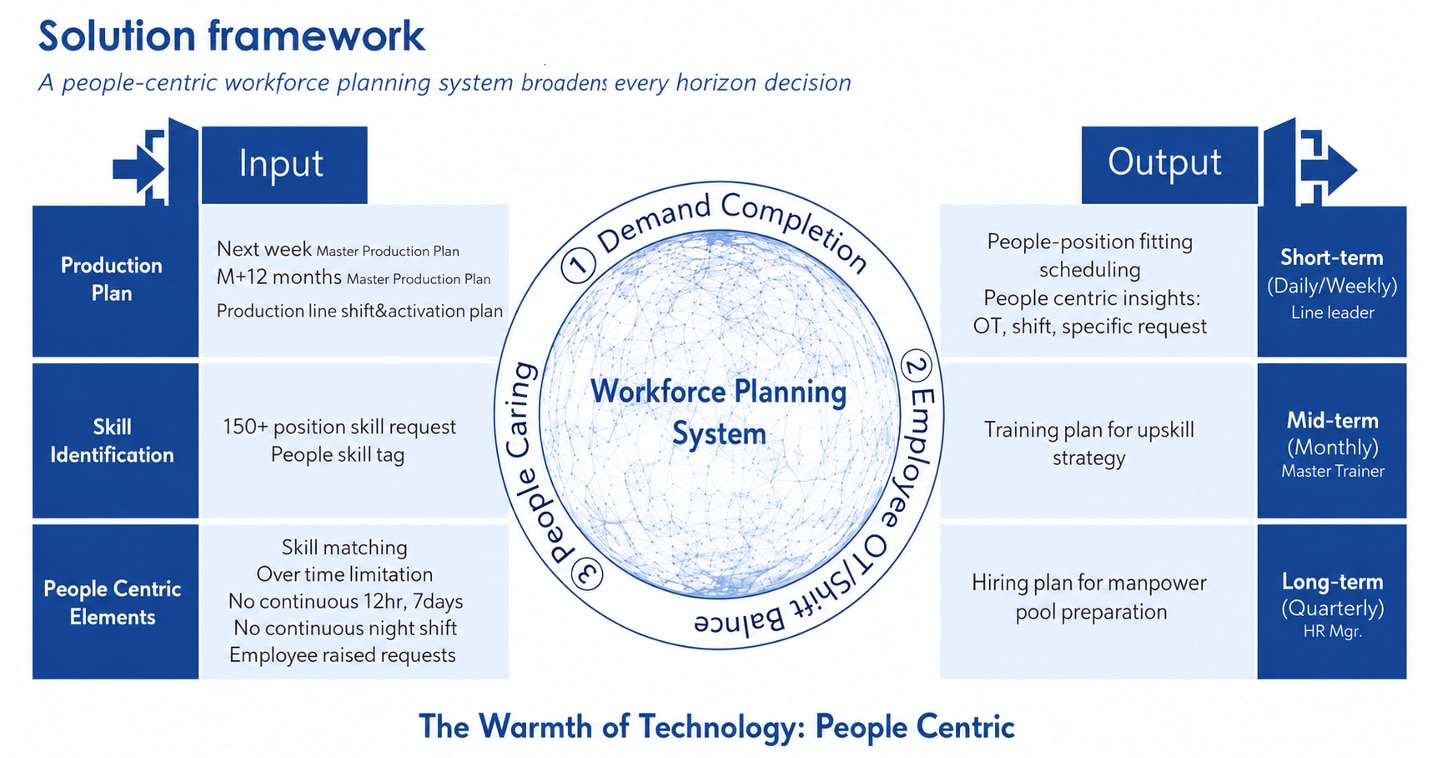
At Schneider Electric’s Wuhan site, an AI-enabled workforce orchestration system helps balance production orders with employees' preferences such as preferred shifts, individual skills and health needs when creating schedules.
By adopting a people-centric approach to balancing operations demand, the site increased employee engagement from 62% to 96%, while reducing defect rates by 46% and increasing labour productivity by more than 50%.
Meanwhile, AUO’s Suzhou site has taken a similarly proactive approach by embedding employee well-being directly into the workforce planning algorithm. Its intelligent scheduling system considers individual health considerations and work preferences, prioritizing light-duty assignments for at-risk workers, rotating fatigue-prone positions and enabling employees to participate in scheduling decisions. This approach has increased employee satisfaction from 55% to more than 96% and reduced turnover by 70%.
These examples show how AI can align production requirements with employee capabilities and preferences, improving employee engagement while enhancing operational performance without treating either as a trade-off.
2. Build technical career pathways for frontline teams
As skills requirements evolve and competition for talent intensifies, manufacturers are investing in long-term talent pipelines and structured pathways that enable employees to continuously develop new capabilities as roles and technologies change.
Schneider Electric partnered with 11 vocational schools to build a sustainable frontline talent pipeline by implementing its “3E” – education, experience and exposure – model.
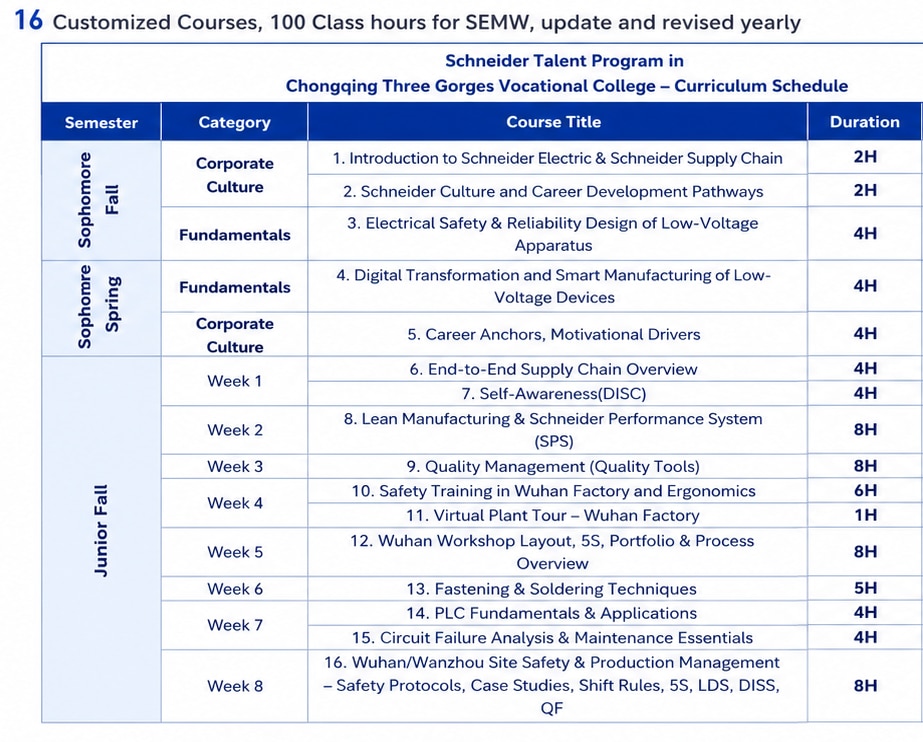
Aligning training with industry needs through a jointly developed curriculum, hands-on experience in automation training laboratories, project-based practice and structured mentorship reduced hiring and onboarding time by 80%, while cutting time-to-technical proficiency by almost 90%.
To ensure continuous workforce development, the site introduced an AI-powered learning platform that maps employees’ capabilities, identifies skill gaps and recommends personalized development pathways. As a result, the share of automation-skilled workers increased from 20% to 76%.
Similarly, the Fujian Ningde Nuclear Power site in Fuding invested in an immersive reactor operator training centre that simulates more than 600 faults and 20 severe accident scenarios. The programme shortened operator training and qualification by six months.
"The frontline operators at our site have been empowered to evolve from passive executors of procedures into digital professionals proficient in low-code development and data analysis. This transformation has enhanced their talent’s core capabilities in addressing on-site challenges," says a spokesperson from Fujian Ningde Nuclear Power Co., Ltd., Fuding site.
“It not only shifts work patterns from experience-based judgment to data-driven decision-making, but also effectively stimulates their ability to take initiatives and dedication through well-defined career advancement pathways and contribution to high-value decisions."
Haier’s Chongqing site focused on helping employees navigate career growth within the organization by implementing an AI-powered key talent identification and career development platform.
The platform supports career development across multiple levels, specifically including management, technical and frontline roles. It provides personalized learning and career pathways based on employee’s aspirations while visualizing succession plans for key operations positions over the next three years. The initiative halved shortages in key-role succession pipelines while giving employees greater visibility into future growth opportunities.
Collectively, these examples demonstrate that leading sites are empowering the frontline workforce by developing technical capabilities and creating internal career pathways that help workers see career growth opportunities in frontline roles.
3. Make innovation everyone’s responsibility
Innovation is often associated with research teams, engineers or senior leaders. Yet, many opportunities for improvement are identified by frontline workers closest to daily operations.
Leading manufacturers are creating systems that enable them to contribute directly to continuous improvement. At Haier in Chongqing, a digital innovation and continuous improvement incentive platform connects real-time quality feedback from market channels and after-sales service directly to improvement tasks, enabling quality issues to be quickly classified and translated into actionable items.
Frontline workers actively claim tasks via a mobile app, while complex issues automatically trigger cross-functional teams for collaborative resolution. Each employee's contribution is recognized through a points-based reward and profit-sharing mechanism. This initiative raised the frontline participation rate in continuous improvement from 19% to 61%, and the average problem resolution cycle was shortened by 47%.
Schneider Electric in Wuhan demonstrates how AI can augment, rather than replace, engineering work. The site deployed 21 AI agents supporting process, industrial and quality engineers by automating routine activities such as data collection, document generation and workflow coordination, enabling engineers to focus on higher-value activities, including failure mode analysis, process optimization and solving complex technical challenges.
The initiative reduced the time engineers spent on new product introduction (NPI) tasks by 75%, halved the time required to reach advanced technical competency and shortened NPI lead time from 36 months to 12 months.
Fujian Ningde Nuclear Power in Fuding has equipped employees with a low-code platform and a large language model, resulting in the development of 353 certified applications as their personalized digital assistants tailored to their work.
Employees develop personalized digital assistants to collect operational data, automate routine processes, verify tasks and generate reports that support operational decision-making. Overall, the site increased digital talent from under 40 employees to almost 470, reduced human error by 71% and increased profit per employee by 50%.
As organizations navigate the next wave of industrial transformation, Lighthouse sites demonstrate that competitive advantage depends on developing people and technology together. Organizations that invest in both realize productivity gains above 11%, compared with 4% for those that sideline the human factor.
Across work design and safety, workforce planning, talent attraction and onboarding, skills development and workforce effectiveness, these examples show how workforce transformation strengthens both operational performance and workforce resilience.
Don't miss any update on this topic
Create a free account and access your personalized content collection with our latest publications and analyses.
License and Republishing
World Economic Forum articles may be republished in accordance with the Creative Commons Attribution-NonCommercial-NoDerivatives 4.0 International Public License, and in accordance with our Terms of Use.
The views expressed in this article are those of the author alone and not the World Economic Forum.
Stay up to date:
Artificial Intelligence


Forum Stories newsletter
Bringing you weekly curated insights and analysis on the global issues that matter.
More on Manufacturing and Value ChainsSee all

Kiva Allgood and Kristine Renker
September 17, 2026


