Soils underpin around 95% of food and are a major carbon store, but with a third already degraded, it's hard to protect the remainder as the climate shifts.
Machine learning can map soils and detect patterns, but it rarely explains soil behaviour or responses to unfamiliar conditions.
Multi-agent artificial intelligence (AI) could help scientists reach better questions faster, as long as the work stays scientist-led.
We are asking more of our soils than at almost any point in modern history.
Roughly 95% of the food we eat depends on soil so it must keep producing food, even as the weather grows less predictable.
Soils must also hold carbon. They store more carbon than the atmosphere and all terrestrial vegetation combined. And they must do all of this under mounting strain because a third of the world’s soils are already degraded, and erosion alone could cut crop production by a 10th by 2050.
But soils do not behave like machines. A solution that builds carbon in one field can underperform in the next, where the minerals, moisture and history differ. Ground that looks stable today may shift after years of heat and water stress.
For scientists and land managers, the hard part comes after the measurement. They must understand why a soil behaves as it does and anticipate what it will do next. Artificial intelligence (AI) is often pitched as a way around that complexity, but a more useful role may be helping scientists to work through it.
How AI could help soil research
AI is already being used for soil research. Machine-learning tools map soil properties, read sensor streams and predict conditions across whole landscapes, surfacing patterns a person would struggle to see. But pattern recognition is only the first step of science.
A model may show that a signal tracks a soil property without explaining why the link exists. It may forecast a change in soil carbon without revealing the process behind it. And a model can falter precisely when it is needed most – when floods, droughts and heatwaves push soils beyond anything in the training data.
That is the gap worth closing.
Soil research now needs better ways to connect evidence, weigh competing explanations and decide what to investigate next.
Could AI work like a soil research team?
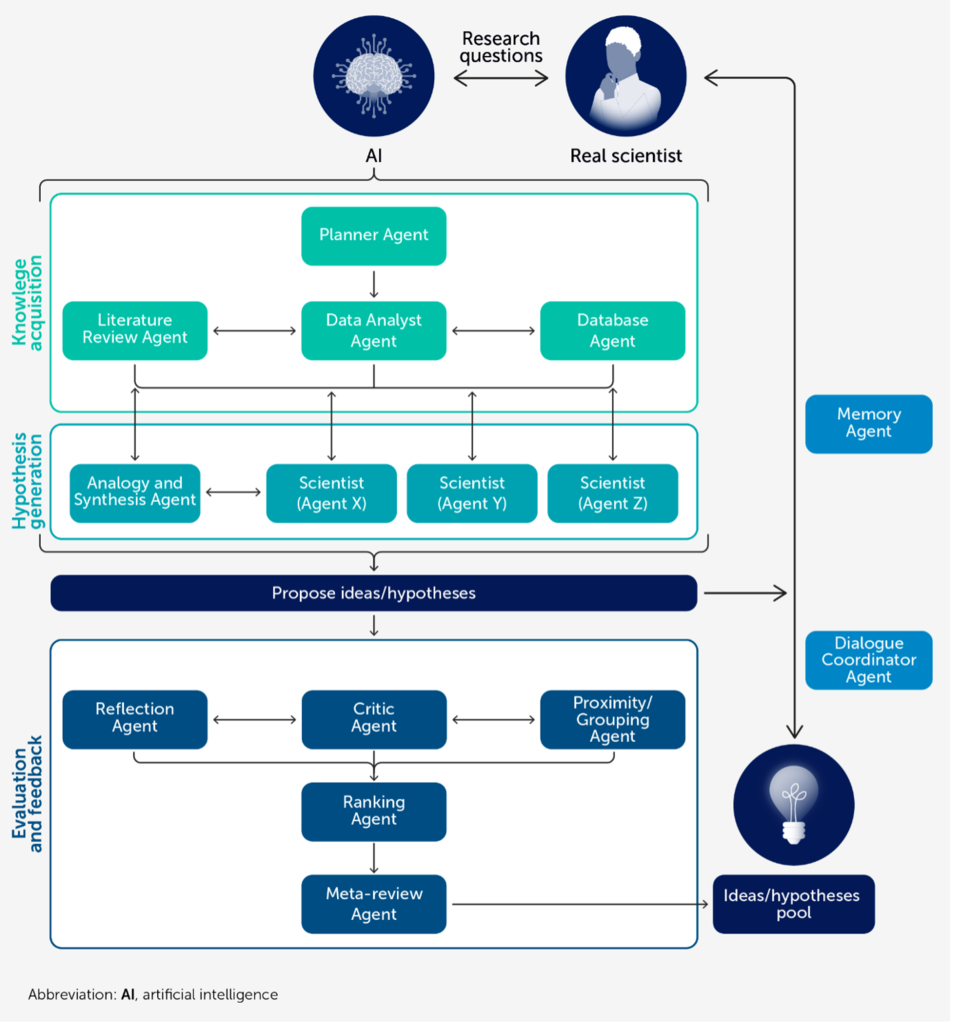
Multi-agent AI systems are one step in that direction. Where a conventional AI model is built for a single task, a multi-agent system assigns roles to several AI agents and lets them work through a problem in stages. One scans the literature while another analyses the data, a third stress-tests a proposed explanation and a fourth weighs competing hypotheses for which are most plausible, useful or testable.
Such a setup is a powerful assistant, but not a scientist in its own right. AI agents are fast and able to range across vast amounts of information, but reliant on human researchers to frame the question and judge the answer.
For a field shaped by local history, climate, biology and management, that human role is decisive – soils cannot be understood from data alone. But AI agents can bring scattered evidence into the conversation.
Rather than another static map, they can help build a soil “digital twin” that updates as new observations arrive. Rather than a simple alert about a worrying trend, they can help researchers probe the causes of a problem and turn scattered papers and datasets into testable questions.

Testing the idea on soil carbon
In a recent article in the journal Frontiers in Science, my colleagues and I tasked a multi-agent AI system with one of the field’s most contested topics: how much carbon soils can hold and how stable it stays.
The debate centres on soil carbon saturation: whether a soil has a ceiling on the mineral-associated carbon it can store. The concept carries real weight in climate policy, where even modest gains in soil carbon are treated as a serious mitigation lever, but its real-world limits are disputed.
The value of the multi-agent AI system lay in the process rather than any single answer. It reviewed recent literature, generated contrasting hypotheses, simulated aspects of peer review and ranked the results by novelty, plausibility, feasibility and breadth of application.
The system organized a messy debate along clearer lines of inquiry by separating a soil’s theoretical storage capacity from what it achieves under real conditions, drawing attention to biological and chemical controls, and suggesting that soils near saturation may respond differently to climate stress than those with room to spare.
Every one of those ideas still needs expert scrutiny to determine whether it is grounded in evidence, genuinely useful and testable in the field or laboratory. Used well, multi-agent AI does not take scientists out of the work. Instead, it gives them a more structured place to begin.
The challenges of using AI for soil research
When using AI, there is a real risk in treating a fluent answer as a deep one. A system trained on uneven data will not understand soils that no one has measured. A model that is reliable in familiar conditions may break when dealing with drought or flood conditions that are outside its experience.
Soil is a hard case. The data is fragmented and local, and the literature is uneven across regions, soil types and farming systems. Even today’s leading models answer only around 65% of advanced soil science exam questions correctly, reminding us of how much ground human judgement still needs to cover when using AI.
Used without transparency, AI tools can make existing blind spots harder to see. Access is also uneven, because the computing power and expertise behind advanced AI are not shared equally across countries.
So, it is important to hold these AI systems to a high standard. They should be able to show where their information came from, communicate their uncertainty and invite challenge.
Scientist-led AI, not AI-led science
Soils are among the planet’s most vital resources – and among the most overlooked. Their condition will shape food security, climate resilience and land stewardship for decades.
Multi-agent AI can help scientists work across that complexity by drawing connections faster, sharpening hypotheses and streamlining the early, laborious stages of research so that expert time is spent where it counts: field observation, interpretation and judgement.
The value of AI systems will rest on the quality of the data behind them, the transparency of their reasoning and the expertise of the people directing them. Used with that discipline, AI agents could become genuine partners in discovery, helping soil scientists move past merely detecting patterns beneath our feet to understand the living systems that sustain us.
The ground beneath every decision we make about food and climate deserves nothing less.