Since the 1970s, so-called leap seconds have been periodically added to global clocks to keep traditional astronomical time aligned with highly precise atomic time.
Adding an extra second can cause severe disruptions to global technology infrastructure, leading to website crashes, delayed flights and network failures.
Driven by these technological headaches and climate change altering the Earth’s spin, timekeeping experts have voted to officially abandon the leap second by 2035, but it could happen as soon as 2027.
"Time is an illusion. Lunchtime doubly so," says Ford Prefect, one of the main characters in Douglas Adams' The Hitchhiker’s Guide to the Galaxy.
Prefect is right: time is not an absolute but a construct, traditionally based on Earth's rotation and, more recently, on atomic clocks. But because these two ways of telling time don’t directly align, leap seconds were introduced in the 1970s to manage the difference.
However, electronic systems don’t like leap seconds, causing website crashes and delayed flights and requiring IT companies to compensate for them to avoid a Y2K-style breakdown.
After decades of research and debate, the members of the International Bureau of Weights and Measures (BIPM) voted in 2022 to abandon leap seconds altogether from 2035. Yet, the leap second may now be scrapped as early as 2027, as experts debate introducing a 'leap hour'.

What is a leap second?
There isn’t a single way of measuring time. While astronomical – or solar – time is the traditional approach, the 1960s saw the advent of atomic clocks, which measure time based on the decay of caesium-133 (used in Coordinated Universal Time, or UTC).
Originally aligned, Earth’s rotation has slowed over time, leading to an ever-greater discrepancy between the two. The solution: adding leap seconds to close the gap. Since the early 1970s, 37 leap seconds have been added.
Climate change is now reversing the slowing of Earth’s rotation, the Smithsonian Magazine reports. This could ultimately require leap seconds to be taken off rather than added. The BIPM’s 2022 decision to abandon leap seconds will prevent this and also relieve those in electronics and IT, where leap seconds have caused substantial issues.
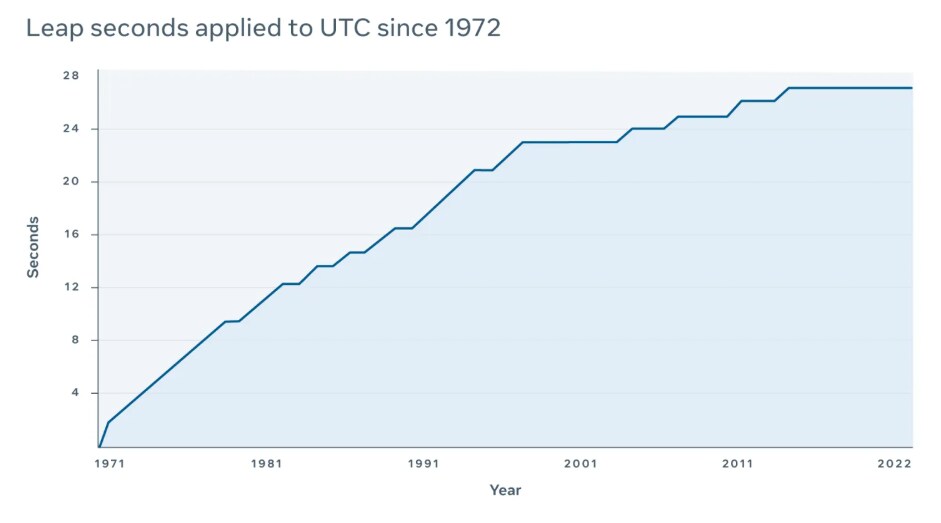
Why do electronics, IT and stock traders struggle with leap seconds?
According to Meta’s engineers, “every leap second is a major source of pain for people who manage hardware infrastructures”.
For example, in 2012, an extra leap second led to widespread Linux kernel failures because the kernel – essentially, the program that bridges between a computer's hardware and software – could not deal with a 61-second minute. A range of websites, including LinkedIn and Reddit, crashed, and Qantas passengers were left stranded as the airline’s flight record system also went down as a result.
A second is also a significant amount of time for mobile transmission, power grids and computer networks at large, all of which are synchronized to fractions of a second. High-frequency stock trading happens in a thousandth or billionth of a second, the New York Times points out.
Many of the companies concerned found their own ways of working around the leap second. For example, Google uses a 'leap smear' that adds extra seconds across the hours before and after each leap. Amazon, Meta and Microsoft are pursuing similar strategies to smooth out the issues that the time divergence creates.
Why is the leap second being abandoned?
Aligning astronomical time and UTC has become increasingly difficult, especially as Earth’s rotation has become more erratic.
This is partly due to climate-related changes at the polar caps: melting ice redistributes mass to Earth's equator, accelerating its spin rate, according to the Smithsonian. This, in turn, has made it even harder to keep astronomical and UTC in sync.
In the longer term, a negative leap second would be needed to correct this discrepancy. This prospect has led the standards bodies that manage time to suggest moving the changeover up to next year. The decision could be made as soon as October, when the national delegates of the General Conference on Weights and Measures meet in Versailles, The Times reports.
Instead of juggling positive and negative leap seconds, atomic time would be allowed to drift gradually away from astronomical time, making timekeeping independent of Earth’s rotation.
The suggestion is that the gap could eventually be allowed to grow by as much as 60 minutes, though scientists say that it would likely take thousands of years for astronomical time and atomic time to drift apart by an hour.