This monthly round-up brings you a selection of the latest news and updates on global trade.
Top international trade stories: New tariffs put US-Canada trade under pressure; Shipping networks adapt to a changing trade map; UAE cuts trade and financial ties with Iran.
1. New US tariffs hit Canadian exports threatening wider trade ties
The collapse of US-Canada trade talks on 21 August has triggered 50% US tariffs on roughly $20 billion of Canadian goods, with Prime Minister Mark Carney pledging dollar-for-dollar retaliation from 8 September.
While the duties hit just 5.5% of Canada’s exports to the US, analysts suggest the measures will push the effective US tariff rate on Canadian goods from 5.1% to 6.9%, Reuters reports.
The dispute places fresh strain on a $715 billion trading relationship and threatens the six-year-old USMCA agreement underpinning cross-border supply chains. That strain could deepen, with further tariffs on Canadian vehicles and auto parts due to take effect on 1 January if no deal is reached.
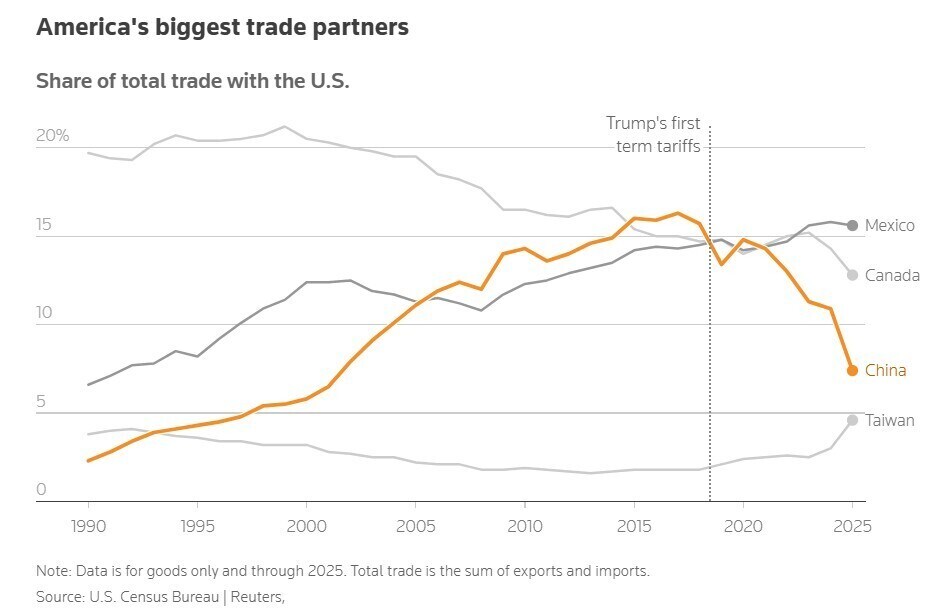
It also raises the question of how much pressure the US economy can withstand. New research from the Federal Reserve Bank of Boston shows that when average realized tariffs on US imports rose from about 2.5% to 10% in 2025, they lifted domestic production costs by an estimated 1.1 percentage points. Productivity gains more than offset the increase, reducing costs by 1.3%, as businesses maintained output while cutting hours worked.
That adjustment helped contain the broader impact, but it was not cost-free – tariffs and productivity gains together added 0.5 percentage points to core PCE inflation in 2025, the Boston Fed estimates. With fresh trade barriers now threatening one of North America's primary supply chains, the scope for productivity to absorb another shock – and cushion an already fragile global economy – could be tested.
2. As supply chains diversify, container logistics face a new test
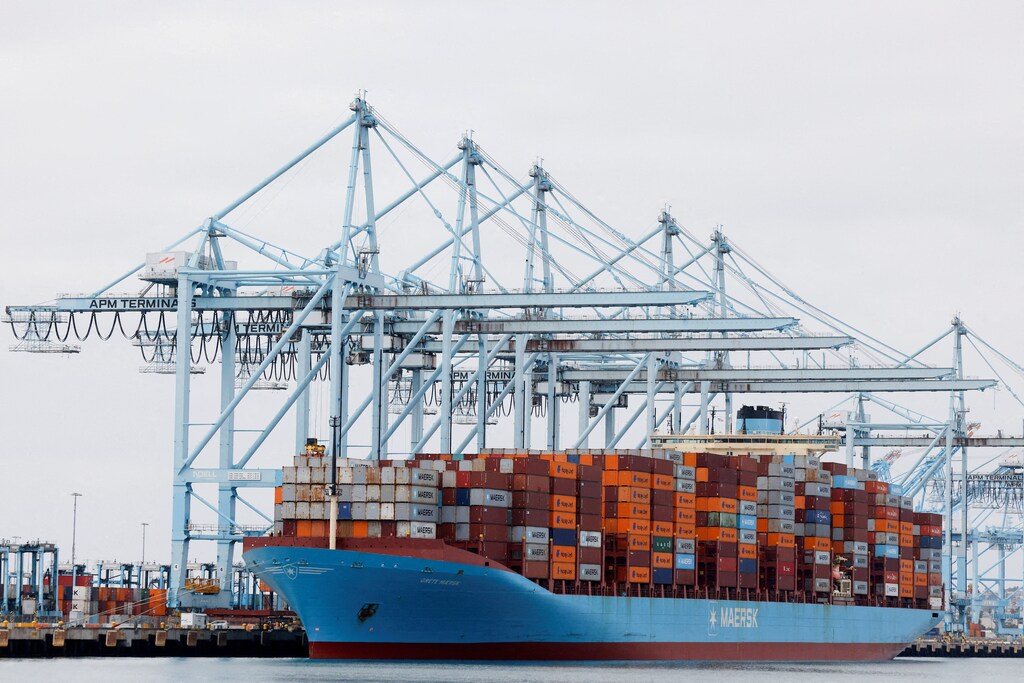
From its 1950s origins to today’s automated mega-ports, container shipping underpinned the expansion of low-cost global trade. A recent Financial Times report traces this history while highlighting a growing structural challenge: that same infrastructure must now adjust to a larger, more complex and geographically shifting trading environment.
That matters because global trade continues to expand, with East Asia the main engine of growth, according to UNCTAD's July/August update. Merchandise trade reached approximately $13.7 trillion in the first half of 2026, up 12.5% year-on-year.
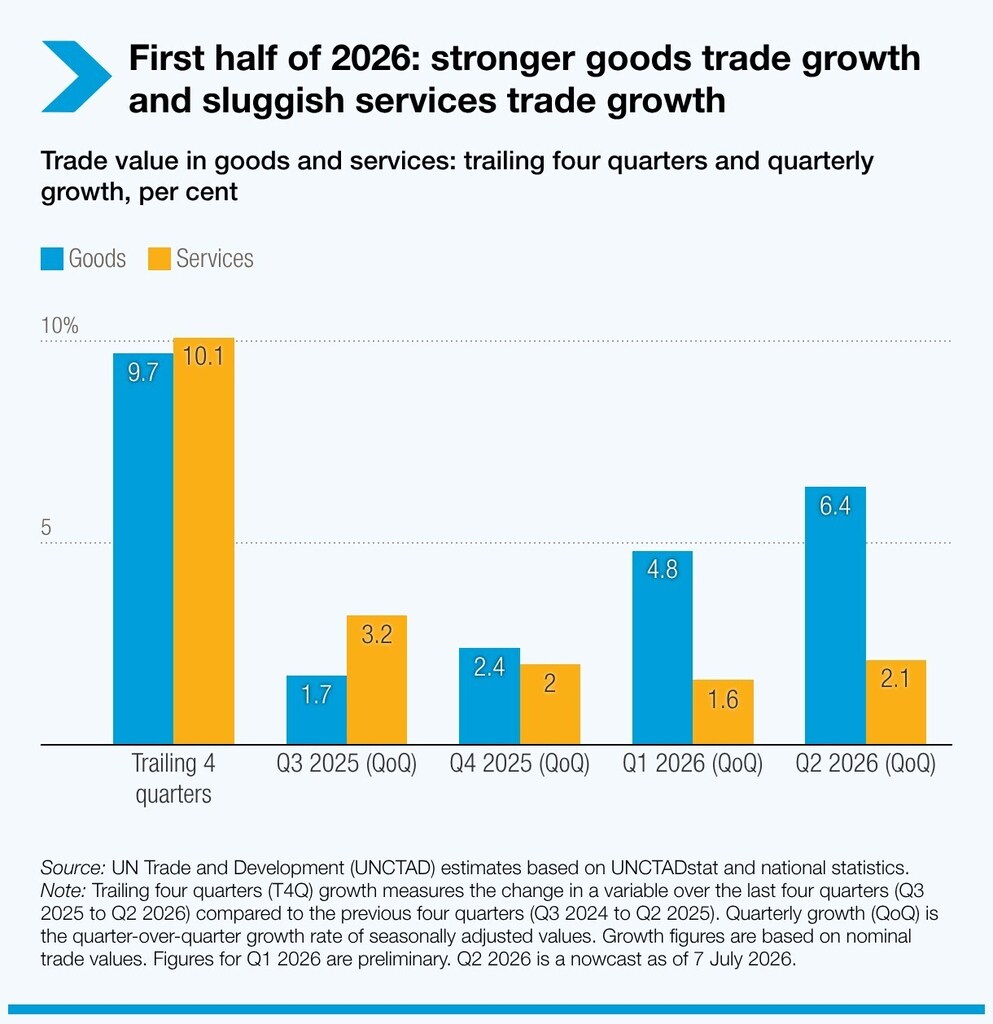
Container shipping reflects that momentum. Maersk raised its full-year outlook again in August as demand remained resilient despite geopolitical disruptions. Meanwhile, global container volumes grew 5.2% in the first half of 2026, according to CTS/SSE data cited by Hapag-Lloyd.
However, alongside pressures on travel routes, the goods moving through the system are also changing. The Port of Los Angeles, for example, recorded its second-highest July volume on record, driven by strong inflows of consumer goods alongside equipment for manufacturing and data-centre construction.
UNCTAD's latest data also points to a shift in the composition of trade, with strong growth in batteries, semiconductors, ICT products and electric vehicles in the first quarter of 2026.
As the FT points out, these demands create new challenges for physical networks. Transport infrastructure must accommodate larger vessels and more complex trade flows; carriers must manage regional equipment imbalances. The next chapter of trade will test how rapidly the supporting network can adapt.
How the Forum helps leaders make sense of regional, trade and geopolitical shifts
The Centre for Regions, Trade and Geopolitics provides a trusted space for leaders to understand evolving trade dynamics, regional developments and geopolitical fragmentation.
By fostering dialogue across sectors and regions, the Centre helps partners navigate uncertainty and explore cooperative approaches to shared challenges.
3. News in brief: Trade stories from around the world
The United Arab Emirates (UAE) has suspended all trade and financial transactions with Iran amid heightened regional tensions. Bloomberg reports that this could be a significant blow to Iran, given the UAE's importance as a regional hub for trade, finance and access to foreign currency.
The move comes as Iran faces increasing economic pressure from the US and ongoing disruption to trade through the Strait of Hormuz. At the time of publication, the US was preparing to launch new economic sanctions on Iran on 24 August, in what US Treasury Secretary Scott Bessent called "an economic D-Day".
CNN reports that pressure is building in global fuel markets as disruptions linked to the Iran war, strikes on Russian refineries and restrictions on fuel exports tighten supplies. As of 19 August:
Diesel refining margins have surged to record levels.
Around 40% of Russia’s refining capacity is reportedly offline.
China has also limited fuel exports to protect domestic supplies.
US gasoline prices are about 30% higher than a year ago, while diesel is up 48%.
US refiners are running at high rates, but hurricane season could put further pressure on supplies.
Canadian pipeline companies are proposing at least six projects that could increase the country’s oil export capacity by 45%, or 2.25 million barrels per day, by 2035. Around 950,000 bpd of the proposed additional capacity would serve exports to the US. However, filling the new pipelines would require significantly higher oil production, while producers remain cautious about committing to major new oil sands projects, Reuters says.
The Panama Canal Authority, which accounts for 5% of global trade, is to cut daily vessel transits from 36 to 32 from 15 September, citing low rainfall linked to a particularly strong El Niño, reports the BBC.
The Guardian reports that China has begun a scheduled container service through Russia’s Northern Sea Route, offering a shorter route between China and Europe as disruptions to the Strait of Hormuz and Suez Canal prompt interest in alternative shipping routes. The route is currently limited by seasonal conditions, high costs and safety and sanctions concerns.
The World Trade Organization will host its first World Trade and Tech Day on 14 September in Geneva, bringing together policymakers and industry leaders to explore how AI can make global trade more inclusive. Given its potential to boost global trade by up to 37% by 2040, discussions will focus on unlocking AI's benefits while tackling unequal access, job disruption and the uneven distribution of gains.
4. More on trade on Forum Stories
As supply chains diversify and businesses look for greater resilience, ASEAN faces a new question: can stronger institutions and clearer rules help the region attract and retain higher-value investment? Read more on why predictability could become increasingly important to the region’s economic future.
The next phase of climate investment in the Global South could increasingly come from South-South investment, argue Jasandra Nyker, Managing Partner at Saja Climate Partners, and Olivia Zeydler, Lead, Emerging Markets at the World Economic Forum. Here, they make the case that proven solutions – from electric mobility to distributed energy – can be replicated across emerging markets, creating commercially attractive opportunities while accelerating climate investment.