A Swiss rail operator has broken the record for the longest passenger train.
The train had 100 passenger coaches and was 1.9km in length.
It took 7 drivers to get it through 22 tunnels and across 48 bridges in the Swiss Alps.
Rail is one of the most sustainable forms of transport for passengers and freight.
Welcome aboard a rail journey that’s as far removed from the morning commute as you’re ever likely to get.
At 14:20 on 29 October, 2022, a passenger train made up of 100 coaches pulled out of Preda station on the UNESCO World Heritage Albula Line, in Eastern Switzerland. The train measured 1.9 kilometres (1.2 miles) in length and weighed in at 2,990 tonnes, according to the BBC, which reported the train’s progress along a steep and winding 25km (15.5 miles) journey through spectacular Alpine landscapes.
Running a train of this length is a major test of driver skill, engineering prowess and technical ability. The record-breaking locomotive was assembled using 25 four-car Capricorn units that normally run on the route.
Seven drivers operated the longest passenger train, precisely coordinating acceleration and braking as the train wound down a route with a vertical drop of almost 800 metres. The drivers had to negotiate 22 tunnels and 48 bridges including the spectacular Landwasser Viaduct before reaching their destination at 15:30.
"We all know the Albula Line very well, every change of gradient, every incline," said lead driver Andreas Kramer, according to CNN Travel. "It goes without saying that we're going through the process again and again." He added: "We need to be 100% synchronized, every second. Everyone has to keep their speed and other systems under control at all times."

Rail travel in a sustainable future
Another feature of the record-breaking journey was the sustainable use of energy. As the train’s brakes were applied on the descent, regenerative energy recovery systems kicked in to feed electricity back into the 11,000 volt overhead supply cables. It’s a similar system to those used in motor racing and now in use on some models of electric cars.
Rail travel will be an essential part of sustainable public transport networks as the world moves forward in the energy transition. A 2022 report from consultants BCG, Riding the Rails to Sustainability, is clear on the potential of rail transport for helping to achieve the world's net zero ambitions.
How is the World Economic Forum promoting sustainable and inclusive mobility systems?
The World Economic Forum’s Platform for Shaping the Future of Mobility works across four industries: aerospace and drones; automotive and new mobility; aviation travel and tourism; and supply chain and transport. It aims to ensure that the future of mobility is safe, clean, and inclusive.
Through the Clean Skies for Tomorrow Coalition, more than 100 companies are working together to power global aviation with 10% sustainable aviation fuel by 2030.
In collaboration with UNICEF, the Forum developed a charter with leading shipping, airlines and logistics to support COVAX in delivering more than 1 billion COVID-19 vaccines to vulnerable communities worldwide.
The Road Freight Zero Project and P4G-Getting to Zero Coalition have led to outcomes demonstrating the rationale, costs and opportunities for accelerating the transition to zero emission freight.
The Medicine from the Sky initiative is using drones to deliver vaccines and medicine to remote areas in India, completing over 300 successful trials.
The Forum’s Target True Zero initiative is working to accelerate the deployment and scaling of zero emission aviation, leveraging electric and hydrogen flight technologies.
In collaboration with the City of Los Angeles, Federal Aviation Administration, and NASA, the Forum developed the Principles of the Urban Sky to help adopt Urban Air Mobility in cities worldwide.
The Forum led the development of the Space Sustainability Rating to incentivize and promote a more safe and sustainable approach to space mission management and debris mitigation in orbit.
The Circular Cars Initiative is informing the automotive circularity policy agenda, following the endorsement from European Commission and Zero Emission Vehicle Transition Council countries, and is now invited to support China’s policy roadmap.
The Moving India network is working with policymakers to advance electric vehicle manufacturing policies, ignite adoption of zero emission road freight vehicles, and finance the transition.
The Urban Mobility Scorecards initiative – led by the Forum’s Global New Mobility Coalition – is bringing together mobility operators and cities to benchmark the transition to sustainable urban mobility systems.
Contact us for more information on how to get involved.
“No form of mass transport has more potential to aid in the fight against global warming than rail,” the report states. BCG’s analysts noted that rail is “responsible for 9% of global motorized passenger movement and 7% of freight shipping – but only 3% of transport energy use”, according to International Energy Agency (IEA) data.
“It uses 80% less energy than trucks per ton of freight carried and holds a four-to-one advantage over cars in terms of its emissions intensity. As a result, rail accounted for just 4% of the transport industry’s global emissions in 2019,” they explained.
Promoting clean rail transport
Despite the green credentials of rail trans;ort, the railways are losing out to other modes of /transport in many countries. The BCG chart below draws on data from a number of national and global sources to paint a picture of the relatively low use of rail for transporting both freight and passengers.
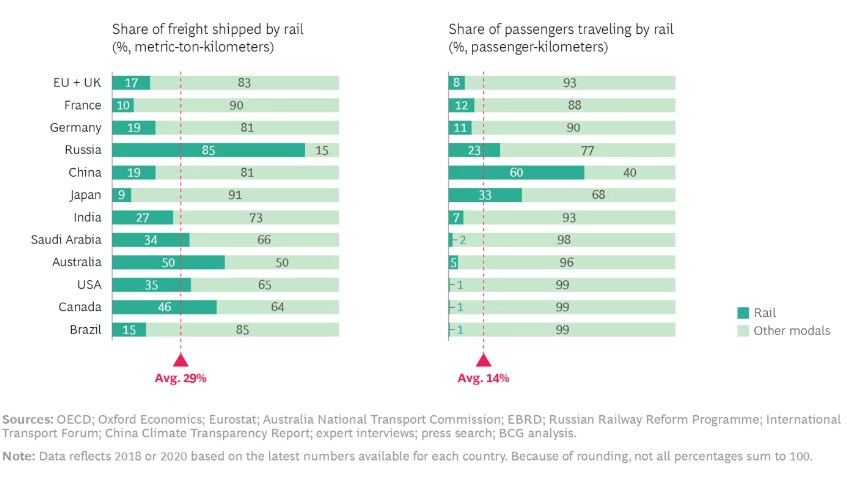
Of course, not all forms of rail transport are sustainable yet, with many locomotives still powered by diesel engines. However, the industry is heading in the right direction on fuel sources, according to the IEA.
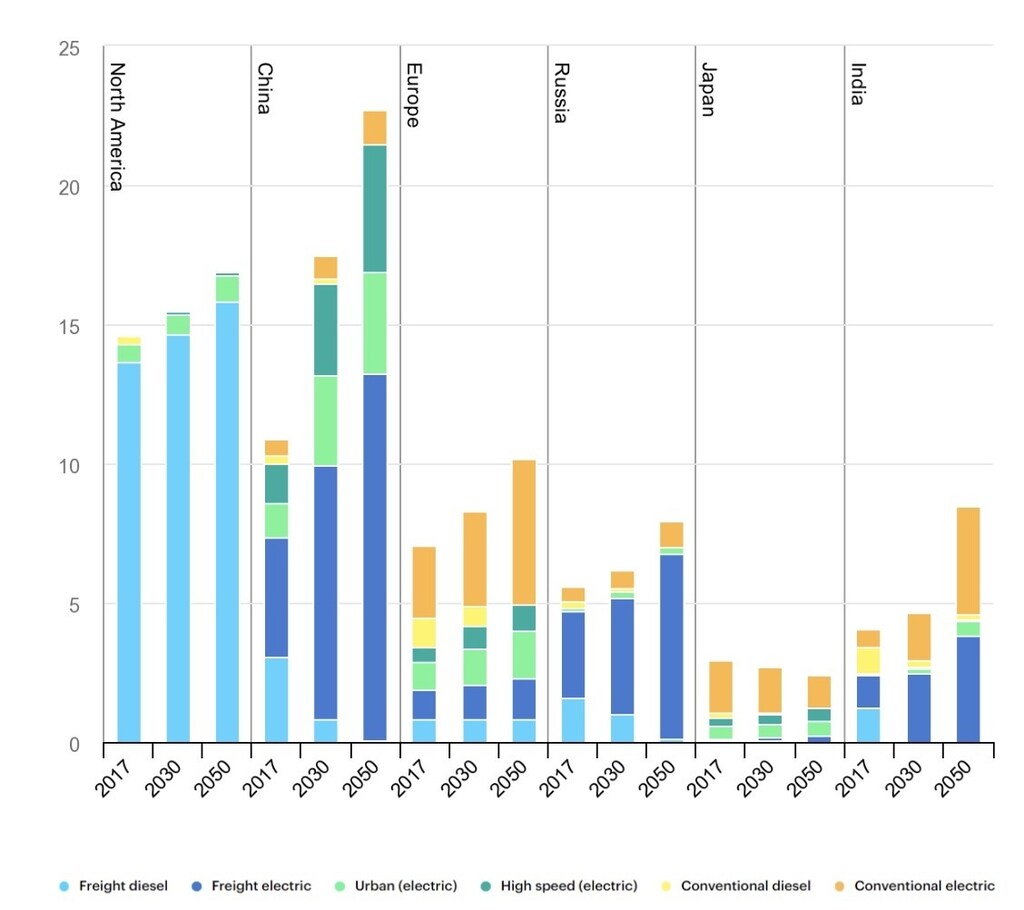
As the illustration shows, the use of diesel trains will fall dramatically across most of the world by 2050. Only the United States lags behind on this with rail freight transport to remain heavily reliant on diesel. The railways will also need to reduce emissions across the entire value chain to become a truly sustainable industry.