Why the 80th UN General Assembly marked a turning point for youth leadership at the UN
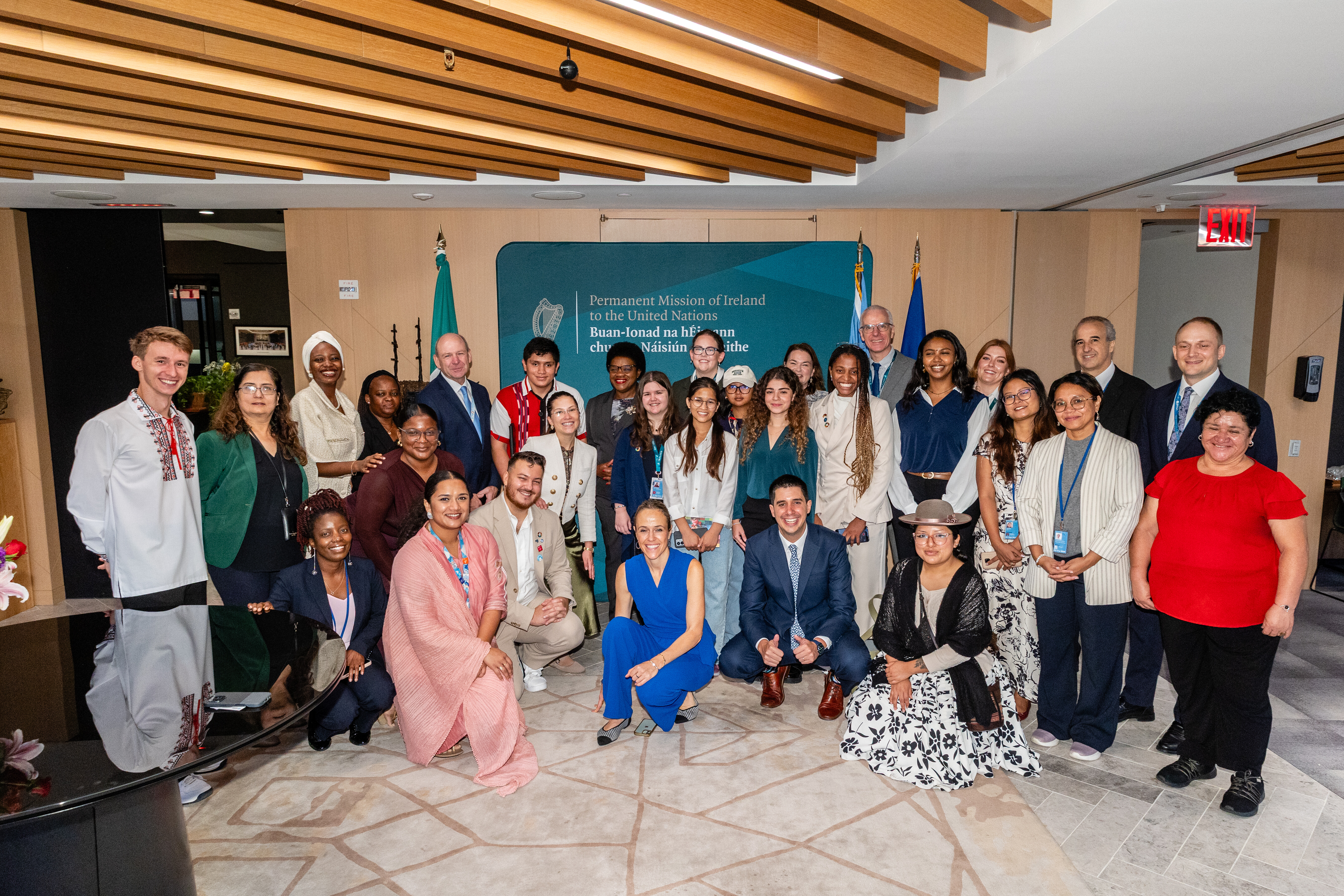
Youth leadership at the UN and institutional youth participation has progressed Image: UN Youth Office/Joel Sheakoski
Christie Burley
Global Head of Programs and Engagement, Corporate Responsibility & Sustainability, Visa- For the first time in history, youth were recognized as equal partners at the UN General Assembly – a landmark moment for youth leadership at the UN and intergenerational collaboration.
- The UN’s Youth 2030 framework and rising “green scores” show tangible progress toward embedding youth participation across global institutions.
- From clearing medical debt to advancing accessibility and humanitarian aid, innovations from the Global Shapers Community are redefining what young leadership and impact look like.
Looking at global demographics, over half of the population is under 30. So, for an institution such as the UN, with an average staff age of 47, rejuvenation is needed. The process has already begun: in March 2025, the Secretary-General António Guterres launched UN80 – a reform agenda to review structural changes, efficiencies and improvements. Moreover, in 2023, the multilateral organization appointed its youngest Assistant Secretary-General.
This year, when leaders gathered for the 80th United Nations General Assembly (UNGA), one meeting stood out – the first-ever high-level session on youth convened by its newly appointed president, Her Excellency Ms Annalena Baerbock.
For the first time, young people were recognized as equal partners in shaping global priorities for meaningful intergenerational collaboration.
Youth leaders bring new thinking to old problems – from reimagining economic models to leading in artificial intelligence (AI) to driving community-based climate action.
”The session, held on 25 September 2025, commemorated the 30th anniversary of the World Programme of Action on Youth and countries highlighted the essential role of youth in decision-making. Kicking off the meeting, the president of Botswana affirmed: “We must bridge the gap between generations, talking with youth rather than talking to youth.”
Iceland’s minister of foreign affairs emphasized this by stating, “Young people are essential partners in shaping the present.” Oman’s foreign minister also reiterated that “young people must be empowered for development.”
The meeting was a time to reflect on the progress made in youth inclusion and an opportunity to examine the ongoing gap in achieving meaningful youth participation. It was a signal from the global system that those who have to live with the consequences must be involved in decisions about a more sustainable future.
Why this moment matters
Today, as multilateralism faces strain and the world grapples with conflict, climate change and inequality, the UN must uphold its global leadership, as it did when it was created. This time, proving that inclusion leads to innovation. At this historic UNGA80 session, youth leadership at the UN was on full display – young participants were not relegated to side events and instead were central to the discussion.
Some countries elected to cede their time at the plenary and panels to their youth delegates, who were able to speak on the floor 34 times, thus enabling opportunities to contribute statements on behalf of their national or regional delegation.
Moreover, the UN Youth Office supported the engagement of more than 300 young people during the General Assembly week. This is a strong indicator that youth participation was central to UNGA.
Beyond those engaged by the UN Youth Office, even more youth (including self-sponsored) were present in the UN halls and at side events thanks to civil society mobilization. Young people are not giving up on the fight for multilateralism.
From UNGA, it is clear that leaders are recognizing youth engagement as a mechanism for renewing the global system. Youth leaders bring new thinking to old problems – from reimagining economic models to leading in artificial intelligence (AI) to driving community-based climate action.
Their leadership is practical, rooted in lived experiences and urgently needed in spaces where decisions often feel detached from reality. By placing youth at the centre, the UN is redefining how legitimacy and accountability can look in the present and for the future.
Momentum and gaps
Outside of the high-level meetings, there are promising signs that the international system is tackling youth inclusion. Under the Youth2030 framework, the UN system now applies “green scores” to evaluate how well agencies and country teams integrate youth engagement into their operations.
These scores measure several key criteria, such as whether young people are consulted in programme design.
To embed youth leadership at the UN and intergenerational collaboration across the UN and beyond, it is essential to institutionalize youth representation, invest in youth-led innovations and for organizations to track and report their progress.
”According to the 2025 Youth2030 Progress Report, among the 50 UN entities that reported into it, 11 achieved a green score of 80% or higher. Over the past three years, UN entities’ average green scores climbed from 45% (2021) to 56% (2024), while UN country teams improved from 25% (2020) to 43% (2024).
These higher scores indicate that more institutions are systematically embedding youth engagement in their work.
However, the overall target of 80% was not met, reflecting a deeper challenge: youth participation has expanded but true influence remains limited. In many institutions, young people mustn’t be only invited to speak but to participate in or inform decision-making.
Leadership in action
Under the banner of the #YouthLead Festival – a week of activities celebrating youth action – 75,000 young people from 182 countries held dialogues leading up to UNGA. However, many more like them are taking action in their communities worldwide and many are already leading tangible change.
For example, across the World Economic Forum’s Global Shapers Community, youth initiatives are providing blueprints for impact:
- Shred the Debt, which won this year’s Innovation Prize, a partnership between the Global Alliance for YOUth and the Global Shapers Community, was able to clear $2 million in medical bills during a successful pilot and is now scaling to 20 cities, aiming to eliminate $10 million in medical debt, restoring dignity and advancing health equity across the United States.
- ShaperAid, a cross-hub collaboration spanning East Jerusalem to Ramallah, mobilizes humanitarian aid to Gaza, demonstrating how solidarity can transcend borders.
- Bauen, another Innovation Prize project by the San Luis Potosi Hub, is advancing inclusion for people with visual impairments by creating tactile signage, maps and awareness materials to make public spaces more accessible, starting with hospitals, schools and government offices.
Just as these projects do, many other Global Shapers are building solutions across 500 cities on topics ranging from mental health to climate action to bridging the rural divide. However, it is important to highlight that the burden young people bear is immense. WHO and UNICEF report that one-in-seven young people aged 10-19 live with a mental health condition.
Youth are carrying immense burdens with too little systemic support. This further demonstrates that despite the added responsibilities, young people are not being supported as they help tackle the great issues of our generation.
To move from momentum to impact, institutional reform must pair opportunity with safety nets to enable young leaders to engage sustainably without burning out.
What comes next?
As the UNGA high-level week is now behind us, the next steps look toward structural change. The first-ever high-level session on youth at the UNGA is momentous and must be the first of many youth sessions for international, regional and national institutions.
To embed youth leadership at the UN and intergenerational collaboration across the UN and beyond, it is essential to institutionalize youth representation, invest in youth-led innovations and for organizations to track and report their progress.
Institutions should look to youth who are already enacting change in their community and join them as they lead the way to a more sustainable future.
Christie Burley is the outgoing Curator of the Global Shapers Washington DC hub and Inés Yábar is the outgoing Curator of the Global Shapers Lima Hub.
Don't miss any update on this topic
Create a free account and access your personalized content collection with our latest publications and analyses.
License and Republishing
World Economic Forum articles may be republished in accordance with the Creative Commons Attribution-NonCommercial-NoDerivatives 4.0 International Public License, and in accordance with our Terms of Use.
The views expressed in this article are those of the author alone and not the World Economic Forum.
Stay up to date:
Youth Perspectives
Related topics:


Forum Stories newsletter
Bringing you weekly curated insights and analysis on the global issues that matter.
More on YouthSee all

Daniel Mahadzir
September 24, 2026


